


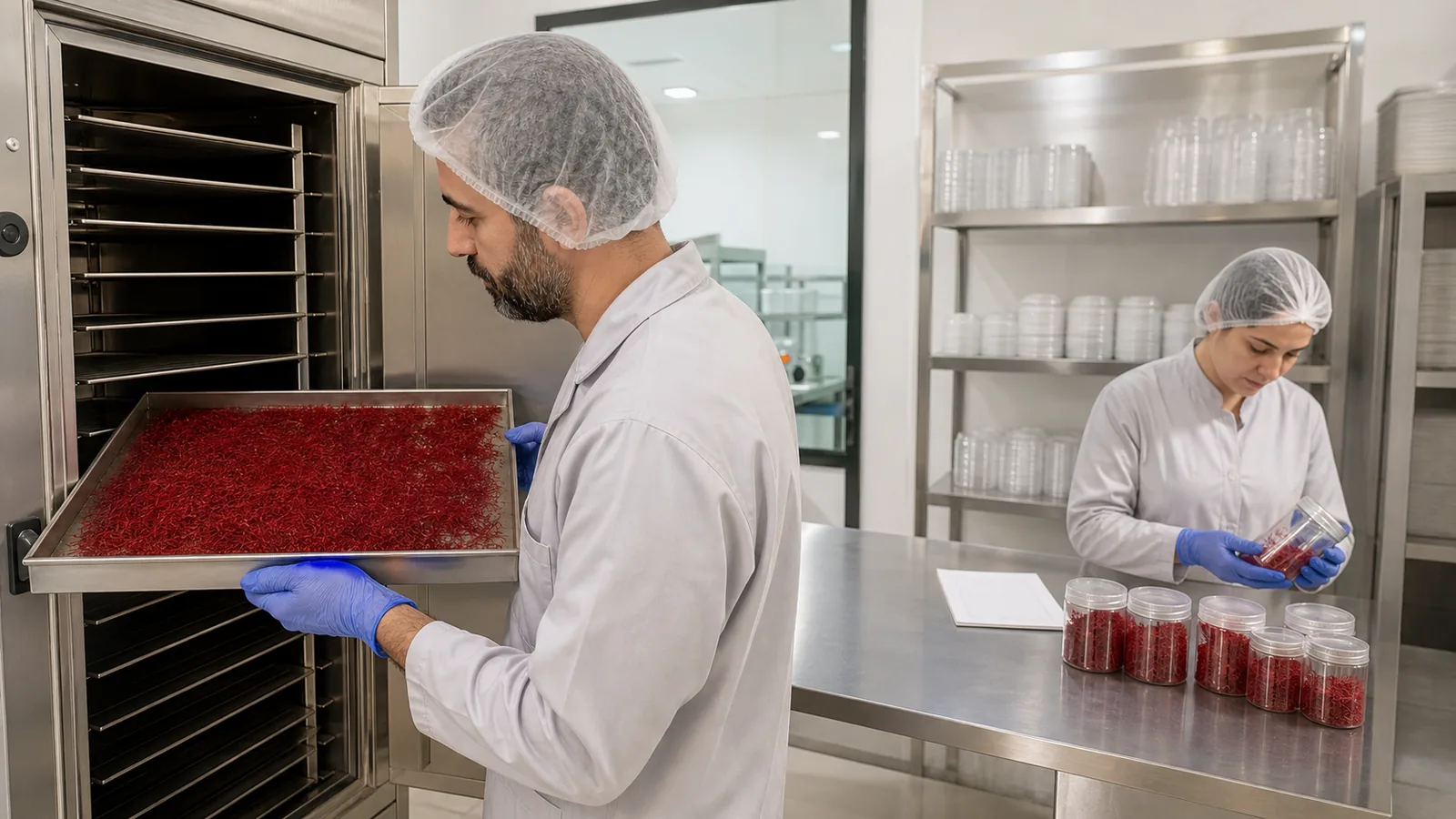
Manufacturers of saffron do more than put dried threads into a jar. The finished spice depends on decisions made across the whole production chain: choosing healthy corms, establishing the field, managing water and weeds, collecting flowers promptly, separating stigmas hygienically, drying them under control and protecting each lot through storage and packing.
The original version of this article reduced that chain to 15 translated instructions. The sequence was useful, but several lines sounded universal when they were not. A planting depth that protects corms in a cold district may be wrong in a different soil. Manure, ash, irrigation and drying heat all need a measured purpose. This updated guide keeps the complete process while explaining where a manufacturer needs evidence rather than a recipe.
Manufacturing begins with propagation material
Crocus sativus is a sterile triploid plant. It does not produce a normal seed crop and is propagated vegetatively through daughter corms. That is why conventional field breeding is limited, which is the point the old page was trying to make when it said crop improvement through breeding was “not allowed.” Research, clonal selection, plant health, agronomy and controlled propagation can still improve uniformity and performance.
A manufacturer that also controls cultivation should record where each planting lot came from. Select firm, intact corms of a suitable size and reject material that is soft, mouldy, badly wounded or otherwise suspicious. Larger mother corms often flower more readily than very small ones, but size cannot compensate for disease or poor identity.
Keep planting material dry, ventilated and protected from heat, condensation, pests and mechanical damage between lifting and planting. “Cool and dry” is a useful direction, not permission to put corms into an uncontrolled refrigerator. Storage temperature and duration must fit their dormancy and the local planting schedule.
Prepare a field that can last
The old checklist called for fertile soil rich in organic material. A better starting point is a well-drained, workable site with a current soil test. Fertility can be corrected; chronic waterlogging is far more difficult. Soil texture, salinity, pH, organic matter and nutrient status should be measured before deciding what to add.
Traditional farms and mechanised businesses may use different layouts. The translated advice to use a “tier instead of a pile” appears to distinguish organised rows or raised beds from irregular heap planting. Straight beds or rows make planting depth, irrigation, weed control and machinery access more consistent. Their dimensions should fit the field, equipment and drainage rather than a copied diagram.
The previous depth ranges were 15–20 cm in cold regions and 10–15 cm in temperate regions, with a warning not to plant more shallowly. Those figures remain useful historical guidance, but research shows that depth interacts with corm size, soil, climate and production system. Deeper soil can buffer temperature, while excessive depth can delay emergence or affect daughter-corm production. Set a consistent local depth after examining those conditions.
Our guide to preparing land for saffron cultivation covers drainage, testing, tillage and bed formation in detail. Those checks should be completed before a commercial corm lot reaches the field.
Manage dormancy without treating it as a dead season
Saffron enters summer dormancy, but the field still needs supervision. The old instruction to “water it down” during the summer break is dangerously ambiguous. Unnecessary irrigation in warm soil can encourage rot, while unusual drought, soil type or a specific production system may require a different response. Inspect soil moisture and follow local evidence instead of watering by phrase or date.
Summer is a good time to control weeds before they set seed, provided cultivation does not cut or expose the corms. Avoid deep tools over planted rows. Record where perennial weeds return so that the next control is directed rather than broadcast across the field.
The former page said that corms move closer to the surface each year and recommended an annual 2–3 cm layer of soil, manure and ash. Daughter corms can indeed develop above the mother corm, but a fixed annual cover is not suitable everywhere. Extra soil can change planting depth and drainage. Manure contributes nutrients and salts; wood ash can sharply alter pH and potassium. Apply any topdressing only after checking the field and the material.
When animal manure supplies nutrients, reduce the mineral fertiliser plan accordingly. The old instruction recognised this interaction but gave no usable rate or timing. Analyse or estimate the nutrient contribution, account for residual fertility and use the crop and soil results. More fertiliser does not guarantee more stigmas.
Irrigate and loosen the surface carefully
Water should enter the bed evenly and then drain. After irrigation, some soils form a surface crust that slows shoot emergence. The original checklist advised breaking that crust so saffron could come through, while warning against corm injury. That remains sound if the operation is shallow and timed when the surface is workable.
Do not cultivate blindly over a row. Check the actual planting depth and use a tool that only opens the crust. If compaction exists below the planting zone, a superficial pass will not fix it; that is a land-preparation problem for the next rotation.
Rodents, corm rot and field hygiene
Mice and other rodents can remove corms and establish runs through a field. The old article warned that neglect could damage both yield and stand establishment. Monitor before losses become obvious: look for holes, disturbed rows, feeding damage and fresh soil. Keep field edges and storage areas clean, protect corm stores physically and use only lawful, locally approved controls that do not create food, wildlife or worker hazards.
Corm rot is not one diagnosis. Several organisms and field conditions can produce similar symptoms, and injury itself can make infection more likely. Separate suspect material, avoid moving contaminated soil or corms, disinfect appropriate equipment and obtain a diagnosis before choosing a treatment. A generic pesticide programme is not quality assurance.
Harvest flowers while they are sound
The traditional instruction gave a collection window of 4–9 a.m., when flowers were opening. Early harvest is practical because temperatures are usually cooler and flowers have spent less time exposed to sun, dust and handling. It is not a universal clock: flowering intensity, weather, labour and transport time determine the safest schedule.
Use clean containers that do not crush the flowers. Keep them away from soil, fuel, animals and direct sun, and move them promptly to the separation area. A manufacturer should record the harvest date, field or supplier lot and time received. Once flowers from different origins are mixed without records, later testing cannot reconstruct their history.
Separate the red stigmas under hygienic conditions. Define the style length and physical form that the buyer expects, train workers to that specification and remove foreign plant matter. Speed matters, but hurried handling that mixes petals, dirt or wet material into a lot only moves the problem to drying.
Drying creates the stable spice
Fresh stigmas are perishable. Drying must reduce moisture promptly and evenly while protecting colour, bitterness and aroma. The old list called the Spanish approach the best method and described a badly translated toasting process involving a heater or electric fire. Spanish-style toasting refers to controlled heated drying; it does not mean holding saffron over smoke or a naked flame.
There is no single best temperature-and-time pair for every dryer and load. Airflow, stigma-layer thickness, starting moisture and sensor position change the result. Validate the cycle on the actual equipment, keep trays food-safe, prevent scorching and define a measurable endpoint. A dry-looking upper layer can hide wetter material below it.
Our article on saffron flower drying methods compares traditional and controlled systems and explains how to judge an endpoint without turning one research treatment into a universal factory setting.
Protect colour and aroma after drying
The former storage advice listed closed metal, wood or glass containers kept cool and away from light and moisture. The protective principles are right: use a food-contact package with a dependable moisture and odour barrier, close it properly, and avoid heat and light. Unlined reactive metal, permeable wood or a decorative lid that does not seal may not meet those needs.
Let freshly dried saffron reach a safe packing condition without exposing it to humid room air. Assign a lot code, retain a representative sample and record net weight, pack date and packaging material. Store cartons off the floor, inspect for pests or condensation and use stock rotation that follows the company’s quality plan.
What a saffron manufacturer should test
A certificate is meaningful only when its sample represents the lot being sold. Depending on the market and product form, controls may cover identity, moisture and volatile matter, extraneous matter, floral waste, characteristic compounds, microbiological criteria, pesticide residues, contaminants and adulteration risks. The applicable specification must be agreed before the shipment is packed.
The FAO/WHO Codex standard defines dried saffron from Crocus sativus and connects it with food-hygiene, contaminant, labelling and non-retail-container requirements. A customer may also contract against ISO methods, national rules or a tighter private specification. These layers should be named clearly; “premium” is not a test method.
Quality records should connect the field or supplier lot to separation, drying, test results and final packs. If material is blended, record every component and the new lot identity. If a result falls outside specification, isolate the lot while it is investigated. Re-labelling it with a different grade name does not correct the product.
How buyers can assess manufacturers of saffron
A serious review goes beyond a polished catalogue. Ask the manufacturer to explain its lot system, sample method, drying control, hygiene programme, traceability exercise and response to a failed result. Compare the certificate with the offered lot number and pack form. For a recurring order, agree how harvest year, physical style and permissible variation will be handled.
It is reasonable for cultivation and processing to involve different specialist businesses. What matters is that responsibility does not disappear between them. The packer needs reliable information from the processor; the processor needs clean, identifiable flowers; and the grower needs feedback when field practice creates a quality problem.
One chain, one accountable lot
The 15 points in the old article were never separate tricks. Healthy corms, organised beds, careful summer management, shallow crust breaking, rodent control, cool-hour harvest, controlled drying and sealed storage all protect the same future lot. Weakness at one stage cannot always be repaired at the next.
Good manufacturers of saffron make those connections visible. They replace vague instructions with measurements, adapt agronomy to the field, and keep enough records to explain how a package moved from corm to dried spice. That discipline protects the farmer’s work and gives the buyer something more useful than a claim.
Sources and review note
This article was reviewed on 28 August 2026 against peer-reviewed research on saffron’s triploidy, sterility and corm propagation, an open-access review of saffron corm-rot epidemiology and management, research on the effect of dehydration methods on saffron quality, and the official FAO/WHO Codex standard for dried saffron. Field rates, pest controls and process settings must be validated for the location, equipment, market and applicable law.

![Exporting Saffron to Turkey + Price Guide [Complete 0 to 100]](https://img.rowhanisaffron.com/20260827003933/saffron-export-turkey-quality-inspection.webp)



