


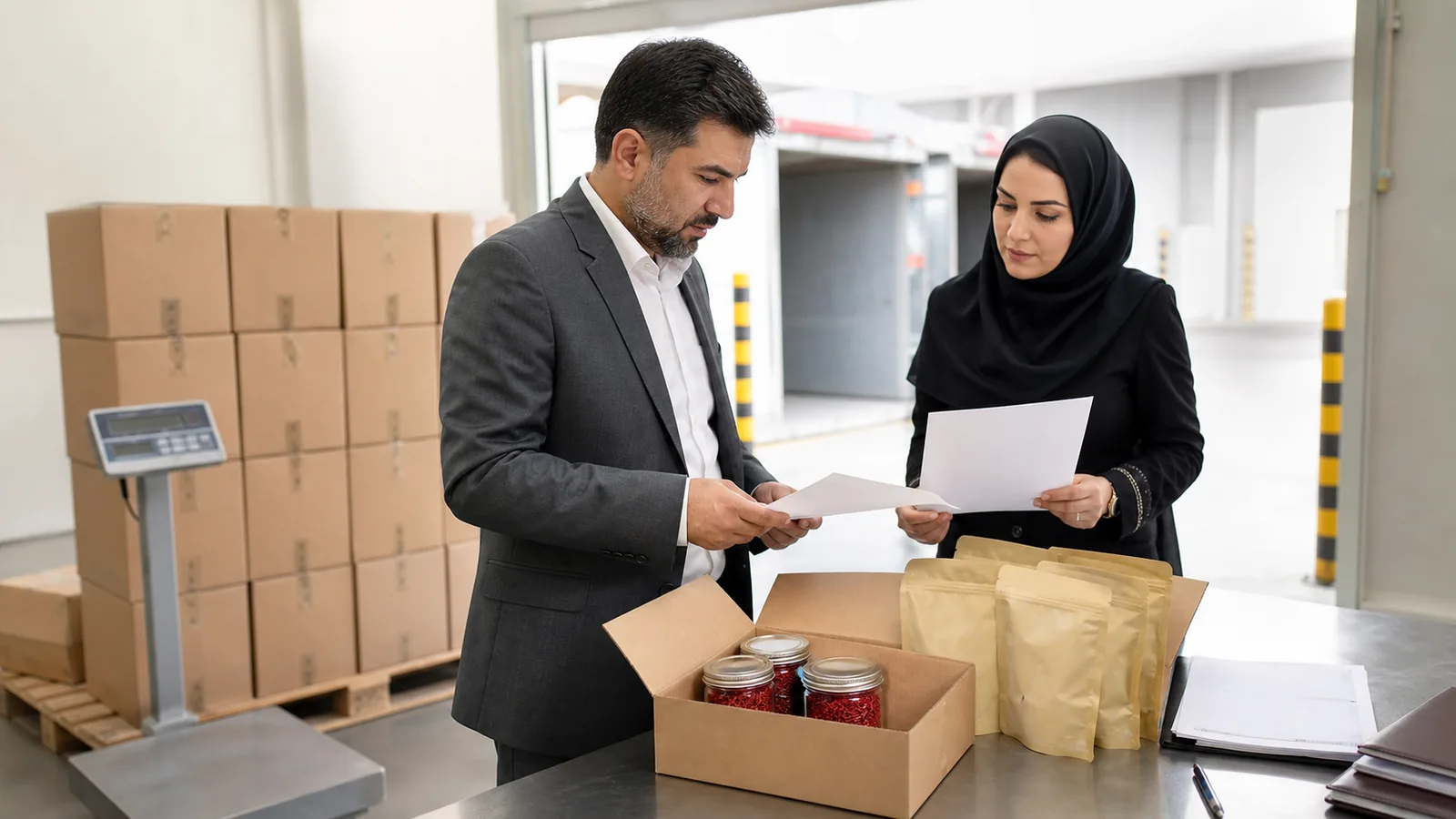
Terms of Iranian saffron exporters are not one permanent document list. An export has to satisfy Iranian registration and customs requirements, the importing country’s food and border rules, and the commercial terms agreed with the buyer. Those requirements can change by destination, product form, shipment date and route.
The earlier version of this article described an Iranian customs workflow from 2014. Its basic sequence—prepare licences and certificates, lodge a declaration, authenticate the documents, pay applicable charges, undergo evaluation and obtain release—is still a useful map. It must not be treated as current legal clearance advice. Before shipping, an exporter or licensed declarant should confirm the live requirements through the competent Iranian authorities, the destination authority, the carrier and the buyer.
Start with the destination and the contract
A shipment should not be packed before the exporter knows where it can legally enter. Ask the importer to confirm the product description, intended use, tariff classification, food registration, labelling language, residue and contaminant limits, required certificate wording, sampling arrangements and border entry point.
Saffron is commonly associated with HS 0910.20 at the six-digit international level, but the destination may use additional tariff digits or treat an extract, supplement, blend or retail preparation differently. The actual product and national tariff schedule govern the declaration.
Agree the delivery term precisely. Incoterms® 2020 rules allocate tasks, cost and risk between seller and buyer, but they do not replace a sale contract, determine product quality or override sanctions, customs and food law. Name the rule and place, such as FCA at a stated terminal, rather than writing only “FOB” or “CIF” without a location.
Confirm that the exporter and declarant can act
The old guide said an export business required a commercial or business card issued through the Iranian chamber system and confirmed by the commerce authority. It also referred to individuals, legal entities and cooperatives. That is historical context; eligibility, exemptions, renewal and the right to declare a particular shipment should be checked in the current Iranian system.
Decide who will appear as exporter, who owns the goods, and who will lodge the customs declaration. If a customs broker or representative acts through a power of attorney, the authority should cover the relevant transaction and remain valid on the declaration date.
The earlier article also mentioned a tax treatment under Article 113(b) and separate cooperative-card arrangements. Those provisions may have changed and are not relied on here. Tax, currency-repatriation and cooperative rules require current professional confirmation.
Build the product file before the customs file
Iranian saffron exporters need records that connect the physical lot to its description. At minimum, keep the supplier or field identity, harvest and processing record, physical form, lot code, pack sizes, net and gross weight, test results and the cartons or seals used for the shipment.
The FAO/WHO Codex standard describes dried saffron from Crocus sativus L. and covers styles, essential composition and quality factors, hygiene, contaminants, labelling and non-retail containers. A buyer may contract against ISO methods, an Iranian standard, a destination rule or a private specification as well. Name the actual standard and edition instead of writing “standard quality” on an invoice.
Our guide to processing and the chemical composition of standard saffron explains how testing, lot identity and specification fit together. A certificate of analysis should identify the tested lot and method; a generic certificate from a different batch cannot support the shipment.
Which certificates may be required?
The 2014 checklist included an export or case-specific licence, packing documentation, a health certificate, an animal and plant quarantine certificate on request, and a mandatory standard certificate. That list should be converted into questions, not copied onto every file:
- Does the current Iranian export regime require a product-specific permit or standard certificate for this form and quantity?
- Does the importing country require an official health, sanitary or phytosanitary document, or will it accept commercial laboratory evidence?
- Must the certificate use a particular model, authority, language, identifier or pre-notification reference?
- Does the buyer’s specification add residue, contaminant, microbiological, authenticity or religious-certification requirements?
- Do wooden pallets, transit countries or the carrier introduce separate documentation?
Dried spice is not automatically subject to the same plant-health certificate as planting material. Conversely, “processed” does not remove food-safety controls. Obtain only the certificates that the competent authorities require, but obtain them in the correct form before dispatch.
Prepare the commercial and transport documents
The invoice, packing list, certificate file and customs declaration must describe the same goods. Common records include the commercial invoice, packing list, transport document, insurance document where relevant, origin evidence when required, test or health certificates, contract or purchase order, and exporter/declarant authorization.
Check names and addresses character by character. Confirm currency, unit price, total value, payment terms, Incoterms rule and named place. On the packing list, reconcile the number and type of packages, marks, net weight, gross weight and container or seal information with the goods actually loaded.
A payment route can be lawful for the product yet unavailable to the chosen bank or carrier. Screen the parties, destination, transit route, vessel or airline, bank and end use under all applicable trade-control and sanctions rules. Do not represent a payment or origin inaccurately to make a transfer pass.
What the old export declaration contained
The previous article listed eleven groups of declaration data. In clear modern language, they were:
- the saffron exporter’s identity;
- the declarant or authorized representative;
- the buyer or consignee;
- the destination country;
- the country of origin;
- the agreed trade term;
- the means of transport and loading point;
- the saffron description, tariff code, type, weight or quantity and export value;
- package type, count, marks and container or gross weight;
- applicable customs-clearance items or charges; and
- the customs office, declaration registration details and required signatures or approvals.
The old translation called one party “Azharknndh”; it meant the declarant. It also referred to the “country of issue” where the surrounding list indicates a trade-country field, likely destination. Use the exact field names in the live declaration system rather than trying to repair an old translation during filing.
Warehouse receipt and declaration lodgement
The historical workflow brought the saffron to the customs-controlled location, obtained a warehouse receipt and submitted a four-copy export declaration. Current processes may be electronic and may not use that paper count. The enduring control is reconciliation: the receipt, declaration, packages and supporting documents must refer to the same consignment.
The earlier article said customs formalities and evaluation could sometimes take place outside customs facilities by agreement and at customs’ request. Never assume an exporter may self-authorize an off-site examination. It must be arranged and recorded through the competent customs procedure.
Authentication, charges and customs evaluation
The described authentication stage checked whether the submitted documents were genuine, whether tariff and declared value information was accurate, and whether the issuing authority was valid. Those checks remain sensible internal controls even before customs reviews the file.
The old “journal office” paragraph referred to paying applicable customs charges through the designated banking route and presenting the receipt. Use only the current official payment channel and match the payment reference to the declaration. A screenshot or transfer to an unofficial account is not proof of customs payment.
At evaluation, customs may compare the package contents with the declared type, quantity, value and supporting documents. If a discrepancy is found, stop and correct it through the permitted process. Altering a certificate, relabelling origin or changing an invoice after examination can turn an operational error into a compliance problem.
Check certificates and approvals for validity
The final section of the old page asked officials to verify the licence to use Iran’s standard mark, check that it was not false, and confirm the expiry dates of declarations, operating licences, standard approvals and packaging permissions. That principle is still important.
Verify a certificate with the issuing body where a registry or validation service exists. Check its scope, lot or facility reference, issue and expiry dates, signatory, laboratory status and any condition on how the mark may be used. A logo copied onto a label is not a licence.
The previous text allowed an export certificate from an accredited inspection company or provincial standards department when a valid standard licence was unavailable. Whether that substitution is lawful today cannot be assumed. Obtain written confirmation from the authority responsible for the current shipment.
A pre-dispatch check for Iranian saffron exporters
- The exporter, declarant, importer and payment parties have been checked and can lawfully act.
- The product form and tariff classification match the physical goods.
- The buyer has confirmed destination-market food, labelling and border requirements.
- The invoice, packing list, declaration, certificates and transport booking agree on names, lot, packages, weight, value, origin and destination.
- Every required certificate is genuine, current and tied to the shipment or facility as required.
- The Incoterms rule and named place are written into the contract and documents.
- Payment, carrier, transit and end-use compliance have been cleared before loading.
- A copy of the released declaration and final transport record will be kept with the lot file.
A buyer assessing the broader commercial chain can also read our article on the economic importance of wholesale saffron, which separates product value from testing, packing, logistics and contract risk.
The safest way to use this guide
The terms used by Iranian saffron exporters have two layers. The contract tells the parties who does what; public law and official procedures determine what they are allowed and required to do. Neither layer should be reconstructed from a 2014 translation after the consignment is already packed.
Use this page as a preparation map. Then obtain the current forms, fees, permit rules and certificate requirements from the competent authorities for the exact shipment. A complete, consistent file protects clearance, but it also protects the buyer relationship: the product, promise and paperwork all describe the same saffron.
Sources and review note
This article was reviewed on 28 August 2026 against the official FAO/WHO Codex standard for dried saffron, the International Chamber of Commerce overview of Incoterms® 2020, the International Trade Centre’s official market-access and trade-analysis tools, and the WTO material on the Trade Facilitation Agreement. No accessible authoritative source was found that would justify presenting the complete 2014 Iranian paper checklist as current in 2026; shipment-specific Iranian and destination requirements must be confirmed directly.

![Exporting Saffron to Turkey + Price Guide [Complete 0 to 100]](https://img.rowhanisaffron.com/20260827003933/saffron-export-turkey-quality-inspection.webp)



