


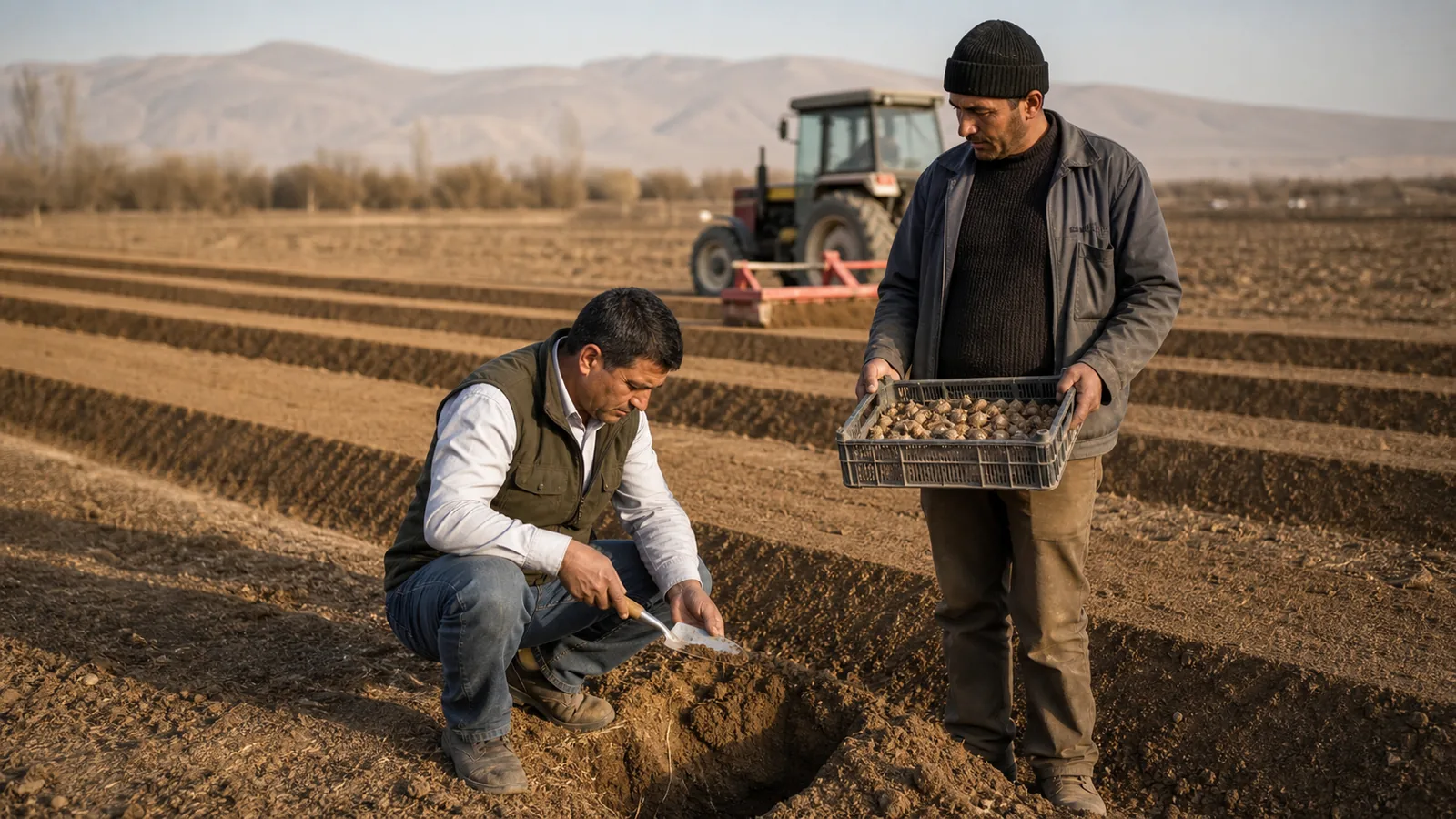
Preparation of land for cultivation of pure saffron is a job for the months before the corms arrive. The aim is not to create one supposedly perfect soil recipe. It is to give the corms a well-drained rooting zone, correct limitations shown by a soil test, and shape a field that can be irrigated without leaving water around the planting material.
This planning matters because saffron is usually treated as a multi-year crop in Iran. A decision made before planting can affect several harvests. Deep compaction, poor drainage or an unsuitable amendment is much harder to correct once rows contain mother and daughter corms.
Begin with the site, not the plough
Walk the proposed field after rain or irrigation. Look for standing water, slow-drying depressions, runoff channels, compacted wheel tracks and places where the topsoil changes colour or texture. Ask what was grown there and whether the field has a history of bulb or corm rots. A flat appearance does not guarantee even drainage.
Saffron grows in several soil types around the world, from sandy and silty loams to clay loams. The useful common feature is a friable, aerated rooting zone that drains. Permanently wet or swampy soil is a poor choice because low-oxygen conditions and persistent moisture raise the risk of corm decline and disease.
The field also needs enough light and a climate that fits saffron’s cycle. The plant flowers in autumn, produces leaves through the cooler season and becomes dormant in summer. Many traditional production areas have dry, warm summers and cool to mild winters. Although dormant corms can tolerate dry summer heat better than actively growing plants, “resistant to high temperature” is not a blanket guarantee; severe heat, frost, unexpected summer moisture and local disease pressure still matter.
Test the soil before deciding what to add
Take representative samples rather than one scoop from the easiest corner. Separate visibly different areas, follow the laboratory’s sampling instructions and tell it that the land is intended for a multi-year saffron planting. Useful measurements include texture, pH, electrical conductivity or salinity, organic matter, lime where relevant, and plant-available nutrients.
The old article stated that saffron soil should have a pH of 7 to 8 and be calcareous. Neutral to mildly alkaline soils are common in major producing regions, but they are not the crop’s only possible setting. A review of saffron-growing soils reported sites from roughly pH 6.0 to 7.8, with some successful sites outside that range. Do not add lime merely because an old checklist says saffron likes calcium; use the measured soil condition and local agronomic advice.
Organic matter can improve structure and water behaviour, but more is not automatically better. Any manure or compost should be mature, suitable for agricultural use and accounted for in the nutrient plan. Fresh, salty or poorly characterised material can introduce weed seed, excessive salts or uneven nutrient release.
Check drainage and compaction
Dig inspection holes across the field. A dense layer below the topsoil may hold water above it even when the surface looks dry. Rooting depth, stone content and the speed at which water moves through the profile are more informative than lab texture alone.
If there is a compacted layer, correct it only when soil moisture is suitable for tillage. Working wet soil can smear and compress it further. If the water table is high or the field repeatedly floods, a raised bed may reduce short periods of surface saturation, but it cannot repair a fundamentally unsuitable site.
Remove large stones, persistent perennial weeds and debris that would interfere with planting or harvesting. Weed control before corms go into the ground is particularly valuable because mechanical cultivation becomes more difficult inside a planted bed.
A practical sequence for preparing saffron land
- Map the field. Mark wet spots, soil changes, water entry and exit points, access lanes and any known disease patches.
- Sample and diagnose. Test each reasonably uniform zone and inspect the profile for compaction, stones and drainage limitations.
- Plan the layout. Decide on beds or rows, irrigation delivery, drainage routes and machinery access before spreading amendments.
- Apply only justified amendments. Base nutrients, lime, gypsum or organic material on the actual soil result and local recommendations. Gypsum is not a universal cure, and lime is not appropriate for every field.
- Carry out primary tillage. The traditional guidance in this article used autumn or winter ploughing to about 25–30 cm. That can create a useful working layer where soil depth and equipment allow, but tillage depth should respond to the profile rather than repeat a fixed number.
- Refine without pulverising. Break large clods, level the surface and prepare a firm, friable bed. Powdering dry soil into dust damages structure and can encourage crusting.
- Form beds and confirm water movement. Shape the field for even irrigation and safe drainage, then correct low points before planting begins.
Traditional and mechanised farms will not use identical equipment. The test is the finished root zone, not the brand or size of the implement. It should let corms be placed at a consistent depth, allow shoots to emerge, and carry excess water away.
Plan for a crop that may stay five to seven years
The earlier guidance expected saffron corms to remain in the same field for five to seven years. That is still a useful planning horizon in a perennial Iranian system, although the economical life of a planting varies with corm density, disease, soil fertility, daughter-corm development and local practice.
Leave enough room for access and future crop care. Dense planting can raise early yield per unit area, while also increasing planting cost and competition as daughter corms multiply. Research results on depth are likewise context-dependent: trials have used depths from about 8 to 20 cm, and the balance changes with climate, corm size, soil and whether protection from heat or freezing is important.
Use healthy, intact corms from a traceable source. Reject material that is soft, mouldy, badly wounded or suspicious. Injury can make corms more vulnerable to rot. Whether corms are bought online from Ghayen, supplied by a neighbour or lifted from another company field, appearance and provenance matter more than a sales description.
For a broader pre-plant check, see our saffron cultivation tips. They cover planting material, storage and field decisions that sit alongside soil preparation.
Fertiliser timing should follow the test
The old translation recommended spreading fertiliser in spring or autumn before planting and completing the chemical work under expert supervision. The sound part of that advice is to incorporate appropriate basal material before rows become difficult to work. The season, formulation and rate cannot be selected without the soil result, expected yield, irrigation water and local rules.
Account for nutrients supplied by compost or manure. Excess nitrogen can favour leaves without guaranteeing more flowers, and unnecessary salts can create a problem in already dry soils. Place amendments evenly; concentrated pockets close to corms are not a substitute for a balanced root zone.
Irrigation starts with the field shape
A good layout delivers water evenly and then lets the soil re-aerate. It avoids drowning the lower end of a furrow while the upper end remains dry. The right system depends on slope, texture, water quality, available flow and farm scale.
Summer is saffron’s dormant period. The old article warned that summer rain or irrigation could be damaging and used this to explain why cultivation was less common in wetter northern Iran; it then mentioned cultivation around Sabzevar. The risk is real where warm, wet soil keeps corms saturated, but a whole region should not be judged by one sentence. Drainage, rainfall timing, temperature, cultivar management and disease history all matter.
Once planting is complete, schedule irrigation from soil moisture and crop stage rather than a copied calendar. The guide to timely irrigation in an organic saffron field explains how those decisions change across establishment, flowering, leaf growth and dormancy.
What the old soil description was trying to say
The original page described a medium-textured, moderately deep, level field without gravel, rubble or weeds. It also referred to sand, clay, silica, iron, gypsum and calcium in a heavily corrupted translation. The practical meaning is that saffron can grow in varied mineral soils, but structure, drainage and the measured chemical condition determine whether a particular field is workable. Its suggestion that calcium alone makes organic matter decompose well was too simple: decomposition also depends on moisture, temperature, aeration, pH and biological activity.
It is not necessary to manufacture a fixed sand-and-clay mixture. Adding a thin layer of sand to a clay field rarely changes the whole rooting profile and can create an inconsistent surface. Correct the actual constraint: compaction, surface sealing, poor grading, salinity, acidity, alkalinity or low organic matter. Some constraints can be managed; others make a different field the safer investment.
Gonabad and Ghayenat are examples, not recipes
Gonabad and Ghayenat have long reputations for saffron quality. Their names do not mean that copying one pH number or ploughing depth will reproduce the same result elsewhere. Quality develops from suitable corms, climate, soil, irrigation, harvest timing, stigma separation, drying and storage together.
This is also where the page’s old commercial wording needs context. Someone searching for pure saffron wholesale supply or a saffron supplier is looking for a finished spice, not a soil prescription. A well-prepared field supports future quality, but purity is ultimately a property of the harvested and processed lot. It cannot be guaranteed by geography or cultivation language alone.
Common land-preparation mistakes
- Choosing a low, wet field because its surface soil looks fertile.
- Ploughing to 25–30 cm automatically without checking the soil profile.
- Working the field while wet and creating a compacted or smeared layer.
- Adding lime, gypsum, fertiliser or manure without a test and a rate calculation.
- Ignoring the history of corm disease or planting visibly damaged material.
- Designing irrigation after the beds have already been formed.
- Using one planting depth for every corm size, soil and climate.
- Preparing a fine surface but leaving perennial weeds and stones in the rooting zone.
What a ready field should look like
Before planting, each management zone should have a recorded soil result and a clear reason for every amendment. The soil should be workable rather than wet, the bed should be friable but not dusty, and water should be able to enter evenly and leave without pooling. Planting depth and spacing should be marked, access routes should be protected, and the corm lot should already have passed a health check.
Good preparation does not promise pure saffron by itself. It removes avoidable constraints and gives healthy corms a stable place to establish. That is the practical purpose of the work: fewer surprises below ground and a field that remains manageable after the first flowering season.
Sources and review note
This article was reviewed on 28 August 2026 against a peer-reviewed study of soil physical and chemical properties in saffron cultivation, an open-access Canadian Journal of Plant Science field study of planting practices and cold-climate saffron, a peer-reviewed investigation of injury and saffron corm rot, and the FAO description of Iran’s Qanat-based saffron farming system in Gonabad. Site preparation, planting depth and amendments must still be adapted to the farm’s soil test, climate and applicable local guidance.

![Exporting Saffron to Turkey + Price Guide [Complete 0 to 100]](https://img.rowhanisaffron.com/20260827003933/saffron-export-turkey-quality-inspection.webp)



