Timely irrigation, organic saffron begins with a simple observation: saffron uses modest amounts of water compared with many crops, yet the timing of that water can shape flowering, leaf growth and the next generation of corms. A calendar helps, but it is only a starting point. Soil texture, autumn temperature, rain, field age, drainage and the irrigation method all change the decision.
For organic production, water management has another job. It should keep the crop vigorous without creating long periods of saturated soil that favour corm problems. Irrigation alone does not make saffron organic. The claim belongs to a documented production and certification system covering the field, inputs, handling and separation of the crop.
Why the first irrigation matters so much
Saffron corms rest through the hot, dry part of the year. As autumn approaches, cooler conditions and moisture help move the crop towards flowering. In Khorasan, the first irrigation is therefore planned with both temperature and the harvest workforce in mind. Watering different blocks on different dates can stagger flower emergence and make the short picking season easier to manage.
The old version of this page gave 15 October as the best date for Khorasan. That is a useful historical reference, not a rule for every farm. A survey of 160 farms in Birjand, Qaen, Gonabad and Torbat-Heydarieh found that first irrigation most often fell between 17 October and 1 November, with cooler Torbat-Heydarieh fields commonly watered earlier. Flowers tended to appear about two to three weeks after that first irrigation.
A farmer should work backwards from local temperature, expected flowering, labour and the forecast. Irrigating by the date alone can be mistimed when autumn is unusually warm, heavy rain is approaching or a dense soil is still wet below the surface.
A practical seasonal pattern
Traditional Khorasan practice is often summarised as four irrigations during the active season. Research farms and modern commercial fields may use more or fewer events. A 2023 survey across 13 Iranian growing areas recorded three to eight irrigations, averaging 4.5. That range is a useful warning against treating one schedule as universal.
1. Pre-flowering irrigation in autumn
This is the first and most sensitive event. Its purpose is to re-wet the root zone and support the transition into flowering. The field should receive enough water to wet the active soil depth evenly without prolonged ponding. In a heavy soil that drains slowly, applying the same volume as a free-draining sandy loam can create very different conditions around the corms.
2. Irrigation after flower harvest
Once the flowers are picked and leaves are established, water supports photosynthesis and corm development. The visible harvest is over, but the crop is still building the reserves that influence future seasons. If useful rain has already supplied that moisture, an automatic irrigation may add nothing except cost and disease pressure.
3. Winter irrigation when the soil requires it
Traditional schedules place another irrigation after winter weeding or field work. The actual need depends on rainfall, soil water and temperature. Cold, wet soil loses water slowly, so an interval copied from a warmer location can be excessive. Check below the dry-looking surface before deciding.
4. Late-season irrigation before dormancy
A final spring irrigation may support daughter-corm growth before leaves senesce and summer dormancy begins. The old page described saffron’s water season as running from September to May. That broad window suits the crop’s autumn-to-spring activity in Khorasan, but the final date moves with climate and the condition of the leaves.
For a fuller stage-by-stage calendar, see our complete guide to saffron irrigation timing. This page keeps a narrower focus: how to adapt those decisions for an organic field and avoid turning a traditional calendar into rigid advice.
How often should an organic saffron field be watered?
The former article reported a 15-day irrigation interval. In the Khorasan farm survey, observed intervals ranged from about 12 days in Torbat-Heydarieh to 24 days in Gonabad. Those figures describe regional practice; neither proves that a fixed 15-day cycle is correct for a particular field.
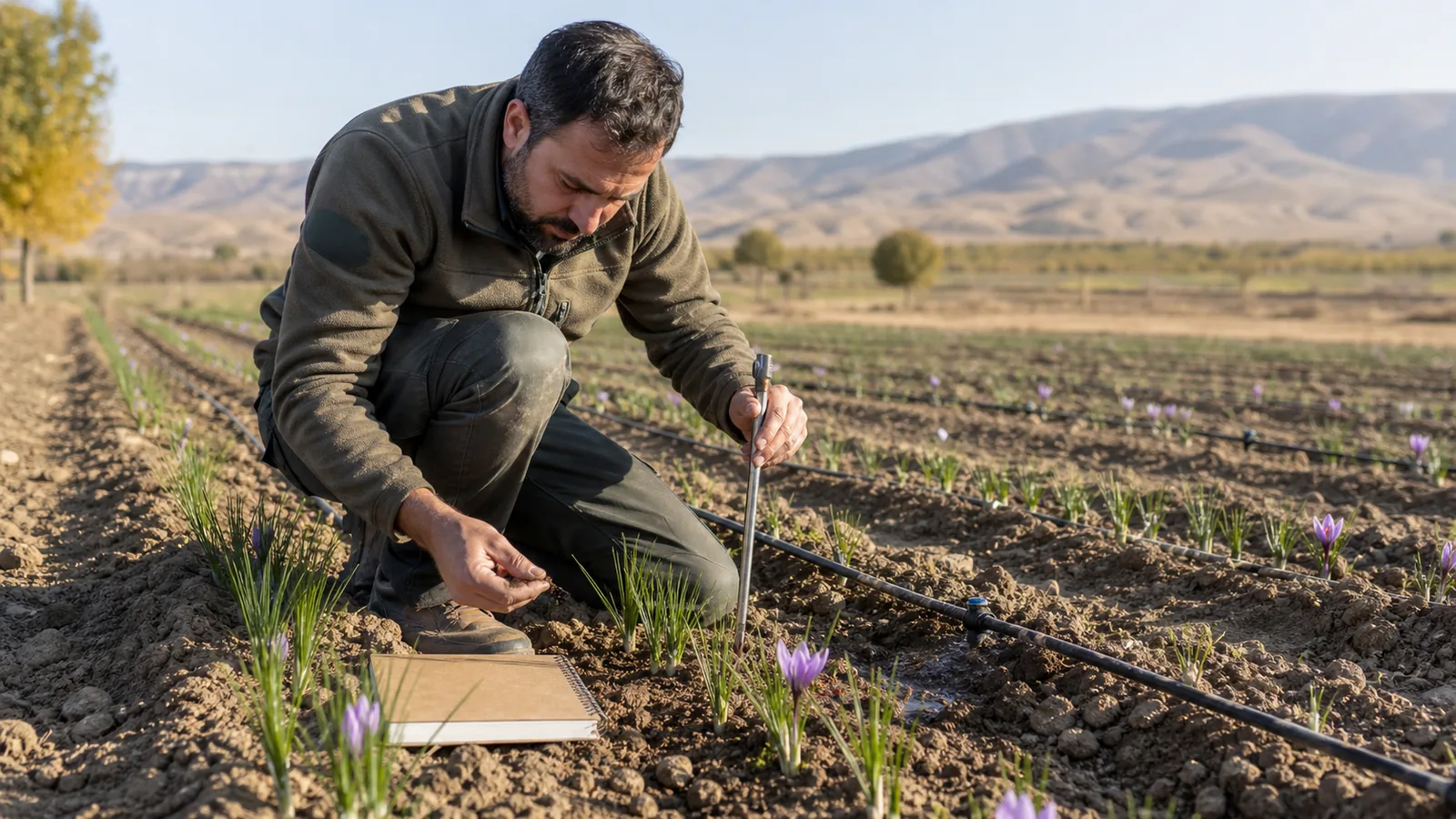
Use field evidence instead. Before irrigation, consider:
- moisture at corm and root depth, not only the top centimetre;
- rain received since the last event and rain expected soon;
- soil texture, infiltration and drainage;
- crop stage and leaf condition;
- distribution uniformity across the irrigation block;
- water salinity and any site-specific leaching requirement;
- signs of ponding, corm stress, rot or pest activity.
Simple records are valuable. Note the date, estimated or metered volume, rainfall, soil condition and what happened next. After several seasons, that farm history is more useful than a generic number copied from another district.
What the old crop-coefficient figures mean
The previous text preserved several research figures but lost their labels in translation. It listed stage lengths of 30, 55, 105 and 30 days, with crop coefficients of 0.4, 0.85 and 0.55 across initial, middle and end periods. A semi-arid Iranian study likewise found that crop coefficients changed markedly through the season, with the greatest values in the middle phase.
A crop coefficient, or Kc, is used with local reference evapotranspiration to estimate crop water use. It is not an irrigation volume by itself. Weather data, effective rain, soil storage, application efficiency and the depth being managed still have to be considered. Values developed under one climate and method should be locally calibrated before they control a commercial system.
Should saffron receive irrigation in August?
Summer irrigation is the most context-dependent question on this page. Trials in parts of Iran have found that an August irrigation increased flower or corm yield under the conditions studied. That supports the old article’s observation that August water can produce a benefit. It does not make summer irrigation automatically safe.
Saffron corms are dormant underground at this time. Adding water to warm, poorly drained soil can increase biological activity around them. Research in Gonabad reported that summer irrigation increased populations of Rhizoglyphus robini, a mite associated with corm damage and rot, along with yield losses. Saffron corm rot also involves soil-borne fungi, and persistently moist conditions can worsen disease pressure.
That is why the former page warned about fungal disease and did not recommend August irrigation for organic saffron. The sensible conclusion is more precise: use it only where local evidence, drainage, healthy planting material and disease history support it. A successful summer-irrigation trial in one soil is not permission to copy the practice into a field with known corm rot.
Water management in an organic system
Organic management relies heavily on prevention. Start with sound corms, a field with suitable drainage, clean tools and water whose quality is known. Avoid moving contaminated soil between blocks. Remove and investigate diseased plants rather than hiding symptoms with extra irrigation. Any biological, mineral or plant-protection input must be allowed by the standard and certifier governing the crop.
Keep records of the water source, irrigation events, field observations and corrective actions. If water travels past conventional farms or through shared infrastructure, assess contamination risks and document the controls used. Organic status is a verified production claim, not a judgement made from the appearance of the threads.
If you are comparing products and searching for the best saffron for sale, treat the word organic as something to verify. Ask which standard applies, who certified the operator, which crop and lot the certificate covers, and whether the document is current. Organic certification does not by itself grade colour, aroma or purity; those are separate quality questions.
Signs that the schedule needs changing
Review the programme when water stands in low areas, distribution is visibly uneven, soil stays wet long after an event, leaves show stress despite a wet profile, or corm disease appears. Repeated dry spots may point to a blocked emitter or poor levelling rather than a need to water the entire field more often.
Yield should also be interpreted carefully. One good flower harvest does not prove the schedule is sustainable if daughter corms are weak or disease is building. Compare several seasons, note field age and separate the effects of irrigation from corm density, fertility, weeds and weather.
Timely irrigation for organic saffron is therefore an adjustment process. Start with the local autumn pattern, measure what the soil and weather have supplied, protect the active crop through spring, and treat summer irrigation as a deliberate site-specific decision. The calendar belongs on the clipboard; the field still has the final word.
Sources and review note
This article was reviewed on 28 August 2026 against a peer-reviewed survey of irrigation and flowering across Khorasan farms, a multi-region study of climate and management factors in Iranian saffron, a three-year Qaen irrigation-method trial, the FAO AGRIS record for summer irrigation and corm-rot mite risk, and the FAO/WHO Codex guidelines for organically produced foods. Local agronomic advice and the rules of the applicable organic certifier should govern an individual farm.