


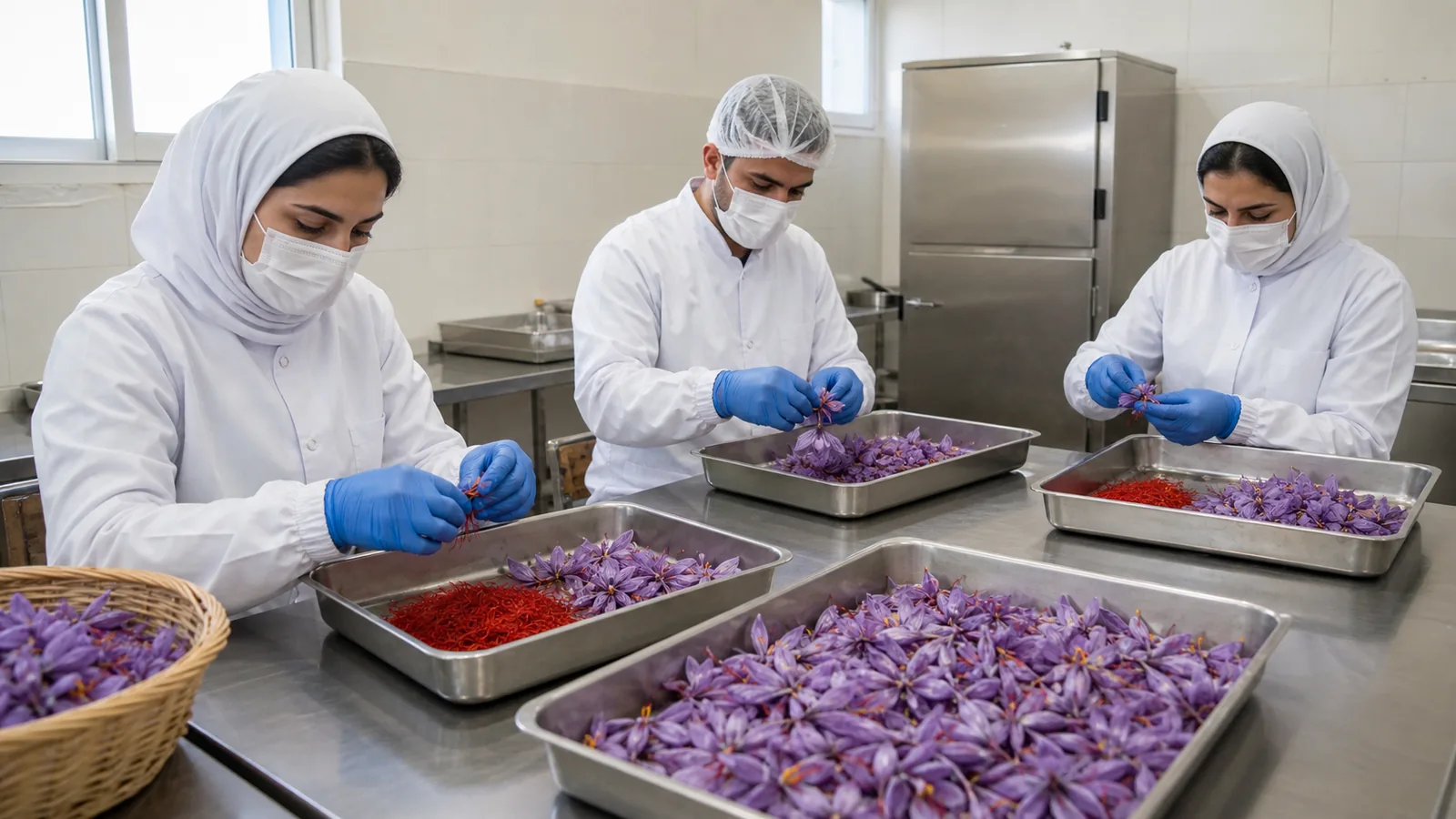
Organic Iranian saffron exports require two separate systems to work together. Organic certification controls how the crop is produced, handled and documented. Food hygiene controls physical, chemical and microbiological hazards during separation, drying, packing and storage. One does not replace the other, and neither justifies a promise of “zero contamination.”
This matters because the original 2014 article used “organic” as though it meant clean, pure and free from every contaminant. The project it described was valuable: move flower processing into a more hygienic environment, train workers and use controlled drying. The language around it needs correcting so that a buyer knows what an organic claim actually proves.
The Khorasan hygiene project described in the original report
The old account attributed the initiative to Iran’s National Saffron Council and Gholam Hossein Shafei in a report from Fars News Agency in Mashhad. Shafei said customers had complained about physical contamination in some Iranian saffron and that a quality-improvement and identification plan had been developed in response.
The project was described as starting experimentally in Razavi Khorasan and then expanding across two provinces. It involved the health network, farmers and the Agriculture Organization. Work that had often been done in homes—especially separating the stigmas from the flowers—was moved into a dedicated hygienic environment.
Workers were trained and used gowns and masks, work areas were disinfected, and machine drying replaced a traditional drying method. The report said this produced consistent colour and aroma and claimed that physical, microbial and chemical contamination had been reduced to zero.
That final claim is too absolute to repeat as a present guarantee. A controlled room, protective clothing and a dryer can reduce hazards, but safety has to be managed through documented controls and verified against defined limits. “No contaminant detected in a tested sample” is not the same as proving that every possible contaminant is absent from every lot.
What “organic Iranian saffron” should mean
Organic is a regulated production and handling claim. It is not another word for natural, traditional, high grade or chemical-free. The farm, inputs, records, processing and businesses in the supply chain must meet the rules of the organic programme under which the product will be sold.
The certification has to match the destination. For the United States, the USDA’s current organic import and labelling guidance explains that imported certified-organic products must follow the applicable USDA rules and identify the certifying body where required. The USDA also requires each organic import shipment to be associated with an electronic NOP Import Certificate.
For the European Union, imported organic products use an electronic certificate of inspection. The European Commission’s TRACES organic-import guidance states that an appropriate e-COI is required for release as organic. These examples show why a generic “organic certificate” should not be assumed to cover every country.
A buyer should verify the certifier, certificate scope, named operator, product category, validity dates and the lot or shipment documents. A logo copied onto a quotation or pack is not proof. The claim must remain traceable through any collector, processor, packer, trader and importer that handles the organic product.
Organic certification is not a food-safety test
An organic system governs permitted practices and the integrity of the certified chain. Food-safety controls address a different set of questions: what can enter the saffron during production and handling, how likely it is, how it will be prevented, and how a failure will be detected and managed.
For saffron, hazards and defects may include:
- physical matter such as soil, plant debris, hair, fibres or fragments from equipment;
- microbiological contamination introduced through hands, surfaces, water, containers or poor storage;
- chemical contamination from unsuitable cleaning agents, environmental exposure, agricultural inputs or packaging;
- moisture uptake, mould, foreign odours and quality loss during drying or storage;
- mixing with non-organic product or loss of lot identity.
The Codex General Principles of Food Hygiene describes Good Hygiene Practices and a hazard-based control approach. The aim is safe, suitable food and effective response when controls fail—not a marketing promise that risk has ceased to exist.
Why saffron flower separation needs control
Fresh flowers arrive with soil exposure, field containers and many hands involved during a short harvest. The useful red stigmas are small, light and easily mixed with petals, stamens, style material and foreign matter. Long delays or compressed heaps can also make the flowers harder to handle cleanly.
A suitable separation room should have cleanable work surfaces, controlled access, appropriate lighting, handwashing and a defined flow from incoming flowers to separated stigmas. Workers need training for hand hygiene, clothing, illness reporting, tool cleaning, lot separation and what to do when they find an unusual object or damaged material.
Gowns, hair restraints and masks may form part of that plan, but clothing alone does not make the room hygienic. Dirty hands, unclean trays, mixed lots or poorly stored flowers can defeat the purpose. The controls have to cover people, premises, equipment, materials and records together.
The shift away from informal home processing described in the 2014 project was therefore more than a cosmetic change. A dedicated environment can make training, cleaning, supervision and traceability repeatable. It still needs verification rather than an assumption that centralisation removes every hazard.
Controlled drying and the meaning of consistency
Drying turns the fresh stigma into stable saffron and strongly influences colour, aroma, handling and storage behaviour. A machine can control temperature, airflow, load and time more consistently than an improvised method, provided the process has been validated and operators follow it.
“Machine dried” is not automatically a quality grade. An overloaded dryer, an inaccurate sensor or the wrong time-temperature combination can produce uneven material. Each batch should be loaded within its tested range, monitored, protected from recontamination and released against the agreed specification.
The Codex standard for dried saffron sets composition and quality factors for filament, cut-filament and powdered forms. Buyers can add contractual tests, but the sampling method and acceptance limits should be agreed before production.
Our guide to saffron flower drying methods explains how harvest, separation and drying connect without presenting one universal recipe for every dryer and batch.
Building an organic export lot
Start with the certified farm and crop records
Confirm the land and crop are within the certificate’s scope and that required production, input and harvest records are complete. If flowers or dried stigmas come from several growers, every source needs an approved path into the organic lot.
Protect organic integrity during handling
Incoming containers, work schedules, trays, dryers and storage locations should prevent mixing with conventional saffron. Cleaning between lots needs a written method. Lot codes should connect received material, processing, packing and final stock without gaps.
Apply the food-hygiene plan
Identify hazards at receipt, separation, drying, conditioning, packing and storage. Set practical controls, monitoring and corrective action. Testing should answer a defined question; a certificate of analysis cannot compensate for an uncontrolled process.
Use destination-approved documents and labels
The organic certificate, shipment certificate, invoice, packing list, origin evidence and label should identify the same product and parties. The importer and certifier should approve the organic presentation before packs are printed or loaded.
Keep a retained sample and release record
Retain a representative sample under suitable storage and record who released the lot, which results were reviewed and which specification applied. If a buyer reports a problem, the investigation needs evidence from the actual batch rather than a generic certificate.
What buyers should ask an organic supplier
- Which organic programme and certifier cover this product and operator?
- Can the certificate be verified directly with the certifier or official database?
- Which growers, processors, packers and traders handle the lot?
- How is organic saffron separated from conventional product?
- Where are flowers separated and how are workers, rooms and tools controlled?
- Which dryer parameters are monitored and how is the batch released?
- What testing applies to this lot and who selects the sample?
- Which import certificate and label rules apply to the destination?
- What happens if a result, document or organic-integrity check fails?
Claims that should make a buyer pause
“Organic,” “sterile,” “chemical-free,” “zero microbes” and “100 percent free of contaminants” are not interchangeable claims. Sterility is not the normal standard for dried saffron, and an organic certificate does not prove a negative result for every pesticide, microorganism or foreign object.
A supplier can make a precise, defensible statement instead: identify the certification scheme, the certified operation and lot, the hygiene system used, the tests performed, the method and the result. Precision is more trustworthy than an absolute promise.
What remains valuable in the original project
The Khorasan initiative addressed a real weakness: delicate food was being separated and dried in many informal settings, making consistent training, cleaning and process control difficult. Bringing growers, health workers and agricultural authorities into a structured programme was a serious attempt to improve export readiness.
The best modern version keeps that practical ambition while using more accurate language. Organic Iranian saffron exports need verified certification, protected lot identity, hygienic separation, controlled drying, destination documents and evidence from the product being shipped. That is stronger than saying contamination has reached zero—and far more useful to a buyer.
Organic-import and food-hygiene guidance reviewed 28 August 2026. Certification scopes, import certificates and labelling rules change; confirm them with the certifier and importer for the destination and shipment.

![Exporting Saffron to Turkey + Price Guide [Complete 0 to 100]](https://img.rowhanisaffron.com/20260827003933/saffron-export-turkey-quality-inspection.webp)



