


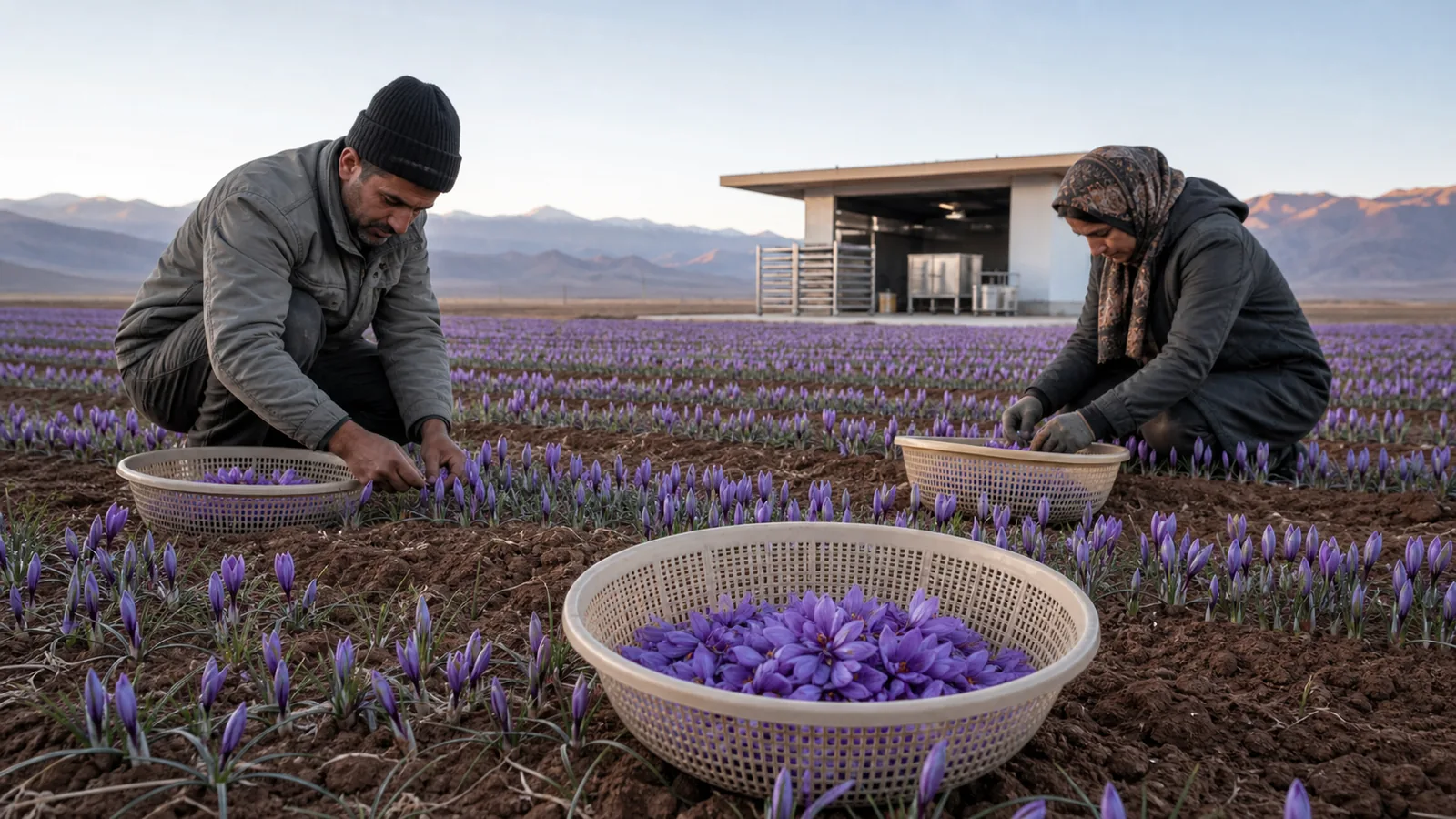
iranian saffron flower drying methods start in the field, not on the tray. A processor cannot recover quality that was lost when flowers sat crushed in a sack, warmed in the sun or waited too long for separation. The reliable sequence is to forecast flowering, collect sound flowers in the cool hours, move them in shallow clean containers, separate a consistent stigma form and then dry that identified lot under controlled conditions.
For readers asking how to dry saffron, the short answer is to spread freshly separated stigmas in a thin, even layer on a food-safe tray, use measured heat and airflow, check a defined endpoint, cool the lot in a protected low-humidity space and seal it promptly. Time and temperature must be validated for the actual dryer and load. A copied setting is not a complete process.
Forecast the Iranian saffron flower harvest
In traditional Khorasan fields, flowers often begin to appear around two to three weeks after the first autumn irrigation. Air and soil temperature, moisture, corm condition, planting depth and location can shorten or lengthen that interval. The old article observed earlier emergence under relatively cool conditions and later emergence in warmer weather; the response is more complex than shade alone, but temperature is central to labour planning.
The timing of the first irrigation matters too. If it is delayed and colder weather arrives, flower emergence may also move later. Growers should watch the field rather than count a fixed number of days, because a concentrated flush can quickly exceed the capacity of harvest and separation teams.
The traditional Iran saffron harvest season in Khorasan runs through October and November, with local variation. The earlier page placed flower emergence from late October to late November and the broader harvest from late October into early December. Those are useful regional planning windows, not dates guaranteed for every district or year.
Harvest before handling becomes the problem
Early morning collection is common because temperatures are usually lower and many blooms are still compact or in bud. A closed or just-opening Iranian saffron flower is easier to move without bending the stigma than a fully open bloom. The original instruction preferred the first hours before sunrise.
Do not turn that tradition into a rule that ignores conditions. Heavy dew can add free moisture, and rain-soaked or muddy flowers need special care. Begin as early as practical once the flowers can be collected cleanly, and increase labour when the daily flush is heavy.
Use clean, shallow, ventilated containers. Avoid deep sacks, compression and exposure to fuel, dust, animals, rain or direct sunlight. Each container should remain tied to its field and harvest date. If several farms deliver to one processor, assign the receiving identity before flowers are unloaded.
Move and open the flowers promptly
Transport should prevent mechanical damage and contamination. A vehicle or room that smells of chemicals, smoke or food can transfer odours to delicate material. Keep the journey short, shade the containers and do not pile a new load on flowers already warming below.
Open the buds and separate the stigmas as soon as the facility can do the job hygienically. If a delay cannot be avoided, keep the flowers cool without crushing or allowing condensation. Refrigeration is a temporary holding measure, not a replacement for a planned separation team.
Workers need clean hands, clothing, tools and contact surfaces. Petals and other floral parts should be cleared from the work area between lots. The speed of separation matters, but a fast line that mixes soil, hair or inconsistent style lengths into the product creates a different quality problem.
Choose the stigma form before drying
Each flower has three red stigma branches joined to a paler style. Where the worker makes the cut determines the physical style of saffron entering the dryer:
- Dasteh, Dokhtarpich or bunch: all three branches stay connected to a substantial portion of the style and may be arranged together. The former translation called this a farmer “category.”
- Sargol or all-red cut: the red stigma is separated at or near its junction with the style. The old wording “saffron flower heads” referred to this form.
- Pushal: the three red branches retain a smaller visible portion of the style. The previous phrase “straw saffron” was a mistranslation.
Do not mix cuts simply to fill a tray. A heavy junction and a fine stigma tip do not always lose moisture at the same rate. Keep the form, wet mass and lot identity consistent, then record the dry yield. Our explanation of saffron types and physical forms gives these trade names more context.
How do you dry saffron threads?
The saffron stigma drying process has one purpose: remove moisture quickly and evenly enough to make a stable spice while protecting the colour, bitterness and aroma expected from the lot. Fresh stigma is not finished saffron. The drying step also changes the balance of compounds associated with those sensory properties.
- Prepare the equipment. Clean the chamber and food-contact trays, remove odours and verify the temperature with an appropriate instrument where possible.
- Load a thin, even layer. Separate clumps and keep one identified cut and lot together. Record the starting mass.
- Apply controlled heat and airflow. Follow a validated cycle for that machine, tray position, load thickness and starting moisture.
- Inspect without contaminating. Check warm and cool zones and rotate trays only when the procedure calls for it.
- Confirm the endpoint. Commercial work should use an appropriate moisture or specification method, supported by physical and sensory checks.
- Cool and seal. Protect the dried lot from humid air, allow it to cool, then pack it in a clean moisture-barrier container.
This is the core of drying saffron threads. Do not raise the temperature just because the tray is late. Excess heat can alter aroma or damage colour compounds, while an overloaded tray can remain damp underneath even when the surface feels dry.
Traditional Iranian shade drying
The traditional method described on this page spread separated stigma and style in rows on clean paper, cloth or glass and left them in a shaded room. Its main attraction is simple equipment. Its weakness is that drying follows the room’s humidity, temperature and air movement, so it can be slow and difficult to repeat.
A long wet phase creates more opportunity for microbial growth or quality loss. Paper and cloth may also carry dust, fibres or odours if they are not suitable food-contact materials. Direct sun is not a safe way to accelerate the process because light and uncontrolled surface heat can harm quality.
If room-air drying is used in a reliably dry environment, keep the stigma in one shallow protected layer, provide clean airflow and measure the endpoint. Elapsed time alone does not prove that saffron is dried evenly.
The Spanish heated-sieve method
The original article described a Spanish method that was beginning to replace traditional drying in Iran. Separated stigma and style were spread on a silk-mesh sieve about 30 cm in diameter, in a layer roughly 2 to 3 cm deep, and dried uniformly over a heater. The claimed advantages were a much shorter process and less time for contamination or microbial growth.
The transferable principle is indirect, even, measured heat through a permeable tray. The historical 30 cm sieve and 2–3 cm layer are not universal specifications. Modern food-grade mesh is preferable to an unidentified fabric, and a 2 cm load may behave very differently in still air than in a forced-air cabinet.
Keep saffron away from flame, smoke, combustion gases and overheated metal. Map the dryer’s hot and cool positions and define an acceptable batch range. Calling a method “Spanish” says nothing by itself about hygiene or final quality.
Dry saffron by endpoint, not by colour alone
Threads darken and become less flexible as they lose moisture, but appearance is not a complete endpoint test. A sound process records the actual chamber temperature, duration, loading depth, wet and dry mass, and the check used to release the lot.
Where a commercial specification applies, sample the dried lot by the required method. The FAO/WHO Codex saffron standard addresses moisture and volatile matter, extraneous matter, floral waste and characteristic quality categories, alongside hygiene and contaminants. A buyer may additionally require ISO or national methods.
When people ask how to dry saffron threads at home, the same cautions apply on a smaller scale. Use a clean food-safe surface, an even layer and gentle controlled equipment. Do not place threads over a gas flame, on a smoky stove or in an unmeasured domestic microwave.
Cooling and storage complete the drying process
Warm threads can take up moisture again or create condensation if sealed too early. Cool the lot in a clean, dry, protected place, then transfer it promptly to an airtight food-grade package that blocks moisture and strong odours. Protect it from light and unnecessary heat.
Retain the lot code through every container. Store packages off the floor and inspect for softening, clumping, condensation, insects, mould or an unexpected smell. Isolate suspect material instead of blending it into a sound batch.
Keep this page distinct from the equipment guide
This article follows the Iranian harvest calendar from first irrigation through morning collection, transport and the Dasteh, Sargol and Pushal separation choices. Readers comparing controlled warm air, traditional shade, microwave, vacuum and freeze-drying equipment can continue to the full guide to saffron flower drying methods.
That distinction matters. The best dryer cannot repair crushed, contaminated flowers or an unidentified mix of stigma cuts. A good saffron drying process begins with harvest capacity and traceability, then uses a clean, validated method to turn one known fresh lot into one stable dry lot.
Sources and review note
This article was reviewed on 28 August 2026 against the University of Vermont Extension Saffron Post-Harvest Handling Best Practice Recommendations, the official FAO/WHO Codex standard for dried saffron, a peer-reviewed study of electric, vacuum and microwave drying methods, and peer-reviewed research on the effect of dehydration method on Iranian saffron quality. Each processor must validate loading, time, temperature and endpoint for its own equipment and market.

![Exporting Saffron to Turkey + Price Guide [Complete 0 to 100]](https://img.rowhanisaffron.com/20260827003933/saffron-export-turkey-quality-inspection.webp)



