


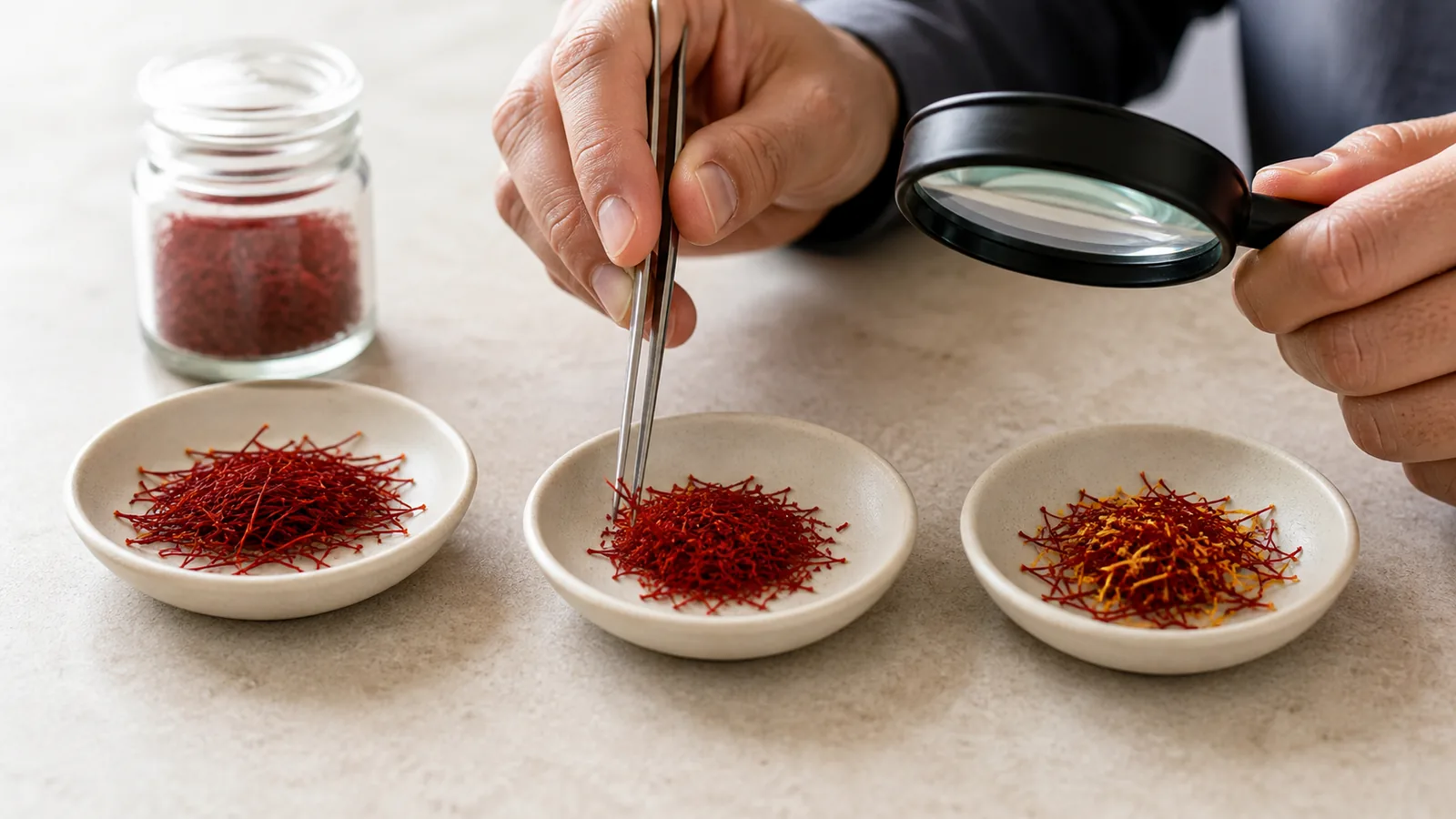
Types of Saffron can mean several different things. A seller may be describing how much red stigma and pale style is present, whether the threads are whole or cut, where the crop was grown, or how a particular lot performed in laboratory testing. These are related details, but they are not interchangeable.
For most buyers, the useful starting point is physical form. Long all-red threads, shorter red tips, red-and-yellow filaments, a complete bundle and powder can all come from the same plant, Crocus sativus. No type name guarantees quality by itself. Freshness, drying, storage, purity and measured colouring strength still decide how the saffron performs.
What does “saffron type” describe?
A saffron type may describe the cut made after the flower is harvested. The flower’s pistil has three red stigma branches joined to a yellow-to-white style. Processors can keep that structure together, retain only a small portion of style, separate long red filaments, or collect shorter red tips.
It may also describe a regional trade tradition. Iran uses names such as Dasteh, Pushal, Sargol and Negin. Spanish trade includes terms such as Coupé and Mancha. The registered Kashmir Saffron geographical indication describes Lachha, Mongra and Guchhi forms. A regional name should be read in its own specification rather than forced into a universal ranking.
The standard process for saffron
The standard process for saffron begins with harvesting fresh Crocus sativus flowers. The stigma and style are separated from the petals and stamens, trimmed or arranged for the intended form, then dried. The dried material is cleaned, graded, packed and protected from moisture, light, heat and strong surrounding odours.
Thread type is decided mainly during separation and trimming. Quality can change during drying and storage. A well-shaped red thread may still be stale or damp; a less decorative cut can still have useful colour and aroma when it has been processed and stored carefully.
Iranian saffron types
Dasteh, Dokhtarpich or Bunch
Dasteh keeps the red stigma and a substantial length of pale style together in a small bundle. Dokhtarpich is another Iranian name; Bunch, Batch and Red & White appear in English trade. The old page called this “bolt daughter Saffron,” a machine-translation error for Dokhtarpich.
That page described the bundle as roughly 70 to 75 percent red and 25 to 30 percent pale material and called it “standard Iranian Persian saffron strands” or “grade 4.” Those proportions and the grade number were not tied to a cited standard. They can explain the old listing, but they should not be treated as a guarantee for every Bunch lot.
Pushal
Pushal contains red stigma with a small yellow or orange portion of style attached. It sits visually between the complete Dasteh structure and the all-red forms. The visible transition can be useful when examining morphology, although it does not replace authenticity testing.
Sargol or All-Red
Sargol is made from red stigma material after the pale style is removed. It is widely called All-Red saffron and often consists of shorter or broken tips. Coupé is a cut, all-red term found in Spanish and international trade, but contracts should not assume every supplier uses Sargol and Coupé to mean exactly the same specification.
The old article described workers cutting away yellow parts with scissors and using static electricity to clean the red material. Manual trimming, sieving, airflow and specialised separation equipment are all possible. The result matters more than a promotional description of the machine: the lot should be clean, correctly labelled and within its agreed physical limits.
Negin and Super Negin
Negin is selected for long, intact, separated red filaments. Super Negin is a further commercial selection for particularly even presentation. Neither word is a complete laboratory grade. Buyers should define length, style allowance, broken-thread tolerance, moisture and chemical requirements instead of relying on the name alone.
Style, Konj or white saffron
The pale part left after red stigma is removed may be called Style, Konj, root, white Persian saffron or cream. “Root” is only a market nickname; the tissue did not grow underground. Style alone is not equivalent to the red stigma product expected when a buyer orders all-red saffron.
The former page said the pale portion had zero crocin, then suggested its apparent aroma came from absorbing more moisture. Both ideas were stated too absolutely. The red stigma is the main source of colouring compounds and the pale style generally contributes much less colouring strength, but composition varies by sample and method. Smell or moisture absorption cannot prove that style is stronger.
Our detailed guide to how Iranian saffron types are produced explains those trims and their post-harvest relationship more fully.
Spanish saffron terms
Spanish trade regulations have long used names including Azafrán Coupé and Azafrán Mancha. Coupé describes a strong all-red cut. Mancha requires more care because the word can appear as a market class while La Mancha also names a protected geographical origin.
A package sold as Azafrán de La Mancha is making an origin claim governed by that protected specification. It should not be inferred merely from a Spanish packer, a Spanish-language label or the word “Mancha” used loosely in trade.
Kashmir saffron forms
India’s registered Kashmir Saffron GI identifies three traditional presentations. Lachha has stigmas separated from the flower and dried without the further traditional processing used for Mongra. Mongra is the detached red stigma form produced by further processing Lachha. Guchhi is related to Lachha but arranged as a bundle rather than packed loose.
These names belong to Kashmir’s own production and GI context. They should not be casually translated into Iranian grade labels, and the name does not replace proof that the crop came from the registered region.
Origin is not a quality grade
Iran, India, Spain, Afghanistan, Greece, Morocco and Italy all produce genuine Crocus sativus saffron. Origin can influence farming and processing traditions, but no country name proves that an individual jar is pure, fresh or strong. Nor does a darker-looking thread automatically outrank a lighter one.
A protected-origin scheme can establish where and how a product was made. A laboratory certificate can describe the tested lot. Those are different forms of evidence. The strongest buying decision uses both when origin is commercially important.
Whole threads, cut threads and powder
Codex CXS 351-2022 uses three straightforward product forms: filaments, cut filaments and powder, while allowing other distinctly different styles when they are labelled accordingly. This vocabulary travels more easily across borders than local names.
- Filaments preserve thread shape and make visual inspection easier.
- Cut filaments may be all red and perform well, even when they lack the presentation value of long threads.
- Powder disperses quickly in food production but hides morphology, so supplier traceability and testing matter more.
None of the three says how powerful, clean or fresh the lot is. Form belongs on the label; quality belongs in the specification and test result.
Type and grade are not the same
Crocin-related colouring strength, picrocrocin-related bitterness and safranal-related aroma are commonly associated with saffron quality testing. Moisture, foreign matter and other identity or safety parameters also matter. The type tells a buyer what part and shape to expect; the grade tells the buyer whether measured requirements were met.
The old article claimed that Bunch saffron necessarily had much lower colouring power because drying was delayed and that part of its quality was lost during that process. More pale style can reduce average colouring strength, and poor drying can damage any type, but neither outcome is automatic. The actual processing record and laboratory result are the fair test.
For the measurement side, see our guide to Iranian saffron standards.
How to choose the right type
Choose long Negin-style threads when visual presentation is important. Select an all-red cut such as Sargol when consistent infusion matters more than thread length. Pushal and Dasteh make the red-to-pale flower structure visible. Use powder when rapid dispersion is required and the supply chain is strong enough to verify it.
Ask the seller to state origin, harvest or packing date, physical form, style allowance, moisture limit, test method and lot number. Those details are more useful than a private label such as “premium,” “grade 4” or “best saffron.”
Sources and review note
This page was reviewed on 28 August 2026 against an open peer-reviewed study of Iranian saffron type classification, the official Kashmir Saffron GI record and its published specification, Spain’s official saffron export-quality regulation, and the FAO/WHO Codex standards register for CXS 351-2022. Local trade names vary, so this guide avoids turning them into unsupported universal rankings.

![Exporting Saffron to Turkey + Price Guide [Complete 0 to 100]](https://img.rowhanisaffron.com/20260827003933/saffron-export-turkey-quality-inspection.webp)



