


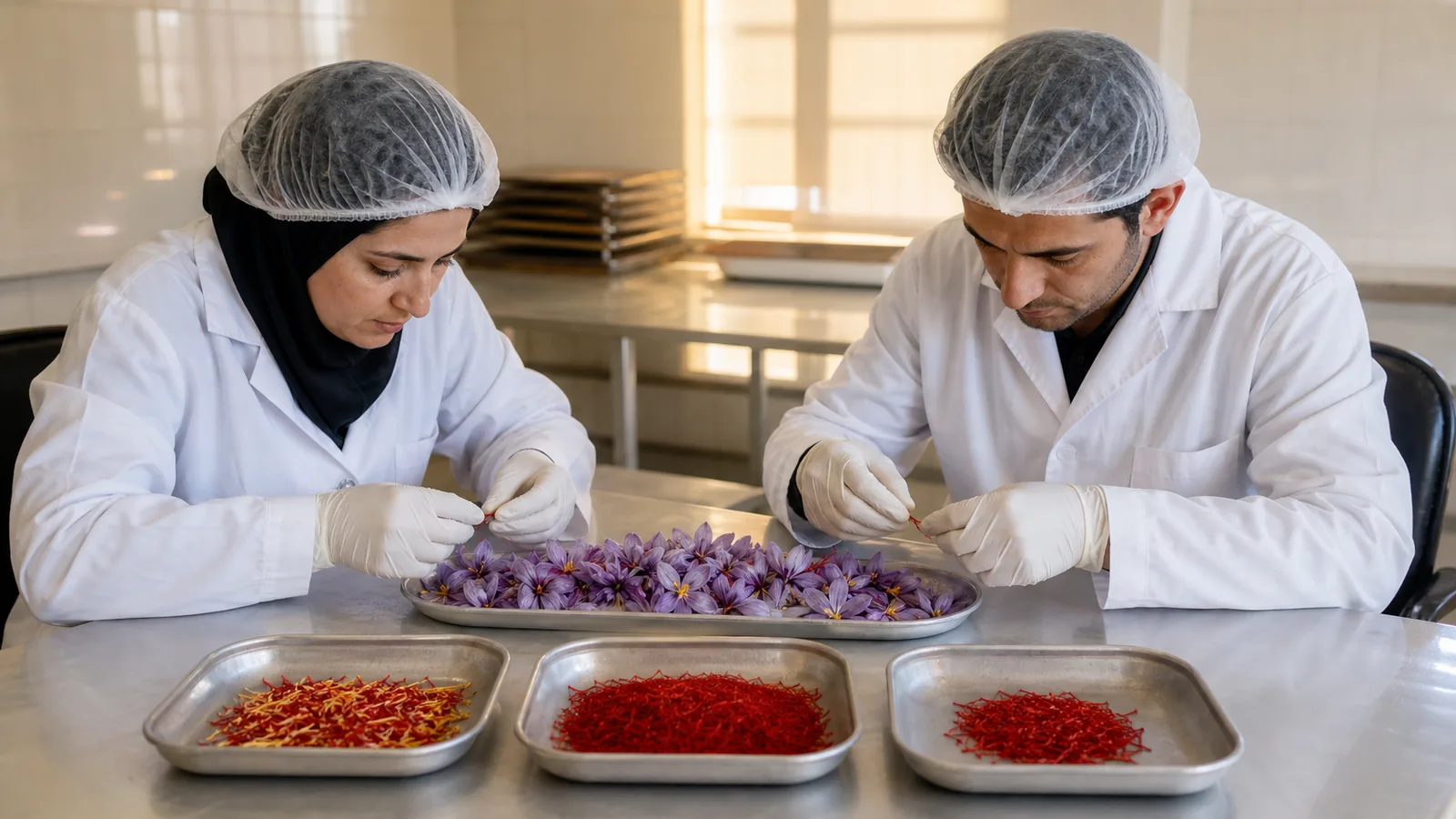
Types of saffron production in Iran are usually names for the way the harvested stigma is separated and trimmed, not different saffron species. Sargol, Negin, Pushal and Dasteh all come from Crocus sativus. What changes is how much of the red stigma remains intact, whether a portion of the pale style is attached, and how the threads are arranged after drying.
This is the key to understanding Iranian saffron types, sometimes searched as types of kesar. A long, intact red thread may be sold as Negin; shorter all-red pieces may be called Sargol; red stigma with some style can be Pushal; and the complete stigma-and-style bundle is Dasteh or Bunch. Those market names describe appearance. Laboratory quality still depends on the actual lot.
The search phrase “Iran saffron production” can also mean national output statistics. Here it means the production process and the physical forms a saffron producer creates after harvest; current volume data are linked separately below.
How is saffron produced?
Iranian saffron starts with corms planted in prepared ground. Crocus sativus does not produce a useful seed crop, so growers propagate it through daughter corms. Once established, the plants flower in autumn. The flowers are collected and moved quickly for separation because fresh floral tissue is delicate.
Each flower carries a pistil that ends in three red stigma branches joined to a paler style. Workers separate that structure from the petals and stamens, then trim or arrange it according to the intended commercial form. The material is dried under controlled conditions, cleaned, checked and packed away from moisture and light. Drying is not a minor finishing step: time and temperature influence colour, bitterness, aroma and storage stability.
The crop itself takes months of field work, but the type name is largely decided in the short post-harvest window. Our saffron cultivation guide covers the field side in more detail. This article concentrates on what processors produce from the harvested flowers.
The anatomy behind Iranian saffron types
The red stigma is rich in the compounds buyers associate with saffron: crocins contribute colouring strength, picrocrocin contributes bitterness and safranal is an important aroma compound. The style beneath it changes from orange or yellow to cream and white. Including more style changes the appearance, bulk and average colouring potential of the finished material.
That does not make every red-only lot excellent or every lot with style poor. Age, drying, storage, moisture, cleanliness, adulteration and the chemistry of the starting crop all matter. A commercial trim and a measured grade answer different questions.
Dasteh, Dokhtarpich or Bunch saffron
Dasteh is also known in Iran as Dokhtarpich and abroad as Bunch, Batch or Red & White saffron. The stigma and a substantial portion of the style remain together, and the pieces are arranged in a small bundle. This form makes the red-to-pale transition easy to see and keeps the flower structure recognisable.
The older version of this page gave a rule of thumb of about 70 to 75 percent red material and 25 to 30 percent pale “root” or “corner.” Those words were mistranslations of the style portion, and the percentages were not tied to a cited national or international specification. They are best treated as a traditional description, not a guaranteed composition for every Dasteh lot.
Pushal saffron
Pushal keeps the red stigma with a small yellow or orange section of style attached. Compared with Dasteh, much less pale tissue remains and the threads are not presented as the same complete red-and-white bundle. Research on Iranian commercial forms recognises Pushal alongside Sargol and Negin as one of the main visible classes.
The attached transition can help a buyer see that the red portion belongs to a real saffron stigma, but appearance alone does not prove authenticity. Pushal can be clean and strong, or weak and badly stored. It still needs the same lot-specific checks as another form.
Sargol, All-Red and Coupé saffron
Sargol consists of red stigma material with the pale style removed. It is commonly described in English as All-Red saffron. The older article also used the French and Spanish trade word coupé, meaning cut, for a comparable all-red presentation. These terms may overlap in trade, but a contract should state the physical and chemical specification rather than assume the names are perfectly interchangeable everywhere.
Sargol often contains shorter or broken red pieces because the stigma tips are separated during processing. The earlier page described cutting away yellow sections with scissors and cleaning the red material using static electricity. Manual trimming, sieving, airflow and specialised cleaning equipment can all be used; the exact process varies by facility. The important result is clean red stigma material without hidden foreign matter.
Negin and Super Negin saffron
Negin is an all-red presentation selected for longer, more intact and visibly separated stigma branches. In current research, the distinction from Sargol is mainly physical: Negin retains long whole filaments, while Sargol contains more short or broken red pieces. The threads should not be clumped by excess moisture.
Super Negin is a commercial selection term used for particularly long, even, well-separated material. It is not a universal scientific grade by itself. Two suppliers can apply the label to different specifications, so buyers should ask for measurable limits and a representative sample.
Style, Konj or white saffron
When processors remove the red stigma, the remaining yellow-to-white style may be called Style, Konj, root, white saffron, creamy style or, in some older English listings, white Persian saffron. Botanically it is part of the flower’s pistil, but it is not equivalent to the red stigma sold for strong colour and flavour. Calling it “root” is inaccurate because it never grew underground.
The former page said style had no crocin at all, then tried to explain reports of a stronger fragrance through moisture absorption. That absolute statement is not dependable across every sample or method. The sound conclusion is narrower: pale style generally has far less colouring value than red stigma, and smell alone cannot establish its chemical quality. A style-only product must not be represented as an equivalent all-red saffron lot.
Filaments, cut filaments and powder
International standards use simpler product-form language than the Iranian trade. Codex recognises saffron offered as filaments, cut filaments or powder, with other distinctly different styles allowed when properly labelled. A shipment can therefore have both a market name such as Sargol and a formal description such as cut filaments.
Powder can be made by grinding suitable dried saffron forms. It disperses quickly, but the buyer cannot inspect thread shape, the red-to-yellow transition or broken material. Traceability and laboratory testing become especially important.
A type name is not a quality certificate
Some factories divide their own products into levels 1, 2 and 3; others use 1 through 4 or letters such as A, B and C. These labels are internal unless a published specification defines them. The old article correctly questioned treating private factory scales as one Iranian national language.
That article hoped the Institute of Standards, the Exporters Association and other parts of the trade would establish shared terminology. Current national, ISO and Codex work provides a stronger specification framework, but private market names still need to be translated into measurable contract terms.
For international trade, ISO 3632 testing is widely referenced for characteristics associated with colour, bitterness and aroma. Codex CXS 351-2022 also sets identity, quality and safety provisions for dried saffron. FAO’s current work with Mashhad University notes that routine ISO tests do not capture every subtle quality difference or sophisticated adulteration, which is why advanced authenticity methods and better post-harvest practice are still being developed.
A useful purchase specification combines the trade type with measurable terms:
- whole, cut or powdered form and the accepted Iranian trim name;
- limits for style, floral waste, foreign matter and moisture;
- test method and minimum results for relevant quality characteristics;
- harvest or packing date, lot identity and storage conditions;
- authenticity and contaminant testing appropriate to the market.
Our explanation of Iranian saffron standards covers the specification layer. For production volumes and regional statistics, use the separate saffron production statistics page; those figures are a different intent from the processing types described here.
Choosing among the types
Choose Dasteh when seeing the complete stigma-and-style structure matters. Pushal offers mostly red stigma with a small visible transition. Sargol is useful when the buyer wants all-red material and accepts shorter cuts. Negin is chosen for long, separated red filaments and a more uniform visual presentation. Powder is convenient for formulation but demands stronger supplier controls.
None of those names removes the need to inspect and test the lot. The best Iranian saffron type is the one whose physical form suits the intended use and whose documented quality matches the contract.
Sources and review note
This article was reviewed on 28 August 2026 against a peer-reviewed machine-vision study of Sargol, Negin, Pushal and Dasteh, a Food Chemistry study of six Iranian saffron trims, the FAO/WHO Codex standards register for CXS 351-2022, and FAO’s current Iran authenticity programme. Trade names can vary between sellers, so the lot specification remains decisive.

![Exporting Saffron to Turkey + Price Guide [Complete 0 to 100]](https://img.rowhanisaffron.com/20260827003933/saffron-export-turkey-quality-inspection.webp)



