


Saffron production statistics are often reduced to one headline: Iran grows roughly 90% of the world’s saffron. That is a useful starting point, but it is not a live global census. Production estimates, export records and cultivated-area reports measure different things, and figures copied from one year into another quickly become misleading.
A peer-reviewed study published in December 2025 describes Iran as the source of approximately 90% of global saffron, or about 439 tonnes of dried stigmas per year. That is the clearest recent figure we found, and it is broadly consistent with Iran’s long-standing position as the world’s dominant producer. It should still be read as an estimate from the research literature, not as a continuously updated official total.
Saffron production statistics at a glance
- Largest producer: Iran, by a very wide margin.
- Recent research estimate: approximately 439 tonnes of dried saffron per year from Iran, representing around 90% of global output.
- Main Iranian growing regions: Razavi Khorasan and South Khorasan remain the centre of commercial production.
- Other established producing countries: India, Greece, Spain, Morocco and Turkey. Cultivation has also expanded in Afghanistan, the United States, South Africa and other suitable regions.
- Important limitation: there is no single, complete annual country table that makes every production estimate directly comparable.
These points answer the broad questions “which country produces the most saffron?” and “how much saffron does Iran produce?” Readers looking for saffron production by country should be wary of a precise top-ten ranking that has no year or shared dataset. A country may cultivate saffron, process imported saffron, or export saffron without appearing in the same position in each type of record.
What the recent 90% figure actually means
The 2025 Scientific Reports study examined organic and conventional fields in Razavi Khorasan and South Khorasan. Its introduction states that approximately 90%, or 439 tonnes per year, of the world’s dried saffron originates in Iran. The paper also identifies Iran, India, Italy, Greece, Spain, Morocco and Turkey as historical producers, while noting newer cultivation in countries including Afghanistan, the United States and South Africa.
That evidence supports saying Iran is the biggest saffron producer in the world. It does not mean every harvest is exactly 439 tonnes or that Iran’s share is permanently fixed at 90%. Weather, corm condition, field age, irrigation, labour availability and the area actually harvested can all change output from one season to the next.
For a closer look at cultivation inside the country, see our guide to saffron production in Iran.
Why published estimates range from 90% to 95%
Claims that Iran produces 90%, 92%, 94% or 95% of the world’s saffron are not necessarily describing the same harvest. Several differences can move the percentage:
- the calendar year or crop year being measured;
- whether the number is a forecast, a harvested total or a later estimate;
- whether “production” means dried stigmas, flowers collected or another stage of processing;
- whether planted land or land actually harvested is used;
- how smaller producing countries are estimated;
- whether a trade figure has been mistaken for a farm-production figure.
This is why we retain the rounded wording “about 90%” for the current picture. A more exact percentage can look authoritative while quietly combining figures from different sources or years.
The historical figures behind this article
This page was first published in October 2013. Its original report described an Iranian harvest of more than 250 tonnes and attributed over 95% of world supply to Iran at that time. It also referred to roughly 75,000 hectares of saffron farms in the Khorasan provinces, a previous harvest above 240 tonnes, and an expectation that production would reach about 250 tonnes after heat and dry conditions reduced an earlier 300-tonne forecast.
The same report said saffron cultivation had spread beyond the two Khorasan provinces into a total of 15 Iranian provinces, with national cultivated area reaching about 83,000 hectares. It named provinces including Yazd, Isfahan, Kerman, East Azerbaijan, Tehran, Markazi, Qom and Semnan. Those details are preserved here as a dated snapshot of the industry, not presented as current acreage.
Its customs section reported 111,552 kilograms of saffron and saffron powder exported during the first ten months of the reporting year. The translated copy rendered the associated value as $349,551,622 and discussed a five-percent tariff on packages above 30 grams. We have not found the archived customs table needed to verify that translated value, punctuation or tariff wording, so none of those figures should be used as a current price or rule.
Production is not the same as exports
Production measures what farms harvest. Export data records goods crossing a customs border. The two totals can differ because saffron may be stored and sold in a later year, imported and re-exported, or classified under a customs code that does not reveal the harvest location.
For example, the UN Comtrade public record for Iran lists 262,974 kilograms and US$154.3 million of exports under HS 091020 in 2021. That is a trade record, not a 2021 production total. The absence of an Iranian row for a later year in the public preview also does not prove that exports stopped; it means the dataset has no comparable row to report.
Spain and the United Arab Emirates have long been important destinations and trading centres for Iranian saffron. Saffron can be sorted, packaged or marketed again after import, which helps explain why export-country lists and producing-country lists do not always match. Our article on choosing a saffron exporter in Iran explains the origin and documentation questions that matter to buyers.
Why Khorasan remains central
Razavi Khorasan and South Khorasan combine suitable dry conditions with generations of specialised knowledge. The recent field study cited above sampled 14 farms across locations including Torbat Heydarieh, Gonabad, Fariman, Birjand and Darmian. That concentration of farms, processing skill and trading infrastructure is why Khorasan appears so often in Iranian saffron production statistics.
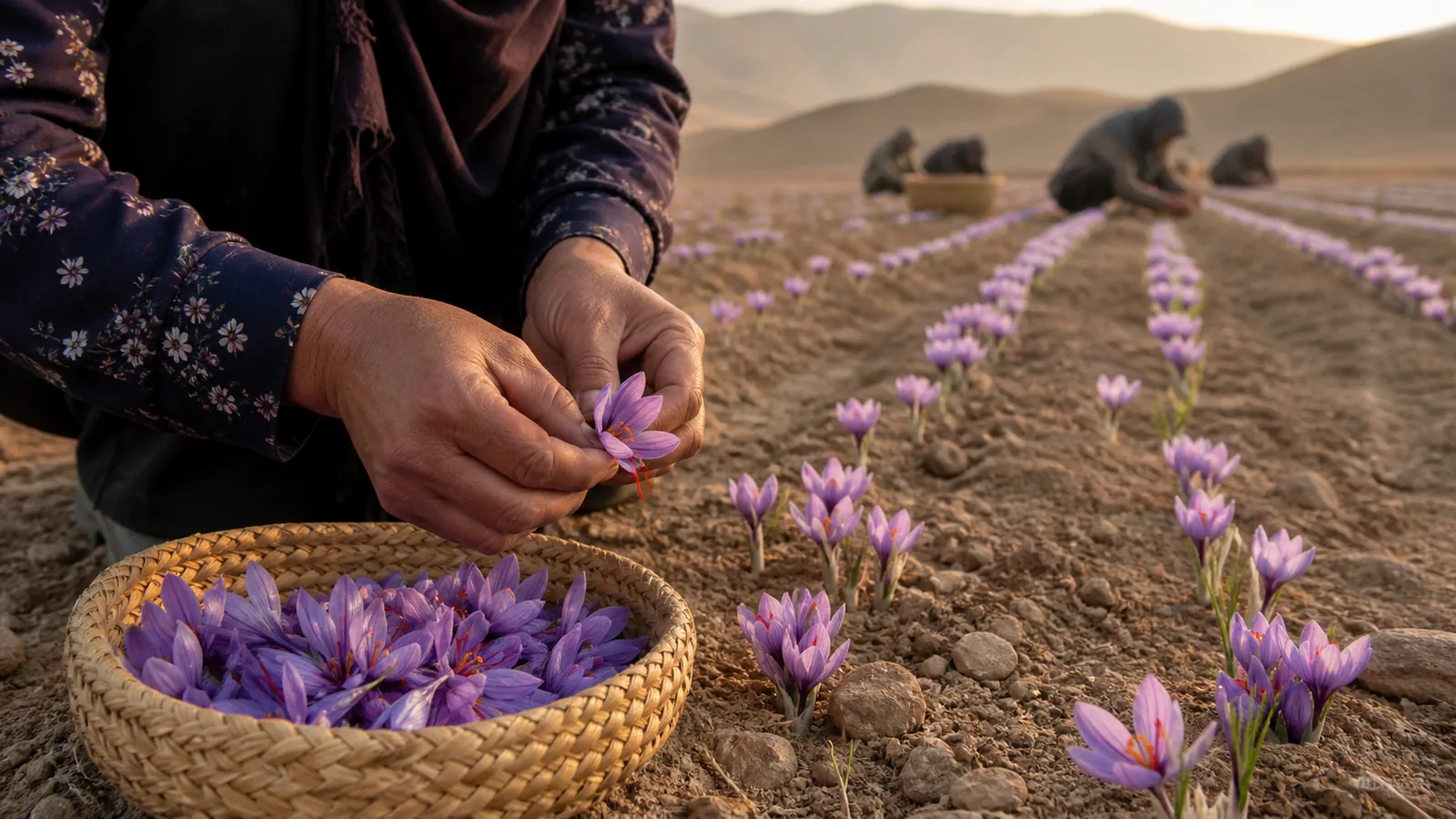
Harvesting is still labour-intensive. Crocus flowers open during a short autumn season, are collected by hand, and their three red stigmas must be separated and dried carefully. Mechanisation can help with some field operations, but the delicate flower and stigma work places a practical limit on how quickly genuine saffron can be produced.
How to interpret saffron yield per hectare
Yield should be calculated as kilograms of dried stigma divided by hectares actually harvested. It should not be calculated from flower weight, planted area that has not yet produced, or export volume. Those mismatches are a common reason two reports appear to disagree.
There is no honest universal figure for saffron yield per hectare or per acre. A young field may produce differently from an established one, and results vary with corm size, planting density, irrigation, soil, temperature, disease pressure and harvest timing. A regional report of three or five kilograms per hectare can describe that place and season without setting a worldwide standard.
How to use country rankings responsibly
A defensible summary is simple: Iran is the leading producer; Khorasan is its main production centre; India and several Mediterranean and North African countries have established industries; and Afghanistan has become a notable newer producer. Beyond that, a “top 5” or “top 10 saffron-producing countries” list needs a named year and a consistent source for every country.
It is also worth checking the commodity itself. English-language datasets sometimes group spices together, while ordinary search results may confuse true saffron (Crocus sativus) with safflower or turmeric. Neither substitute belongs in true-saffron production totals.
Source and review note
We reviewed this article on 28 August 2026. The current production estimate comes from the open-access paper “Organic versus conventional saffron production: apocarotenoid content and heavy metal contamination in Iran”, published in Scientific Reports on 5 December 2025. Trade figures use the official UN Comtrade record linked above. Historical 2012–2013 figures are clearly identified so they remain useful without being mistaken for current saffron production statistics.

![Exporting Saffron to Turkey + Price Guide [Complete 0 to 100]](https://img.rowhanisaffron.com/20260827003933/saffron-export-turkey-quality-inspection.webp)



