


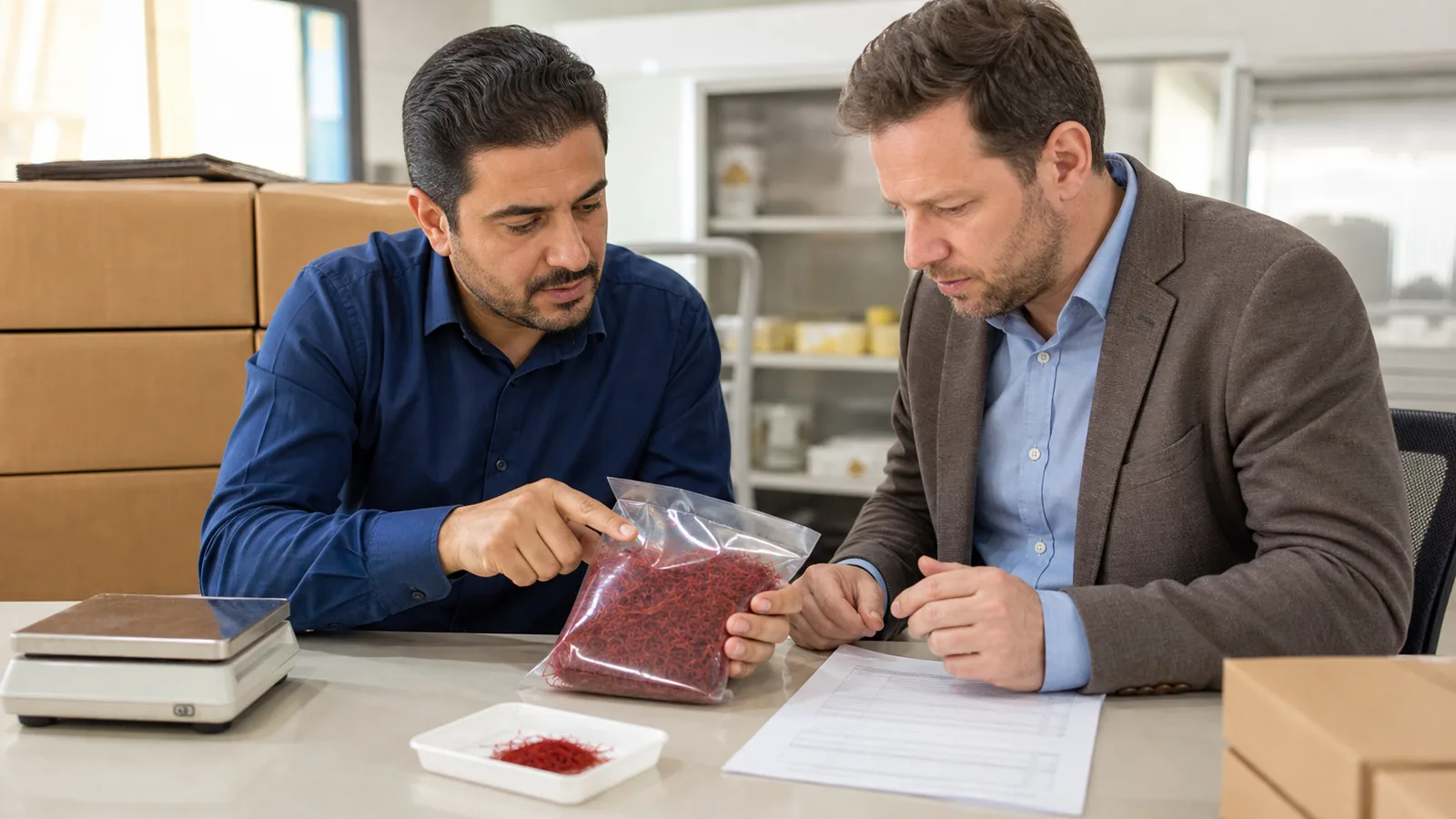
A dependable saffron exporter in Iran should be able to identify the exact lot, explain the trade grade in measurable terms, provide relevant test results and prepare the documents required for the buyer’s destination. A Mashhad address or a premium-sounding grade name can be useful context, but neither proves quality on its own.
The original reports behind this article describe Khorasan’s role in production and trade, rising export activity, bulk versus packaged sales and the prominence of Dasteh and Negin saffron. This guide preserves that history while turning it into a practical way to assess an exporter today.
Why Mashhad became a saffron export hub
Mashhad sits close to Iran’s main saffron-growing belt and developed into a collection, grading, packing and trading centre. Growers and traders from Razavi Khorasan, South Khorasan and places such as Qaen bring product into the wider regional market. This concentration makes it easier to assemble commercial lots and arrange export services.
The scale is documented in Iran’s 2017 proposal to the FAO/WHO Codex Committee on Spices and Culinary Herbs. For the 2014–2015 crop year, the Ministry of Agriculture-Jahad figures in that document assign 218.348 tonnes to Razavi Khorasan, 48.019 tonnes to South Khorasan and 2.640 tonnes to North Khorasan. These are historical production figures, but they explain why Mashhad became an important trading centre.
Location is not a quality certificate. Saffron offered in Mashhad can come from different farms, crop years and handling systems. The buyer still needs evidence for the lot being purchased.
What the old export figures actually show
The destination report said saffron exports through Khorasan customs increased by 12% over the preceding comparison period. It did not preserve the dates, weight, value or customs series behind that percentage, so the claim cannot be expanded into a national annual result.
The source page contains another garbled comparison: 80,472 kilograms followed by 104,921 kilograms, a numerical increase of about 30.4%. The text discusses both production and exports without identifying which measure the figures belong to. They cannot represent Iran’s total production, because the official 2014–2015 record gives 218,348 kilograms for Razavi Khorasan alone and 280,323 kilograms nationally.
The defensible reading is narrow: an old report recorded a tracked saffron quantity rising from 80,472 to 104,921 kilograms, but the surviving translation does not establish whether it was export volume, a regional total or another period-specific measure. It is preserved here as an unresolved historical figure, not relabelled as production.
For scale, the same Iranian Codex proposal reports national exports of 158.794 tonnes worth $227.629 million in 2014 and 121.573 tonnes worth $165.303 million in 2015, citing the Iran Customs Office. Those completed-year totals should not be mixed with the page’s undated 12% or 30.4% comparisons.
Dasteh, Negin and the meaning of a grade name
The old articles identify Dasteh and Negin among the main forms sold for export. Dasteh, sometimes called bunch saffron, generally keeps red stigmas attached to a visible portion of the pale style and presents them in a bundle. Negin usually describes separated, predominantly red filaments selected for appearance. Actual specifications vary among sellers.
These trade names are not enough for a contract. The current Codex saffron standard CXS 351-2022, amended in 2025, distinguishes styles such as filaments, cut filaments and powder and sets physical and chemical requirements. A commercial grade should therefore be translated into a sample, a written specification and test results rather than accepted as a name alone.
Bulk saffron versus export-ready packaging
The destination observed that bulk exports were more developed than Iranian retail packaging and branding. That does not make every bulk shipment weak or every small package superior. A food manufacturer may legitimately need a tested bulk lot, while a retailer needs consumer-ready packs that meet the destination’s label and net-content rules.
In either case, packaging should protect the saffron from moisture, contamination, crushing and unnecessary light exposure. The seal and lot code should connect the container to the supplier’s records. Codex also requires an accurate declaration of contents and appropriate labelling; non-retail containers have their own labelling framework.
Evidence to request from a saffron exporter in Iran
Before approving an order, ask for evidence that belongs to the offered lot:
- a representative sample and a written description of style or commercial grade;
- crop or packing date, stated origin and a lot identifier;
- a recent certificate of analysis from an appropriate laboratory;
- the agreed physical and chemical specification, including any applicable ISO or Codex criteria;
- contaminant, pesticide, microbiological or authenticity tests required by the destination or buyer;
- net weight, pack material, label artwork and carton configuration;
- commercial invoice, packing list and origin documentation; and
- health, phytosanitary or other official documents when the route requires them.
A certificate is useful only when its sample can be traced to the shipment. Check the laboratory, report date, method, lot number and result units. A generic certificate displayed for every product page does not establish the quality of the lot in front of you.
A practical buying sequence
Start with intended use and destination rules. Define the filament style or powder requirement, target specification, pack size and quantity. Ask the exporter to quote against that brief, then compare the sample and certificate with the written offer.
Once the product is accepted, confirm price terms, Incoterm, payment method, production lead time, inspection point and responsibility for rejected goods. Match the final packing list and lot numbers to the approved sample before dispatch. Our guide to the rules for exporting saffron covers the route-specific document check in more detail.
The best reason to work with a Khorasan-based exporter is access to the supply chain and export experience. The best reason to choose one exporter over another is stronger lot evidence, clearer terms and consistent delivery.

![Exporting Saffron to Turkey + Price Guide [Complete 0 to 100]](https://img.rowhanisaffron.com/20260827003933/saffron-export-turkey-quality-inspection.webp)



