


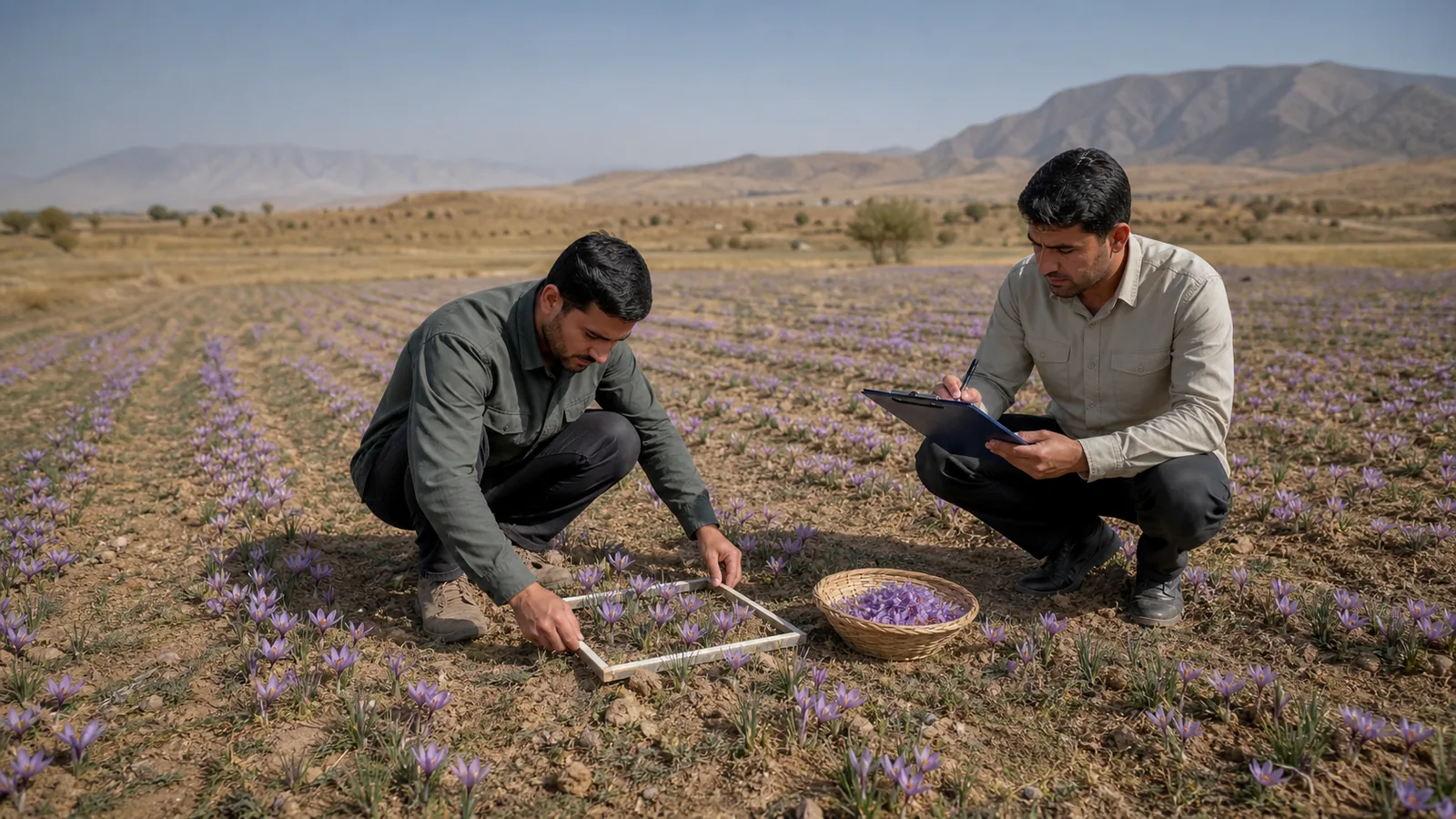
Production 5kg saffron per hectare is achievable in some established fields, but it is not a universal farm average or a first-year promise. This page began with a 2015 report from Sirjan County. Ahmad Masoudi, then identified as the county’s agricultural director, said more than five kilograms per hectare could be harvested in years four, five and six when climate was suitable and field operations were timely.
That statement needs its full setting. The article described about 50 hectares under saffron in Sirjan, mainly around Homa Shahr, and named Balvard, Pariz, Malekabad, parts of the outskirts and Zeidabad as areas considered suitable. It did not report measured production from all 50 hectares, a sample method or a current yield benchmark.
The useful question is therefore not “Does saffron produce five kilograms everywhere?” It is “What would have to be measured before five kilograms per hectare is a defensible result?”
What five kilograms per hectare means
A hectare is 10,000 square metres. Five kilograms of dry saffron equals 0.5 grams per square metre, or about 2.02 kilograms per acre. The figure should refer to the dried stigma product after flowers have been picked, stigmas separated and moisture removed—not fresh flowers or wet threads.
The old Sirjan report did not specify the drying endpoint or whether yellow style portions, rejected material or unsold stock were included. That matters. A farm can produce an impressive fresh-flower weight and still deliver less accepted dry saffron after separation, drying, sorting and testing.
Flower count offers another way to see the workload. A commonly cited production range is around 150 to 170 flowers for one gram of dried saffron, although flowers and stigmas vary. At that range, five kilograms would require roughly 750,000 to 850,000 flowers. Our detailed explanation of how many flowers make one gram of saffron shows why the number is an estimate rather than a fixed conversion.
The 2015 Sirjan report
The article attributed the information to the Kavir regional branch of the Iranian Students News Agency (ISNA). Masoudi said Sirjan had about 50 hectares of saffron fields, with most of the area in Homa Shahr.
The original Persian place names were damaged in the old English translation. They are Homa Shahr, Balvard, Pariz, Malekabad and Zeidabad—not “druse,” “underflow” or “property Islamabad.” Masoudi also referred to parts of the wider Sirjan outskirts.
He described saffron as a useful alternative for a water-scarce county because it generally needs less irrigation than many competing crops. He connected the crop with local employment, saying labour demand was concentrated around planting and harvest.
All of this is a historical account. The 50-hectare figure, site assessment, labour statement and five-kilogram claim should not be read as a 2026 Sirjan survey. A field that was suitable in broad climate terms may still have poor drainage, saline water, diseased corms or an uneconomic labour situation.
Why field age changes the result
Saffron is a perennial corm crop. A newly planted mother corm produces flowers and daughter corms, and the underground population changes each season. The first crop may be light. Flowering can rise as the stand establishes, then crowding, smaller daughter corms, disease pressure and uneven nutrition may pull performance down.
Masoudi specifically placed the more-than-five-kilogram outcome in harvest years four through six. That may have reflected the fields and system he knew, but it should not be applied to every planting.
A six-year field study found that year and corm-size interactions significantly affected saffron performance. Flowering increased from the first to the third year, then declined in the fifth and sixth years in that experiment. Larger corms yielded more during the first three years, while smaller corms performed differently later. The study’s central lesson is not that one season is always best; it is that corm size, environment and field age interact.
Another Iranian field experiment reported dry-stigma yield rising from less than one kilogram per hectare in a one-year field to 4.09 kilograms in a three-year field under the strongest treatment combination. Those figures do not set a ceiling. They show why a target needs its planting stock, density and age attached.
Five kilograms sits inside a very wide research range
A broad scientific review reported saffron stigma yields from about 2 to 28 kilograms per hectare across different studies and production environments. The spread is too wide to use as a promise. It reflects differences in climate, corm origin and size, density, field age, irrigation, fertility, disease, harvest, drying and measurement.
A five-kilogram result is therefore plausible without being automatic. An exceptional research plot is not a county average, and a county statement is not a guaranteed result for a particular farm. Compare like with like: dry stigma yield, same field age, similar area basis, known management and a clear harvest year.
Sirjan’s locations still need field-level checks
Homa Shahr, Balvard, Pariz, Malekabad and Zeidabad cover different elevations and local conditions. A regional statement about suitable climate and soil cannot replace an assessment of the planting block.
Saffron needs a seasonal thermal rhythm: flower initiation develops during the warm resting phase, then cooler autumn conditions help bring on emergence. Soil should drain well enough to protect corms from prolonged saturation. Water quality, rooting depth, slope, prior crop and disease history can differ between neighbouring fields.
Use the site guide to weather and climate for planting saffron, then check local records. A small trial with soil, temperature, water and yield measurements is safer than treating the word “Sirjan” as an agronomic certificate.
The planting and harvest calendar
Masoudi placed Sirjan planting from the second half of Shahrivar through the end of Mehr, roughly September into late October. He placed harvest from the second half of Aban into early Azar, roughly November into early December. The Iranian calendar wording should be retained because Gregorian dates shift slightly and weather does not follow a fixed page.
The dates are also unusually late for some saffron systems. Corms already forming roots or shoots can be damaged by delayed handling, while local growers may use different lifting and planting schedules. The 2015 statement records Sirjan practice as described by the official; it is not a universal instruction to keep dormant corms out of the soil until October.
For a current field, inspect corm stage and local soil temperature before setting a schedule. Plan labour and clean drying space before flowering starts. Once flowers emerge, a calendar cannot create extra picking capacity.
Lower water use does not mean no water
Saffron’s active growth occurs during the cooler part of the year, which can make it attractive in water-limited rotations. It may use less irrigation than some summer crops. Still, the crop depends on stored soil moisture, rain and well-timed irrigation during critical stages.
Too little water around emergence or during leaf and daughter-corm development can limit the current and following crop. Too much water, especially in poorly drained soil, can increase corm-health problems. The correct schedule changes with rainfall, soil texture, salinity, field age and irrigation method.
A three-year study in Qaen evaluated sprinkler, drip, furrow and basin irrigation and measured differences in dry stigma yield, quality and water-use efficiency. Other semi-arid research found that reducing irrigation to 50% of the studied water requirement lowered flower number and dry stigma yield in the second year compared with higher treatments. The evidence supports managed water, not a no-irrigation slogan.
How to measure hectare yield correctly
Use the planted, productive area—not the whole property or an expected expansion. If only part of a hectare flowers, record that area separately. Do not multiply the best square metre by 10,000 and call it a completed harvest.
For each field and season, keep a short production record:
- mapped productive area and field age;
- corm source, size range, planted weight or count, density and planting date;
- rainfall and every irrigation date and amount;
- first flower, peak period, final harvest and whole flowers collected;
- fresh stigma weight, drying method, final dry weight and moisture endpoint;
- grade, rejected material, tested quality and accepted saleable weight;
- labour hours for picking, separation, drying and packing.
If yield is estimated from sample plots, choose them before seeing the crop and include weak as well as strong parts of the field. Report the sampling method and uncertainty. Whole-field accepted dry weight is more useful for a business decision than a perfect-looking quadrat.
The current ISO 3632-1 saffron specification applies to dried filaments, cut filaments and powder. Meeting a production weight does not establish purity or quality; testing and buyer specifications still determine what portion is saleable.
What tends to move a field toward the target
Start with healthy, traceable corms suited to the system. Larger corms can improve early flowering, but size does not overcome rot, poor drainage or unsuitable temperature. Density changes the number of plants competing for space and affects how daughter corms develop over time.
Prepare the soil around an actual test rather than a generic fertiliser recipe. Watch emergence and leaf growth, investigate weak patches, control weeds without damaging the crop, and diagnose corm symptoms before choosing a treatment. Harvest flowers promptly, separate stigmas cleanly and dry them consistently.
“Timely operations,” the phrase used in the Sirjan report, means coordinating the whole chain. Planting on a recommended date will not rescue a field if flowers wait in warm piles or dried saffron absorbs moisture in storage.
Labour and finance belong in the hectare calculation
Masoudi said saffron created useful local employment, especially during planting and harvest. The crop’s short flowering window does concentrate work. Picking is only the visible part: flowers must be moved, opened, separated and dried without a delay that harms quality.
Five kilograms of dry saffron can represent hundreds of thousands of flowers. Before expanding area, a farm needs a realistic daily labour plan for the peak, clean workspace, drying capacity, records and a route to market. Gross kilograms do not show wages, corm cost, water, rejected material or the price actually received.
The final sentence of the old translation referred to growers who had not obtained financial facilities in the previous planting period and said planning would be made for the current year so required facilities could be paid. The source is grammatically incomplete and provides no programme name, amount, eligibility rule or outcome. It remains a 2015 announcement, not evidence that finance is available now.
Reading the Sirjan five-kilogram claim correctly
Production 5kg saffron per hectare is best treated as a mature-field target reported for suitable Sirjan conditions in 2015. It was tied to years four, five and six, timely work and local climate. It was not stated as the measured average of all 50 hectares.
A grower can use five kilograms as a planning scenario, then test every assumption: productive area, field age, corms, water, flower count, drying loss, accepted quality, labour and realised price. Keep the annual record even when the result is lower. A defensible three-kilogram harvest teaches more than an unsupported five-kilogram promise.
Ahmad Masoudi’s role, ISNA/Kavir attribution, 50-hectare area, Homa Shahr concentration, Balvard/Pariz/Malekabad/outskirts/Zeidabad suitability, Shahrivar–Mehr planting, Aban–Azar harvest, years-four-to-six five-kilogram claim, lower-water comparison, employment and incomplete finance statement are retained from the 2015 report. No current Sirjan area, yield or support programme is inferred. Sources were reviewed on 29 August 2026.

![Exporting Saffron to Turkey + Price Guide [Complete 0 to 100]](https://img.rowhanisaffron.com/20260827003933/saffron-export-turkey-quality-inspection.webp)



