


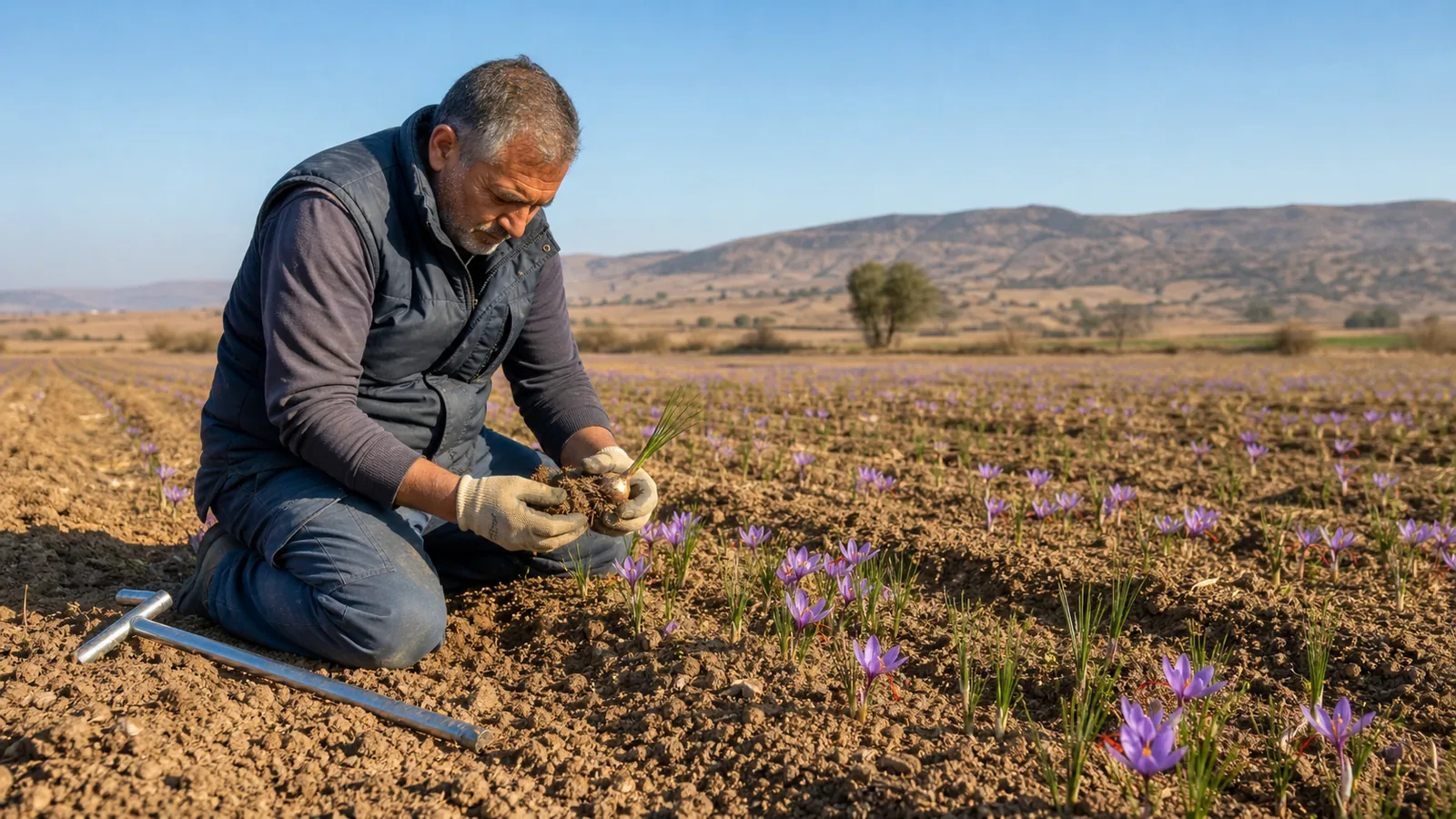
Good weather for planting saffron combines a dry, warm summer dormancy with cooler autumn conditions, enough moisture to start growth, and soil that drains quickly. Saffron does not need one exact climate or altitude, but it does react strongly to the timing of heat and water. A sunny field can suit the crop; the same field may fail if corms sit in wet soil.
The familiar description—mild winters, hot summers and dry areas—captures the seasonal rhythm of many successful saffron regions. It should not be treated as a rigid subtropical formula. Crocus sativus is grown from Iran and Afghanistan to Mediterranean countries, the Himalaya and cooler Alpine sites. Local soil, drainage and management decide whether the weather pattern is genuinely workable.
What weather does saffron need?
Saffron follows a cycle that is almost the reverse of many garden crops. The corm rests underground in summer. Floral development takes place during that dormant period, shoots emerge as conditions cool, flowers appear in autumn, and the leaves continue growing through the cooler season before dying back in spring.
That cycle explains the basic climate preference:
- Summer: warm and comparatively dry, without prolonged saturation around dormant corms;
- Early autumn: cooling temperatures and carefully timed moisture to support emergence and flowering;
- Winter and spring: a cool growing period with enough water for the leaves and daughter corms, but free drainage around the root zone;
- Year-round: good light, aerated soil and no standing water.
A recent climatic-suitability study reports that warm conditions support floral induction during summer dormancy and cites roughly 23–27°C as favourable for that stage, with autumn flowering associated with cooler temperatures. Those are useful biological reference points, not a weather guarantee for a field.
How much heat can saffron tolerate?
The original version of this article gave 35–40°C as the plant’s maximum temperature range. Published cultivation reviews also describe saffron surviving upper temperatures around that range. Survival, floral induction and best yield are different questions, however. A corm under dry soil can tolerate heat that would stress actively growing leaves or cause trouble when combined with wet, poorly drained soil.
It is therefore safer to assess the whole annual pattern than to ask whether one summer maximum is below 35 or 40°C. Duration matters. So do soil temperature, planting depth, moisture and the timing of the heat in relation to dormancy.
Does saffron need a mild winter?
Mild winters can work well, but cold weather alone does not disqualify a site. Saffron’s vegetative growth naturally occurs during the cool part of the year, and established cultivation trials include sites with winter frost and snow. The corm does not need a cold winter to end summer dormancy in the way a spring bulb may need chilling.
The practical hazards are severe exposed conditions, repeated freeze-and-thaw at an unsuitable planting depth, and waterlogged soil. Cold wind can add stress or damage exposed flowers, so a sheltered field may be useful, but a solid barrier that shades the crop or traps humid air creates a different problem.
Summer rainfall and irrigation
The old article said rainfall or irrigation during the summer rest period is harmful. The concern behind that sentence is real: heavy summer rainfall and persistent moisture can favour corm rot, mites and soil-borne disease. It is the duration and drainage of the moisture, not the mere existence of one summer watering, that matters.
Modern field research does not support a universal “never irrigate in summer” rule. Some production systems use limited late-summer water to help synchronise development, followed by irrigation at planting, before flowering or during vegetative growth as local conditions require. A grower should base that choice on soil moisture, drainage, disease history and regional advice rather than a calendar copied from another climate.
What about humid regions such as Gilan and Mazandaran?
The original text named Gilan and Mazandaran because their humid, rainier conditions contrast with the dry saffron areas of Khorasan. That does not mean every location in those provinces is impossible. It means a grower cannot assume that a crop adapted to an arid or semi-arid system will behave the same way in a wet coastal field.
In a humid area, inspect the site after sustained rain. Raised beds, a slope that safely sheds excess water and a friable soil profile may reduce risk. A hollow that remains saturated, a compacted layer beneath the bed, or a high water table is a poor choice regardless of annual rainfall totals. Small local trials are more sensible than committing a large field on a climate label alone.
Sun, shade and wind
Open sun is the dependable starting point for saffron. Good light supports the leaves while they replenish the corm after flowering. A planting that is heavily shaded during winter and spring may produce weak growth even if summer shade seems attractive.
The old account noted saffron growing near barberry bushes around Birjand and Ghaen, and with almond trees around Gonabad. Those examples can be plausible because deciduous plants, row spacing and irrigation layout change the amount and timing of shade. They do not establish a general rule that planting under trees improves saffron. Check the canopy during the crop’s active season, as well as competition for water and the machinery or hand access needed for harvest.
Is 1,300 to 2,300 metres the ideal altitude?
The previous article gave 1,300–2,300 meters above sea level as a high-performing range. Many established saffron districts do sit at moderate or high elevation, including parts of Khorasan and the western Himalaya. Altitude can bring useful day-night temperature variation, lower humidity and a distinct seasonal cycle.
It is not a universal planting requirement. Peer-reviewed trials have produced saffron at Alpine locations from 560 to 1,000 metres, while a western Himalayan study recorded its strongest result at 2,195 metres under that trial’s particular temperature, rainfall and humidity. Elevation is a proxy for local climate, not a substitute for measuring it.
Choose planting weather, not only a planting date
In the northern hemisphere, dormant corms are commonly planted in summer before autumn emergence. The exact month varies with climate, production system and corm source. The useful planting window is when the soil is workable and not saturated, there is enough time for establishment, and planned irrigation can be controlled.
Do not plant into mud simply because the calendar says it is time. Avoid damaged or diseased corms, and do not leave healthy corms exposed to extreme heat for longer than necessary. Weather cannot compensate for poor planting material.
A practical field-weather check
Before deciding that a site has good weather for planting saffron, review several years of monthly data rather than one pleasant season. Then walk the actual field. Ask:
- Is summer normally dry enough for dormancy, and can exceptional rain drain away?
- Do autumn temperatures fall in time for emergence and flowering?
- Is water available when establishment and leaf growth require it?
- Will the field receive good winter and spring sunlight?
- Does water disappear through the soil profile rather than pooling above a compacted layer?
- Are frost pockets, hot reflected walls or damaging winds creating a microclimate unlike the nearest weather station?
Climate is only the first screen. Soil texture, planting depth, corm size, disease pressure and crop management affect the result alongside weather. Our full guide to saffron cultivation and growing conditions brings those field factors together.
Sources and review note
We reviewed this article on 28 August 2026. Seasonal climate and temperature context comes from the peer-reviewed climatic-suitability analysis for Crocus sativus and the western Himalaya agro-climatic field study. The range of successful elevations is also informed by the Alpine cultivation trial. FAO’s description of the Qanat-based saffron farming system in Gonabad supports the Iranian arid-climate and water-management context. Recommendations still need to be adapted to the field and local agricultural guidance.

![Exporting Saffron to Turkey + Price Guide [Complete 0 to 100]](https://img.rowhanisaffron.com/20260827003933/saffron-export-turkey-quality-inspection.webp)



