


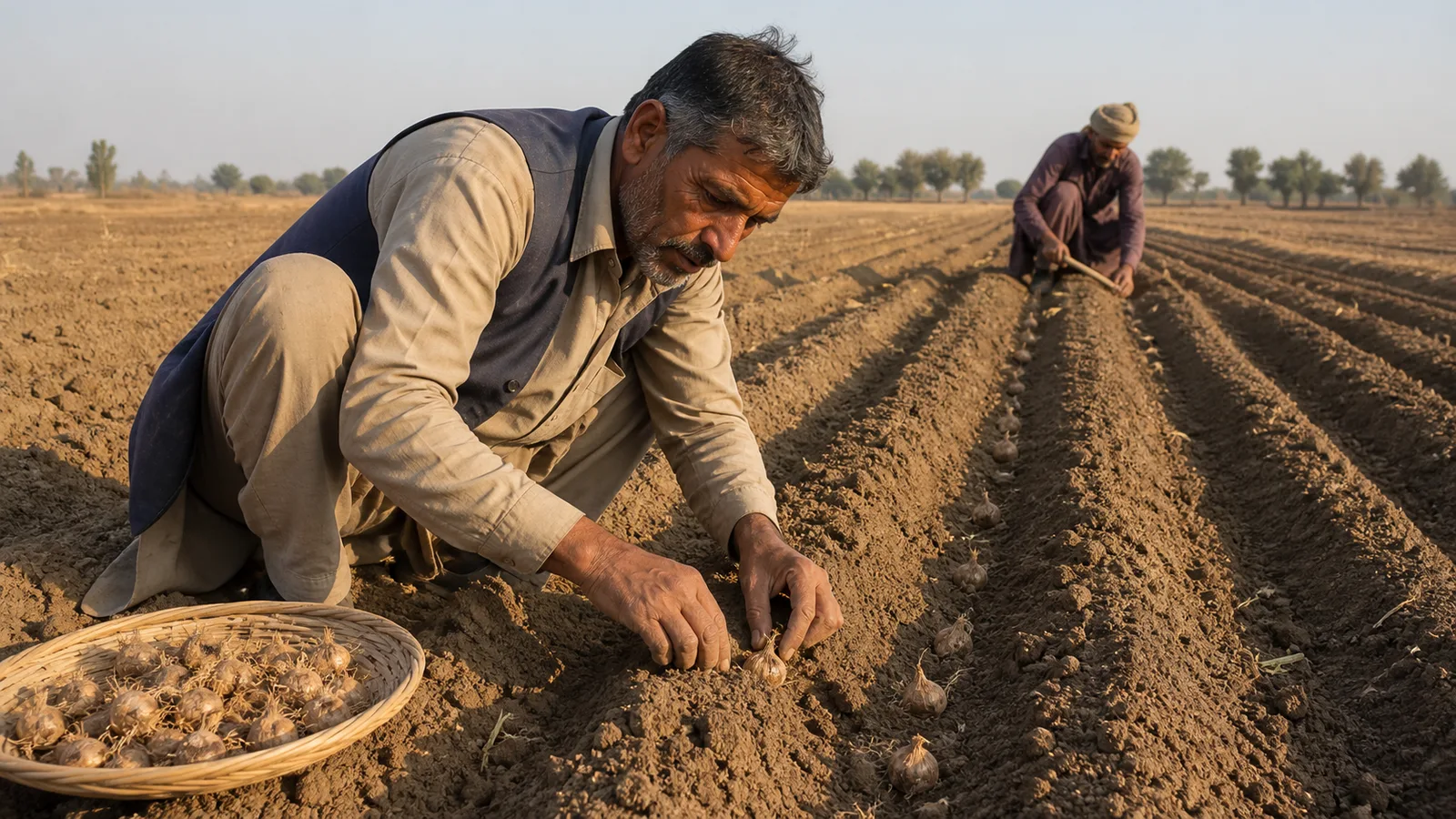
Successful saffron cultivation starts with healthy corms, free-draining soil and a calendar built around autumn flowering. Saffron does not grow from commercial “saffron seed.” Crocus sativus is sterile and is propagated by planting corms, the compact underground storage organs often sold as saffron bulbs. Larger, sound corms usually flower more reliably than small ones, but planting depth, climate, soil and irrigation still have to work together.
There is no single spacing, depth or planting month that is best everywhere. A dry Iranian field, a rainy European garden and a controlled greenhouse have different risks. Use the principles below, then adapt the numbers through local soil tests, climate records, clean planting material and small field trials.
Saffron plant botany
Crocus sativus L. is an accepted species in the iris family, Iridaceae. It is a perennial geophyte: the visible leaves and flowers come and go, while its life cycle continues below ground through corms. The plant has no conventional above-ground stem.
A mature planting corm is roughly spherical to slightly flattened and may measure about 3–5 centimetres across, although commercial lots are often graded by weight or circumference. A dry brown fibrous tunic covers the corm. Short fibrous roots emerge around its base, while buds at the top produce leaves, flowers and replacement corms.
Each plant commonly makes several narrow, grass-like leaves. Counts and length vary with corm size and growing conditions; descriptions often report about 6–9 leaves, while larger plants may produce more. A pale membranous sheath protects the emerging leaves and flower as they move through the soil.
The flower and the part sold as saffron
Saffron normally flowers in autumn. Its purple flower has six similar-looking tepals—three botanically derived from sepals and three from petals—plus three yellow anthers. In the centre, the style divides into three red to red-orange stigma branches. Each branch is often about 2–3 centimetres long.
Those three stigmas, sometimes with a limited portion of the style depending on the product grade, are separated and dried to make commercial saffron. Petals and yellow stamens are not saffron spice. This small usable portion of each flower explains much of the harvest labour.
Why saffron is planted as corms, not seeds
Saffron is a sterile triploid and does not produce fertile seed. It multiplies vegetatively: the planted mother corm supports the season’s growth and forms daughter corms that carry the planting forward. Calling saffron a “triennial plant” is incorrect. A bed can remain productive for several years, but the corm itself renews through daughter corms rather than simply becoming seven years old.
Climate and site selection
The classic saffron cycle suits places with a dry dormant summer, autumn moisture that triggers growth, cool flowering weather and a winter-spring leaf period. It can tolerate cold, but the safe minimum depends on soil drainage, snow cover, planting depth and local material. Persistent summer wetness and waterlogged soil are often more damaging than dry heat.
Choose an open site with good light and air movement. Avoid hollows where water stands or cold, wet air settles. In high-rainfall climates, raised beds or ridges may be more important than copying the deep planting used in a dry region.
Soil requirements for saffron cultivation
A loam or sandy loam with good structure is convenient, but texture alone does not decide success. The root zone must drain after irrigation or rain while retaining enough moisture for autumn growth. Heavy clay can work only when structure and drainage are corrected; very coarse sand may need organic matter and more careful water management. Salinity and corm rot risk should be assessed before planting.
The previous guide prescribed pH 7–8 as a universal target. Saffron is grown across a wider range, and published guidance differs by soil and region. Test the field rather than adding lime automatically. Correct severe constraints according to a laboratory result and local agronomic advice.
Prepare the bed before corms arrive
Break compaction, remove perennial weeds and create a level or gently raised planting surface. If a soil test and local practice support compost or well-decomposed manure, incorporate it before planting. Do not place fresh manure directly against corms, and do not apply an unexplained “10–20 tons” after they are already in the ground. Nutrient amounts need a per-area unit, analysis and crop plan.
Avoid moving saffron immediately back into a field with unresolved corm disease. Rotation, clean tools, drainage and healthy planting stock are more useful than simply requiring that land has never grown saffron.
Choose healthy saffron corms
Select firm corms with an intact brown tunic and no soft areas, mould, rot, unusual lesions or insect damage. Keep lots from different suppliers separate until their health is known. Do not strip protective tunics aggressively or cut clustered corms in a way that creates wounds.
Size matters because a corm’s stored reserves support emergence and flowering. A 2024 planting-depth and corm-size experiment found larger corms generally produced more biomass and daughter corms, with the result modified by planting depth. That evidence supports grading by measurable size or weight—not the old claim that a bulb should be “at least seven years old.”
When to plant saffron
Plant during the dormant period with enough time for roots to establish before autumn flowering. Depending on latitude and climate, published seasons extend from late spring through early autumn. The former July-to-October window may fit some areas but is too late in others. Use local flowering dates and soil temperature rather than a global calendar.
Store lifted corms in a dry, ventilated, shaded place only as long as necessary. Heat, trapped humidity and poor airflow reduce planting quality.
Planting depth, spacing and layout
Rows or beds make weeding, irrigation and lifting easier than irregular holes. Place each corm with its growing point upward and maintain an even depth. Wider spacing favours larger daughter corms and easier access; higher density can increase early flower yield per area but creates competition and crowding later.
Field studies commonly test depths between 10 and 20 centimetres. Results are not identical. A 2019 Iranian field experiment indexed by FAO AGRIS found higher flower and stigma yield at 10 centimetres in its conditions, while the 2024 experiment found 15-centimetre planting gave the highest emergence across its tested corm sizes. Deeper planting can protect corms from temperature swings but delay emergence or reduce multiplication; shallow planting can expose them to heat, frost, drying and cultivation damage.
For that reason, do not copy the old prescription of 15–20 centimetres or 3–15 corms per hole without testing the local system. Match depth to corm size, soil texture, winter conditions, rainfall, bed design and how many years the field will remain in place.
What to expect in the first year
A new bed may flower weakly or unevenly in its first autumn, especially when corms are small, planted late or placed too deeply. Deep planting can delay emergence because the shoot must travel farther and the soil environment differs. The source attributed late leaves to unsettled soil; it is safer to assess corm size, depth, planting date, moisture and health rather than assume soil settlement is the cause.
Irrigation and seasonal care
Saffron needs moisture at the right time, not continuously wet soil. In dry production regions, a planned autumn irrigation helps initiate growth; later water supports leaves and daughter-corm development. In wet climates, rainfall may supply much or all of this. Stop treating a fixed irrigation schedule as universal and monitor the root zone.
Control weeds while they are small, using methods that do not injure shallow shoots or corms. Inspect poor patches for rot, pests, compaction or drainage failure before adding fertilizer. Leaves should remain until they yellow naturally because they replenish the daughter corms for the next season.
Harvest flowers and protect quality
Pick flowers promptly, preferably during the cool part of the day, and keep them in shallow clean containers. Separate stigmas soon after harvest. Dry them under a controlled, repeatable process and protect the finished saffron from moisture, light, heat and foreign odours. The current international product specification, ISO 3632-1:2025, applies to dried saffron in filament, cut-filament and powder forms and includes storage and transport recommendations.
How long can a saffron field remain productive?
A planting can produce for several years, but “4–10 years” is a broad range, not a promise. Daughter corms multiply, crowding increases, disease pressure can build and yields change. Record flowers and dried stigma by area each year. Lift, grade, treat or discard corms according to crop-health guidance, and replant when declining yield, crowding or disease makes renewal worthwhile.
Premium saffron begins before the flower opens. The strongest cultivation plan uses measurable corm quality, site-specific depth and density, sound drainage, well-timed water and rapid clean handling. A fixed recipe copied from another climate cannot replace those decisions.

![Exporting Saffron to Turkey + Price Guide [Complete 0 to 100]](https://img.rowhanisaffron.com/20260827003933/saffron-export-turkey-quality-inspection.webp)



