


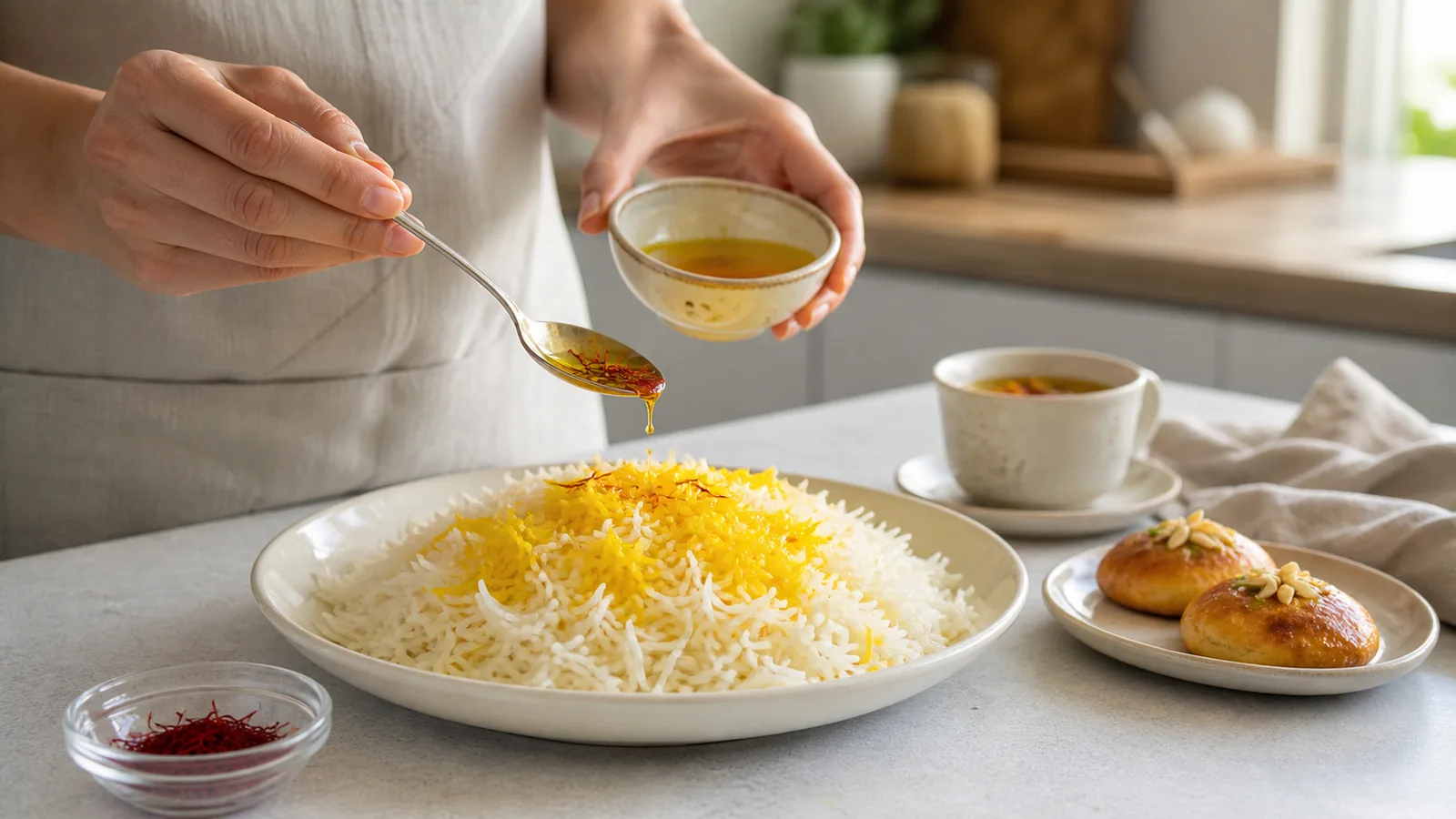
Uses of Iranian saffron range from everyday rice and celebratory sweets to restaurant sauces, bakery products and carefully formulated drinks. The reason is simple: a small amount can bring colour, aroma and a gentle bitterness at the same time. Iranian origin describes where the saffron was grown and processed; it does not restrict the spice to Iranian recipes. Good whole threads can be used wherever genuine saffron is called for.
The most practical uses remain culinary. Saffron works particularly well with rice, dairy, sugar, mild broths and foods that give its aroma room to develop. It can also be used in commercial food production, but a manufacturer has to validate flavour, colour, stability, labelling and cost for the finished product rather than treating saffron as a drop-in replacement for every synthetic colour.
First, prepare saffron so it can do its job
Whole threads do not release all their character the instant they touch a dish. Crush a small pinch gently, steep it in a little warm water, milk or stock, then add both liquid and saffron to the recipe. Ten to twenty minutes is enough for many home dishes. Avoid a hard, prolonged boil at the start; heat and time can flatten the more delicate aroma.
When the dish cooks for a long time, reserve part of the infusion for the later stages. This gives the food time to take on colour while keeping more of the fragrance noticeable at serving. Our detailed guide to using saffron in cooking covers grinding, blooming and timing for different recipes.
Iranian food and sweets
In Iranian kitchens, saffron often appears where colour and fragrance mark a special meal. It is spooned over steamed rice, stirred into rice dishes and used with chicken. Soups and broths can take a small amount, especially when their other seasonings are restrained enough for saffron to remain distinct.
Desserts are another natural home. Saffron suits rice pudding, halva, custards, ice cream and cakes, and it pairs comfortably with rose water, cardamom, pistachio and almond. The old version of this page referred broadly to Iranian desserts, fillings and many kinds of saffron cake. Those uses remain valid, but each preparation needs its own balance: too much rose water can hide the saffron, while too much saffron can make a delicate sweet noticeably bitter.
For a straightforward savoury starting point, see our saffron rice method. It shows how a modest infusion can colour part of the rice and then be folded through the rest rather than saturating the whole pot.
Rice dishes beyond Iran
Saffron has travelled through several food cultures, and rice is a recurring theme. Indian cooking uses it in biryani, pulao, kheer and festive milk sweets. Arabic and Gulf kitchens use saffron in rice, meat and sweet dishes; Arabic coffee may combine it with cardamom. These are living traditions with many regional and household variations, not one standard recipe.
In northern Italy, saffron is central to risotto alla Milanese. It also appears in rice cookery in southern Switzerland. Spain is closely associated with saffron in paella, where the spice supports the rice and stock rather than acting as a loud standalone flavour. France uses it in dishes including bouillabaisse and other seafood preparations.
The earlier article called Indians and Arabs the world’s largest saffron consumers, but it supplied no comparable consumption dataset. It is safer to say that Indian, Iranian, Arab and Mediterranean cuisines all have well-established saffron traditions. Cultural importance and measured national consumption are different claims.
Seafood, chicken, soups and sauces
Saffron is useful in foods with enough moisture to carry an infusion. Add it to fish soup, shellfish broth, a light cream sauce or chicken stock. Garlic, onion and tomato can sit beside it, but very smoky or aggressively hot flavours tend to dominate it. The aim is not to make every mouthful taste strongly of saffron; it is to build a warm aromatic layer through the dish.
For seafood, bloom the threads separately and add the liquid after the base has developed. With chicken, saffron can go into a marinade, braising liquid or finishing sauce. In soup, taste before adding more. Colour develops quickly and is a poor guide to how much aroma the finished bowl will retain.
Dairy, baking and confectionery
Milk and cream soften saffron’s bitter edge and carry its aroma, which explains its use in butter, cheese, ice cream, custard and milk drinks. In baking, an infusion distributes more evenly than dry threads. Saffron is used in cakes, biscuits, cookies, enriched breads and seasonal buns in several European traditions, including Britain and parts of Germany and Scandinavia.
Confectioners may use it in chocolate, candy, jelly and filled sweets. The result depends on the base: dark chocolate can overwhelm a light dose, whereas white chocolate, almond and dairy leave more space for saffron. Breadcrumbs were also named in the former article. They can be coloured or flavoured, although this is a specialised formulation rather than a common household use.
Drinks and fermented products
Saffron can flavour tea, coffee, milk, syrups and non-alcoholic drinks. Arabic coffee with cardamom is one familiar example. In India and Iran, saffron also appears in milk-based drinks and tea preparations. Start lightly and allow the infusion to disperse before judging it; a drink can turn bitter faster than a large pot of rice.
The old article said that saffron was used in “wine fermentations” in large amounts and connected wine with Arab consumers. That wording was both unsupported and culturally careless. Saffron is used in some alcoholic drinks, liqueurs and fermented beverage research, but it is not a general feature of Arab cuisine, and “large amounts” is not a safe or useful formulation rule.
How the food industry uses saffron
Food manufacturers use whole saffron, powder or standardised preparations for flavour and colour. Bakery mixes, dairy products, beverages, jellies, chocolate and confectionery are plausible applications. The previous page also listed sausages and margarine. Those products can be formulated with saffron, but their appearance in old promotional copy does not show that the practice is widespread today.
Commercial work needs more control than a home recipe. A producer must define the saffron form, dose, dispersion method, heat exposure, shelf life and target colour. The batch should meet an appropriate identity and quality specification. The Codex standard for dried saffron covers whole threads, cut threads and powder, while laboratory methods can evaluate colour, aroma, moisture and extraneous matter.
Calling saffron “natural” does not remove normal food-safety or labelling duties, and natural is not automatically a health claim. In the United States, FDA guidance lists Crocus sativus saffron as a spice and explains that spices which also colour food may require declaration as a spice and colouring or by their common name, depending on the use. Other markets have their own rules.
Uses outside food
Saffron has a long history as a textile and artistic colourant, and its aroma and pigments have prompted use in perfumery and cosmetics. Cost and stability limit many large-scale applications. Today, researchers also study saffron compounds for pharmaceutical and nutraceutical products, but a concentrated extract or supplement is not equivalent to seasoning food with a few threads.
This article does not infer a treatment effect from culinary use. Health questions require evidence for the exact preparation and dose, and anyone considering a concentrated saffron product should follow its instructions and seek qualified medical advice where appropriate.
Choosing the right form for the job
- Whole threads are easy to inspect and suit rice, tea, broths and dishes where blooming is practical.
- Powder disperses quickly in doughs and industrial mixtures, but purity is harder to judge visually.
- Infusions distribute colour and aroma evenly in rice, sauces, dairy and drinks.
- Standardised extracts may help commercial consistency, provided the specification and permitted use are clear.
Whatever the form, protect saffron from light, moisture, heat and strong surrounding odours. Buy only enough for a reasonable turnover, keep the container sealed, and label commercial stock by lot. The best use is the one that lets a small quantity remain recognisable in the finished food without forcing colour, bitterness or cost beyond what the recipe needs.
Sources and review note
This page was reviewed on 28 August 2026 against the FAO/WHO Codex standards register (CXS 351-2022, Standard for Dried Floral Parts—Saffron), the FDA spice list, the FDA Food Labeling Guide and a peer-reviewed review of saffron composition, quality control and culinary uses. Regional dish examples are descriptive; they are not claims that every household or producer follows the same recipe.

![Exporting Saffron to Turkey + Price Guide [Complete 0 to 100]](https://img.rowhanisaffron.com/20260827003933/saffron-export-turkey-quality-inspection.webp)



