Compositional analysis of Iranian saffron asks what the dried stigmas contain and how those components are measured. Chemical analysis often begins with three closely related groups of compounds: crocins for colour, picrocrocin for bitterness and safranal for aroma. They are the spice’s best-known markers, but they are not its whole composition. Dried saffron stigmas also contain carbohydrates, protein and amino acids, small amounts of lipids, minerals, water and many minor plant compounds.
That distinction matters when reading a laboratory report. A vivid red thread does not have one fixed chemical formula, and an origin label such as “Iranian saffron” does not guarantee identical values from every farm or harvest. Variety within authentic material is normal. Quality is judged from a defined sample, a stated method and several measurements considered together.
The three compounds that define saffron’s sensory character
Crocins: colour that moves into water
Crocins are water-soluble glycosylated derivatives of crocetin. They give a saffron infusion its strong yellow-to-golden colour even though the dry stigmas look deep red. The word crocin is often used as though it names a single substance, but saffron contains a family of cis- and trans-crocins. One commonly cited member has the molecular formula C44H64O24.
The original version of this article also listed alpha-carotene, beta-carotene, lycopene and anthocyanins among saffron pigments. Those broader pigment classes have been reported in the plant, but crocins are the distinctive water-soluble colour markers used when the dried spice is assessed. A crocin result should therefore be read as a measured quality characteristic, not as the percentage of all material in the sample.
That version also quoted crocin at 9.1 to 15 percent without identifying the sample, whether the material was fresh or dry, or the analytical method. Because “crocin” may refer to a family of related compounds and methods do not always produce directly comparable figures, this old range should not be treated as a specification for Iranian saffron.
Picrocrocin: the bitter principle
Picrocrocin is the monoterpene glycoside most closely associated with saffron’s characteristic bitter taste. Its molecular formula is C16H26O7. It also sits in the pathway that produces aroma: during drying and storage, picrocrocin can break down and contribute to the formation of safranal.
This relationship explains why processing cannot be judged by chasing one number. Drying needs to remove moisture promptly, yet temperature and time influence the balance between colour, taste and aroma compounds. A fragrant batch is not automatically a strong-colouring batch, and aroma alone cannot establish purity.
The former article gave a picrocrocin melting point of 156 °C and said fresh material contained 4 percent. It did not identify the reference material, sampling basis or test method. The first value belongs to compound characterisation, while the second cannot safely be generalised to a commercial lot; neither replaces a result from the sample being assessed.
Safranal: the leading aroma compound
Safranal is a volatile monoterpene aldehyde and a major contributor to saffron’s recognisable aroma. Its correct molecular formula is C10H14O. The earlier text on this page gave C10H16O; that formula has been corrected.
Iranian saffron contains many other volatile compounds as well. A gas chromatography–mass spectrometry study of Iranian samples identified 40 constituents representing 90 percent of the measured peak area in that experiment, with safranal the largest single peak at 26.29 percent. That is a result for the analysed volatile extract, not a claim that one quarter of every saffron thread is safranal.
What else is present in dried saffron?
The bulk material surrounding those signature compounds includes several ordinary plant components:
- Carbohydrates: simple sugars and larger polysaccharides form a substantial part of the dry matter. Published estimates vary with the sample and the analytical definition, so the old statement that sugars are merely “more than 20 percent” is too imprecise to serve as a specification.
- Protein and amino acids: saffron contains both, although they are not the measures normally used to describe colour, aroma or commercial grade.
- Lipids and sterols: these occur in comparatively small amounts. They should not be confused with saffron’s volatile aroma fraction.
- Minerals: potassium is commonly prominent, with calcium, magnesium, phosphorus, sodium and trace elements also reported. The old list “K2O, Na2O, P2O2, Cl2” mixed questionable formula notation with a composition claim; laboratories normally report individual elements or ions with units and a validated method.
- Vitamins and minor phytochemicals: the literature reports small amounts of B-group vitamins and compounds such as flavonoids. Thiamine is vitamin B1 and riboflavin is vitamin B2; they are not two names for the same vitamin.
- Moisture and volatile matter: even dried stigmas retain some water. Moisture control affects stability, mass and the risk of deterioration during storage.
These categories describe the spice more honestly than a universal percentage chart. Published composition tables often combine results from different origins, harvests and test methods. They are useful as context, but they are not a substitute for a certificate from the actual lot being sold.
Why Iranian saffron does not have one fixed profile
Soil, climate, growing location, harvest timing and agronomic practice can influence a plant’s chemistry. The changes continue after picking. The interval before drying, drying temperature, exposure to oxygen and light, packaging, humidity, storage time and grinding can all affect the compounds ultimately measured.
Research can sometimes distinguish geographic groups using stable isotope ratios and trace-element patterns. In one study, authentic samples from Iran and Spain could be separated statistically from their isotope and element profiles. Later work comparing Iranian and Chinese samples also found useful regional differences. These are population-level laboratory models, however. They do not mean a buyer can confirm origin from colour, smell or a single mineral result.
How laboratories analyse saffron
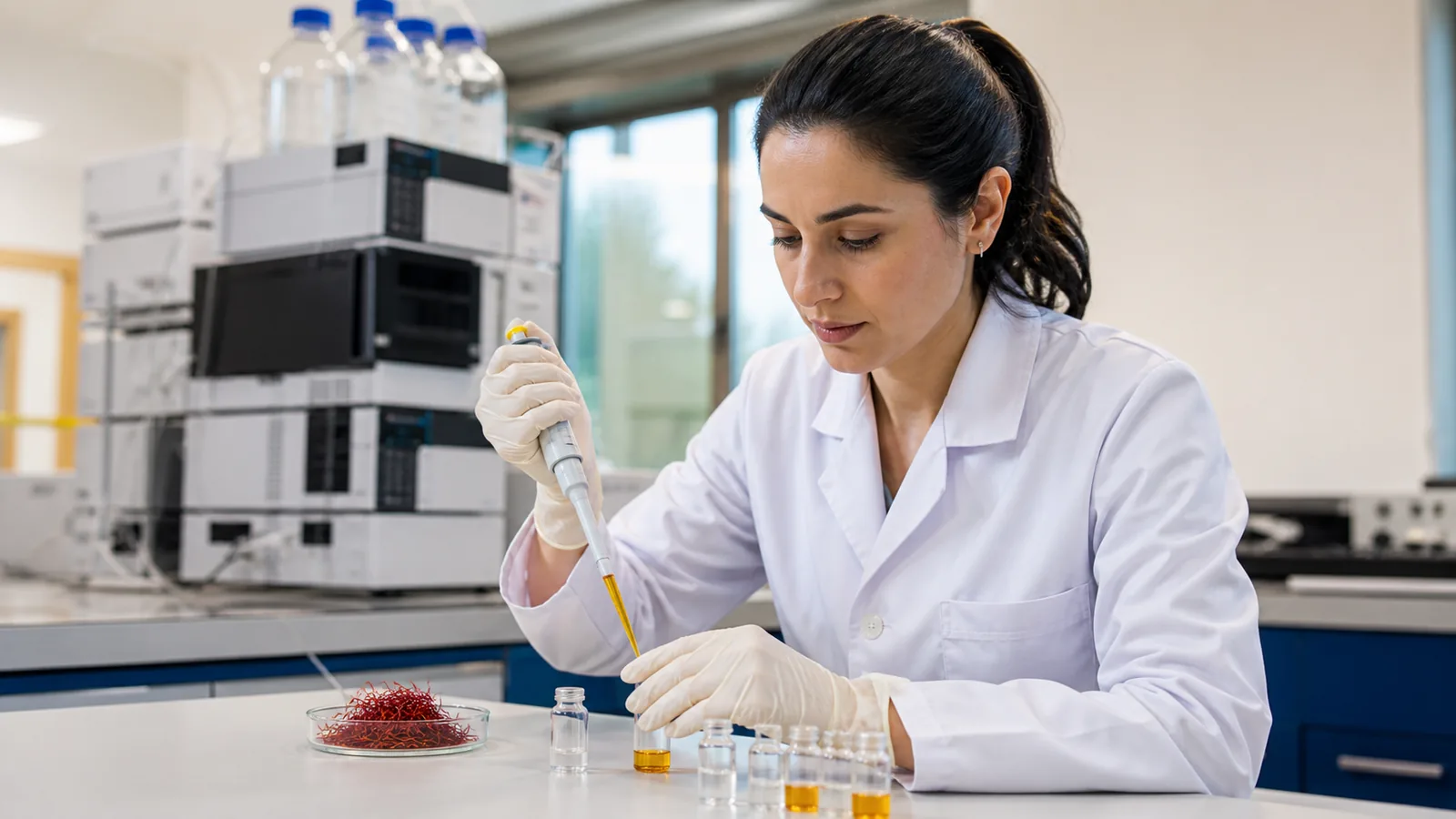
The method depends on the question being asked. ISO 3632 provides specifications and test methods for saffron as a spice. Its established spectrophotometric approach evaluates characteristics associated with colouring strength, bitterness and aroma. The result is useful for grading and comparing a properly sampled lot, but it does not identify every individual molecule.
More selective methods answer different questions. High-performance liquid chromatography can separate individual crocins and picrocrocin more clearly than a broad absorbance reading. Gas chromatography coupled with mass spectrometry is suited to volatile compounds such as safranal. Microscopy, DNA-based methods, isotope analysis and elemental profiling may be added when authenticity or geographic origin is in dispute.
A sound report should state the lot, sampling date, sample form, method, units and laboratory. It should also make clear whether the result describes whole threads, powder or an extract. Without that context, a precise-looking number can be misleading.
What composition can and cannot tell a buyer
Composition testing can support decisions about quality, consistency and authenticity. It can reveal weak colouring strength, abnormal moisture, foreign colouring matter or a profile that deserves further investigation. It cannot by itself prove every claim on a label, predict how a person will respond to saffron or turn a food ingredient into a medical treatment.
For procurement, compare certificates from the same method and require the result to match the supplied lot. Our guide to Iranian saffron standards explains the specification context, while the introduction to crocin in saffron looks more closely at the colour compounds. Keep the physical sample sealed, dark, dry and away from heat so the material tested remains representative of the material used.
Sources and review note
This article was reviewed on 28 August 2026 against the current ISO 3632-1 saffron specification page, an updated peer-reviewed review of saffron phytochemistry and quality control, a GC–MS study of volatile compounds in Iranian saffron, and research on chemical profiling of Iranian and Spanish saffron origin. Values from individual studies are identified as sample-specific rather than universal specifications.