


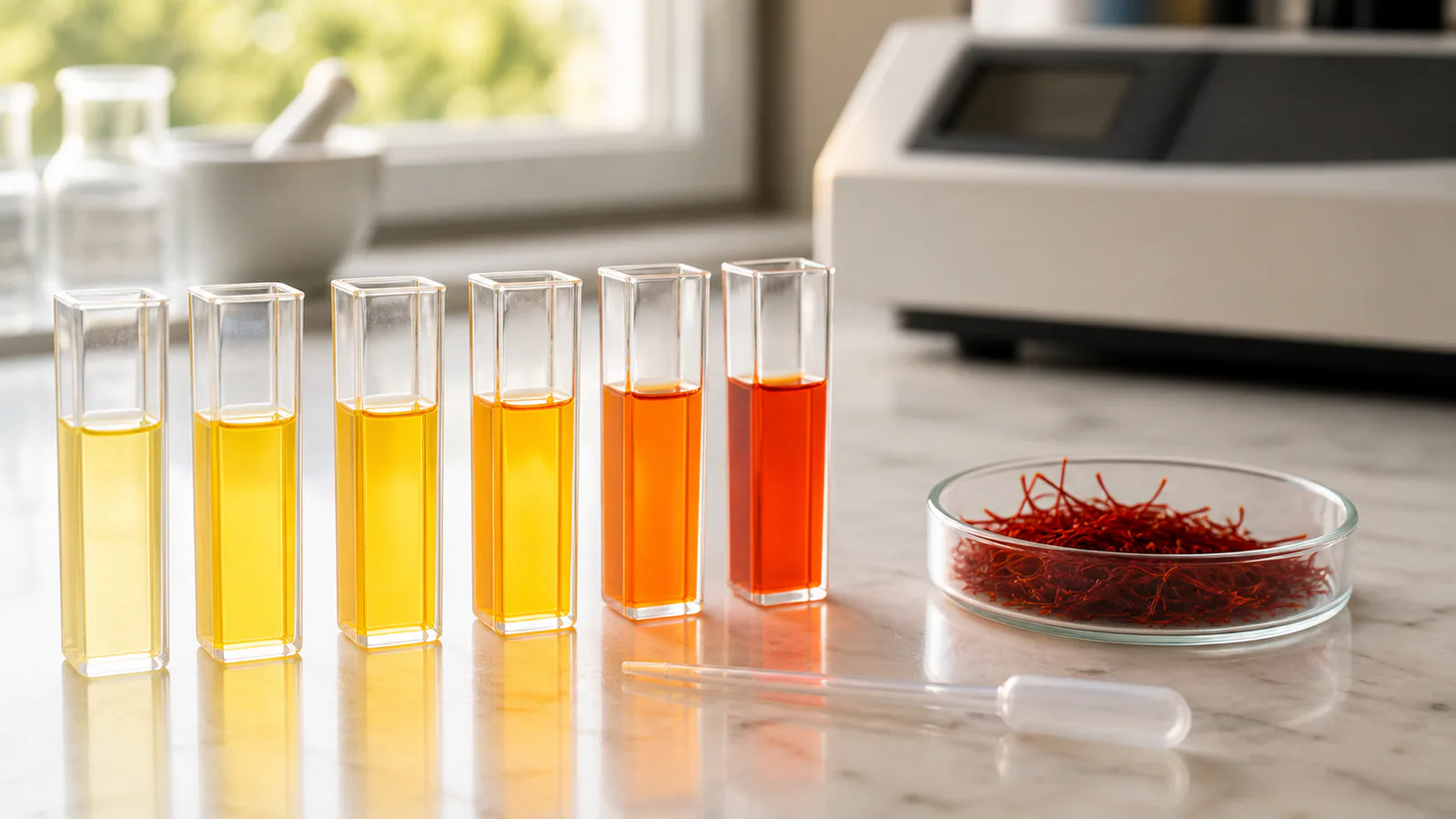
Crocin is the main family of water-soluble carotenoid pigments responsible for saffron’s strong yellow coloring power. When saffron threads are infused, crocins move into the water and create the familiar golden color. They are scientifically interesting compounds, but crocin is not the source of every saffron property and a laboratory finding is not automatically a health benefit from eating the spice.
What is crocin in saffron?
The word crocin is often used for a group of related compounds rather than one perfectly uniform molecule. Crocins are sugar-containing derivatives of crocetin. Those sugar groups help make them water soluble, which is unusual among many carotenoids and explains why saffron releases color readily into warm water.
The occasional search spelling “crocian” refers to the same intended term, but crocin is correct. Crocin should also not be confused with curcumin, the yellow pigment associated with turmeric.
Color, taste and aroma come from different markers
Crocin is primarily linked with coloring strength. Saffron’s other well-known chemical markers have different sensory roles:
- Crocins: yellow-to-orange coloring strength in an infusion.
- Picrocrocin: an important contributor to characteristic bitter taste.
- Safranal: a major volatile marker associated with saffron aroma.
The old article incorrectly attributed saffron fragrance and aromatherapy effects to crocin. Crocin is not volatile enough to be the principal aroma compound; safranal is the relevant marker. The FAO/WHO Codex standard for dried saffron likewise separates taste strength as picrocrocin, aroma strength as safranal and coloring strength as crocin. Read the Codex saffron standard.
Why crocin matters to saffron quality
Laboratories can estimate coloring strength by measuring how a prepared saffron solution absorbs light at a defined wavelength. That test is useful for grading and quality control, but one number does not prove origin, freshness or authenticity on its own. Moisture, foreign matter, ash, taste and aroma markers also matter, and sophisticated adulteration may require additional analysis.
A strong color release can be desirable in cooking. It does not mean a cook should use boiling water for a long time or leave saffron exposed to light. Crocins can degrade with heat, oxygen, light and poor storage. Keep threads dry, protected from light and tightly closed, then make only the infusion needed for the recipe.
How the body handles crocin
After oral use, crocin is not simply absorbed intact in the same form seen in a laboratory vial. Pharmacokinetic research indicates that much of it is converted in the intestine to crocetin before absorption, while a large portion is eliminated through the digestive tract. Formulation, dose and food context influence exposure.
This is one reason a cell experiment using a known crocin concentration cannot be translated directly into “eat more saffron.” A review of saffron pharmacokinetics describes this conversion and the limited direct circulation of orally administered crocin. See the pharmacokinetic review on PubMed.
Antioxidant and anti-inflammatory research
Crocin has shown antioxidant and anti-inflammatory actions in many cell and animal experiments. These findings make it a useful research compound. They do not establish that crocin prevents aging, cancer, cardiovascular disease, diabetes, arthritis or neurodegeneration in people.
Health outcomes require appropriate human trials. A chemical can affect a laboratory pathway without reaching the same tissue or concentration after it is eaten. Researchers also need to distinguish whole saffron, a standardized saffron extract, purified crocin and crocetin; the results are not interchangeable.
Crocin, mood and cognition
Trials of saffron preparations have reported signals for mood and some cognitive outcomes, but most cannot show that crocin alone produced the effect. Whole saffron also contains safranal and many other compounds. Reviews have noted promising results alongside small samples, short follow-up, regional concentration and variable preparations.
It is therefore too strong to call crocin a natural antidepressant or memory treatment. Depression and cognitive change require proper assessment, and supplements should not replace prescribed care. Our guide to crocin and multiple sclerosis research shows why preclinical cell protection must be kept separate from treatment claims.
Does crocin prevent cancer?
No clinical evidence supports selling saffron or crocin as a cancer-prevention or cancer-treatment product. Laboratory researchers have studied effects on cancer cells and experimental models, but those systems do not establish a safe, effective therapy in people. Anyone receiving cancer treatment should discuss supplements with the oncology team because interactions and product quality matter.
Saffron beyond crocin
The merged source article promised many whole-spice benefits: lower cholesterol, protection against fat in blood vessels, menstrual relief, digestion support, asthma relief, blood-pressure and immune regulation, and treatment of blemishes or eczema. Most of those claims were stated without condition-specific clinical evidence and cannot be assigned to crocin.
Some saffron preparations have been studied for mood, PMS and metabolic measurements, but results for one outcome or extract do not validate the whole list. Saffron is not a substitute for cardiovascular, respiratory, dermatological or reproductive care. The safer overview is our article on saffron properties, tradition and safety.
Culinary use
Crocin’s most reliable everyday contribution is color. For an even infusion:
- Gently crush only the amount of saffron needed.
- Add warm water and allow time for the color to disperse.
- Use both the liquid and threads in rice, stew, dessert or a drink.
- Avoid judging quality from color alone; unusually instant or harsh color can justify closer inspection.
Saffron’s aroma comes into focus as the warm infusion reaches the dish, while picrocrocin and related compounds contribute taste. The pleasure comes from their balance, not the maximum amount of one pigment.
Natural dye and cultural use
Crocins also explain saffron’s long history as a natural dye for textiles, art and ceremonial materials. A chemistry review describes crocins and crocetin as the water-soluble carotenoid dyes behind these uses. Read the crocin dye review on PubMed.
This cultural role is real without becoming a medical claim. The value of saffron has always included color, rarity, labor, fragrance and tradition as well as modern scientific interest.
The accurate conclusion
Crocin is special because it is a water-soluble carotenoid pigment central to saffron’s coloring strength and quality assessment. It is also a valuable subject of pharmacological research. Its established role in food is color; its possible biological roles require preparation-specific human evidence. Keeping those two truths together makes the science more useful and the saffron story more honest.

![Exporting Saffron to Turkey + Price Guide [Complete 0 to 100]](https://img.rowhanisaffron.com/20260827003933/saffron-export-turkey-quality-inspection.webp)



