


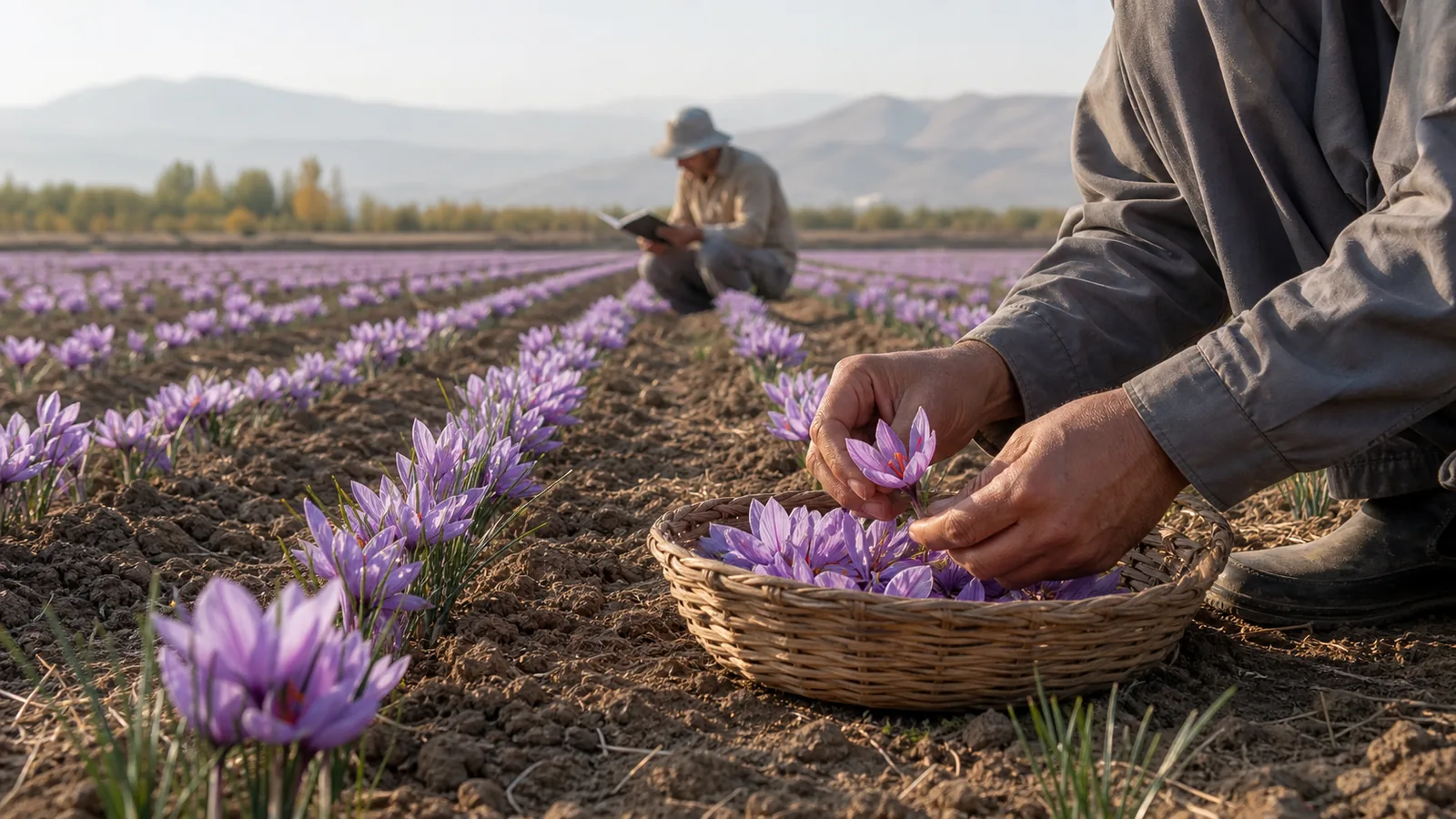
Saffron farming operations follow the plant’s annual cycle: establish healthy corms in free-draining soil, manage water and weeds without disturbing the crop, harvest flowers during the brief autumn bloom, then separate, dry and protect the red stigmas. Each step affects the next. A clean harvest cannot recover a lot that began with diseased corms, and careful field work can still lose value through slow handling or poor drying.
This guide explains the whole sequence for Crocus sativus, from field planning to sealed storage. The exact calendar, planting depth and irrigation programme must be adjusted to the growing region, soil and production system; they are not universal numbers.
How saffron is cultivated through the year
Saffron does not produce a useful seed crop. It is a sterile plant propagated through corms, the compact underground stems often called saffron bulbs. A mother corm forms daughter corms, the foliage supports their development through the cool season, and the leaves die back as the plant enters summer dormancy.
That biology shapes the farm plan. The grower has to protect both the current season’s flowers and the daughter corms that support later harvests. Cutting green leaves too early, leaving beds waterlogged or damaging corms during cultivation can reduce future performance even when the immediate field still looks sound.
The University of Vermont’s saffron cultivation guide describes the crop as a perennial that may remain in place for several years. It also notes that local conditions change the suitable planting method and depth. Commercial saffron farming therefore starts with a field-specific plan, not a copied checklist.
Our shorter collection of saffron cultivation tips can be used as a field reminder; the sections below explain why each operation needs local judgement.
Plan the field before planting
Choose soil that drains promptly
Saffron can grow in several soil textures, but prolonged standing water raises the risk of corm rot. Inspect the field after rain or irrigation rather than judging drainage from a dry surface. Low spots, compacted layers and blocked outlets need attention before planting.
Organic matter can improve soil condition, yet “more” is not automatically better. Use a soil test and know the maturity, salinity and nutrient content of any composted manure. Fresh manure, an unmeasured fertilizer mix or ash added by habit can create nutrient or salt problems. A local agronomist should set the amendment programme around the test result and the field’s cropping history.
Match the site to the production cycle
The site needs enough light, access during the short harvest peak and a practical route to the separation and drying area. Crop rotation and previous disease history also matter. A plot that is convenient but repeatedly wet, difficult to weed or far from the processing room can create avoidable losses.
Before investing in corms, check local plant-health, import and agricultural rules. Growing saffron is not inherently an unusual legal activity, but jurisdictions can regulate imported planting material, quarantine pests, pesticide use, labour and food processing.
Select and handle saffron corms carefully
Use sound, correctly identified Crocus sativus corms from a traceable source. Larger corms often have greater flowering potential, but size does not excuse disease, wounds, mould or poor storage. Inspect lots on arrival and keep supplier, lot and treatment records.
If corms must be held before planting, keep them dry, ventilated and protected from heat, moisture and physical damage. Do not seal damp corms in an airtight container. Storage duration and temperature should follow the supplier’s advice and local production guidance; planting material held too long can sprout or deteriorate.
Rows generally make cultivation, observation and mechanical access easier than irregular piles or crowded planting holes. Density is still a business and agronomic decision. Close spacing can increase the number of corms in the first planted area, while also making later crowding, disease inspection and lifting more difficult.
Set planting depth for the field, not by folklore
The original version of this article prescribed 15–20 cm in cold regions and 10–15 cm in temperate ones. Those ranges are useful historical practice, but climate alone does not determine depth. Soil texture, drainage, frost exposure, heat, production duration and whether the crop will be lifted annually all influence the choice.
University of Vermont trials and guidance discuss planting depths across a broad range and explain the trade-off: deeper planting can buffer corms from temperature extremes, while excessive depth may restrict growth or affect daughter-corm production. Place corms consistently, avoid inverted or damaged material, record the actual depth and compare results by block.
Prepare a level bed and firm the soil gently enough to remove large air pockets without creating a hard cap. If irrigation or rain forms a crust, loosen only the shallow surface. Deep cultivation around emerged shoots can injure the corms the work is meant to help.
Manage water around dormancy and flowering
One old rule says never irrigate saffron during summer dormancy. The safer principle is to avoid unnecessary moisture around dormant corms while preventing conditions that threaten the field or soil. Regional rainfall, soil water-holding capacity and the timing of irrigation used to stimulate growth all vary.
Water should infiltrate evenly and leave the root zone without prolonged saturation. Record the date and amount of irrigation and rain, then compare them with emergence, flowering and disease observations. A calendar copied from another region is weaker evidence than the field’s own measurements.
Heavy watering immediately before flowers are handled can also complicate access and cleanliness. During bloom, the priority is to keep the harvest route workable and avoid splashing soil onto flowers.
Control weeds without harming corms
Weeds compete for water, light and nutrients and can slow hand picking. Summer dormancy may offer a useful control window, but the operation must match the weed species and the depth of the corms. Repeated deep tillage can cut or expose planting material.
A good programme combines field sanitation, timely shallow cultivation, mulching where suitable and other locally approved controls. Keep the bed surface manageable before the autumn shoots appear. Once the crop is active, work slowly enough to protect its narrow leaves and emerging flowers.
Older advice sometimes recommends adding a 2–3 cm layer of soil, manure and ash each year as corms move towards the surface. Do not make that an automatic annual recipe. First inspect corm position, soil level and drainage, then use tested, mature material only where it solves a measured problem.
Watch for rodents, disease and field damage
Rodents can remove or damage corms, particularly in an unprotected bed. Look for tunnels, disturbed soil and missing plants rather than waiting for a major loss. Barriers such as buried mesh may suit a raised bed or small plot; field-scale control needs an approach that is lawful, safe and appropriate to the species.
Also inspect for soft, discoloured or decaying corms and patches of weak emergence. Isolate suspect material and seek a reliable diagnosis before applying a treatment. “Bulb disease” is not one condition, and treating the wrong cause wastes time while the problem spreads.
Keep machinery, containers and tools clean between lots when soil-borne disease is a concern. A simple field map helps the grower return to a weak patch and compare it with drainage, planting-stock and treatment records.
Harvest saffron flowers at the right stage
Flowers are commonly collected in the morning, while they are fresh and before prolonged exposure in the field. The exact hour is less important than readiness and condition. Pick developed flowers promptly, avoid crushing them and keep wet or visibly contaminated material apart.
The University of Vermont harvest guidance recommends checking the crop daily during bloom and using containers that protect the flowers. Shallow, clean trays or baskets are preferable to deep sacks that compress the harvest.
Move flowers to a shaded, clean processing area without an unnecessary wait. Keep field, date and batch identity with them. The three red stigmas are the spice; petals, stamens, soil and other plant material should not enter the finished lot.
Separate and dry the stigmas as a controlled process
Separation should begin promptly enough to prevent a backlog of warm, compressed flowers. Workers need clean hands and surfaces, good light and a consistent instruction on how much yellow style may remain with the red stigma. The chosen commercial grade will affect trimming, but hygiene does not change with grade.
Drying reduces moisture and develops the familiar characteristics of saffron. Traditional Spanish toasting over a heat source is one historical method, not a universal “best” method. Direct flame, smoky fuel or uncontrolled high heat can damage or contaminate the product. The dryer’s temperature, airflow, load depth and time must work together.
The University of Vermont drying guide compares practical equipment and stresses controlled handling. For a fuller look at picking, separation and drying choices, see our guide to saffron flower drying methods.
Do not judge a batch only by a single timer setting. Record fresh and dry weights, equipment settings and final condition. A processor selling into a defined market should test against the buyer’s specification and the applicable standard rather than relying on colour alone.
Store dried saffron away from its main enemies
Once the dried lot has cooled and its condition has been checked, use a clean, food-suitable container that closes securely. Protect saffron from moisture, light, excessive heat, foreign odours and pests. Metal, glass and suitable barrier packaging can all work when the closure and storage environment are right; the material name by itself is not a guarantee.
Label each lot with enough information to trace its field, harvest and drying batch. Keep packed product off the floor and inspect the storage area. The official Codex standards catalogue lists CXS 351-2022 for dried saffron, which describes commercial forms and core quality requirements; contracts and local food rules may add further conditions.
Records turn farming operations into a repeatable system
Commercial growers need more than a list of jobs. Saffron agriculture becomes repeatable when a short record for each block connects the corm lot, planting pattern, soil test, amendments, irrigation, weed and pest observations, first flower, peak harvest, labour, fresh stigma weight, drying batch and accepted dry weight.
That record makes “saffron yield per hectare” meaningful. Yield varies with corm size and density, field age, climate, management, flower recovery, trimming, drying and the standard used for acceptance. A number without the season, field and product basis is easy to misread.
Review the operation after the crop, while the difficult days are still fresh. If flowers waited for separation, the next investment may belong in the processing room rather than the field. If emergence was patchy, investigate planting depth, stock health, drainage and pests before buying more machinery.
A practical order for saffron farming operations
- Inspect the site, drainage, crop history and access.
- Test the soil and plan amendments from evidence.
- Buy healthy, traceable corms and inspect them on arrival.
- Choose a consistent row layout, depth and density for local conditions.
- Record water, weeds, nutrition, pests and crop development.
- Prepare labour, shallow containers and the processing room before bloom.
- Pick ready flowers gently and move them promptly out of the field.
- Separate, dry and evaluate each traceable batch under controlled conditions.
- Pack in a closed food-suitable container and protect it from light and moisture.
- Compare field and processing records before changing next season’s plan.
These operations are linked, but they are not rigid. The strongest saffron farm keeps the biological sequence intact while adjusting the measurements to its own soil, climate, equipment and market.
Agronomy and post-harvest guidance reviewed 28 August 2026. Local growing conditions and regulations vary; confirm field decisions with qualified regional advice.

![Exporting Saffron to Turkey + Price Guide [Complete 0 to 100]](https://img.rowhanisaffron.com/20260827003933/saffron-export-turkey-quality-inspection.webp)



