


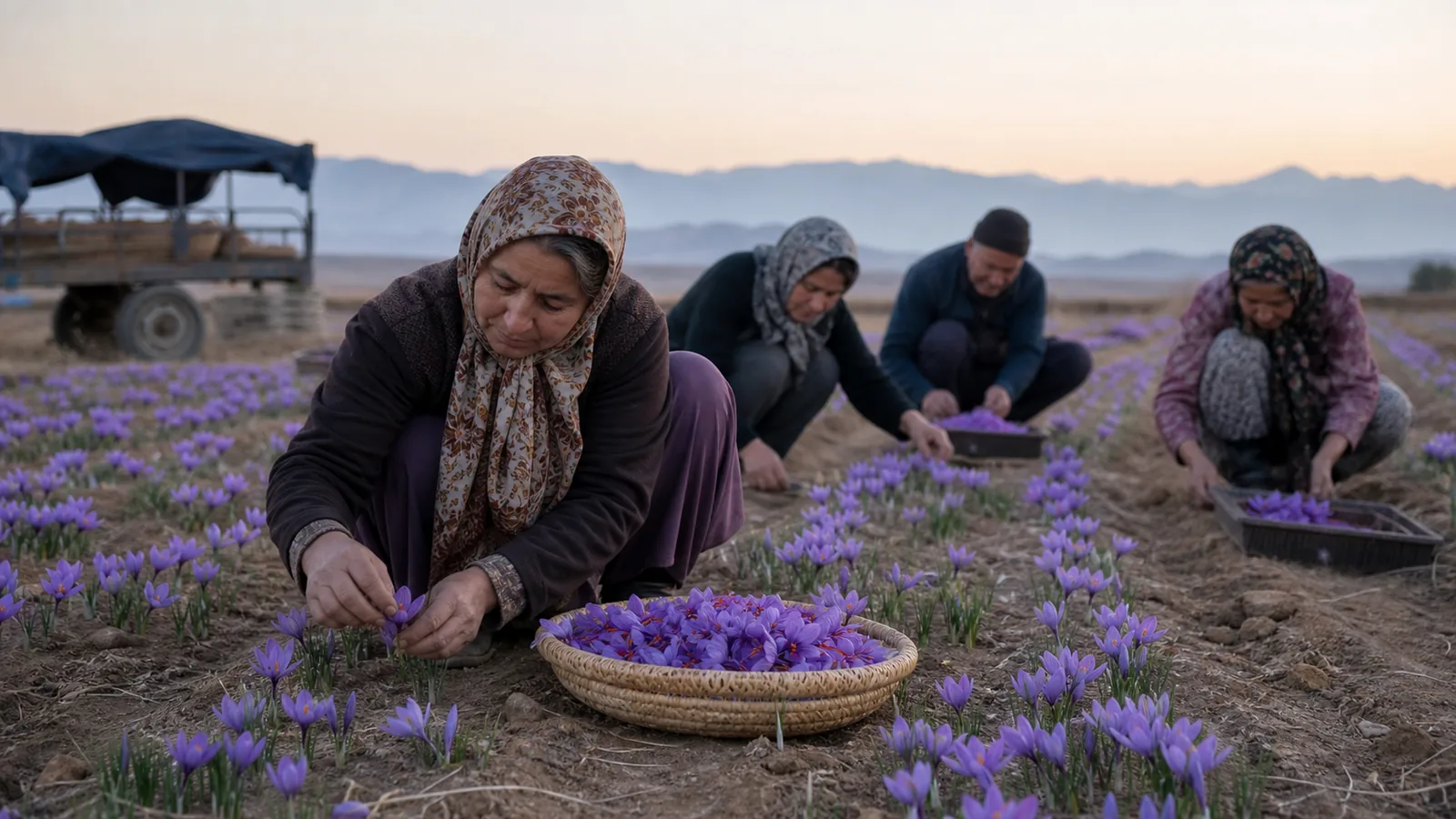
The harvest of saffron flower is short, concentrated and different in every field. A date printed in an old market report cannot tell a grower when today’s crop will emerge. Soil moisture, temperature, altitude, corm condition and local weather all affect flowering, so the practical signal is the flower itself: fully developed and beginning to open, ready for careful collection.
This article first appeared as a 2014 harvest forecast. It mentioned dates, acreage, expected production and prices that belonged to that season. Those details are preserved below as history, then separated from the field practices that remain useful.
What the original harvest forecast said
The report attributed its comments to Gholamreza Miri. He said the official saffron harvest would begin within the next ten days, around 1 November, and that warmer areas would start roughly 10 to 15 days later. The account expected harvesting to continue until about 15 December.
Miri connected favourable rain in March, April and May with a 10 percent national increase in saffron acreage and forecast 15 to 20 percent more saffron flower production than the previous year. Those were seasonal expectations, not permanent growth rates.
The same article said flower prices had fallen by 3 percent on the previous Thursday—described as about US$100 per pound—as the harvest approached. It suggested further price falls were possible and described pre-harvest deflation as a normal annual pattern.
A final sentence gave a range of 3.6 million to 5.5 million per kilogram but labelled the unit as dollars. The currency and basis are clearly mistranslated or incomplete, so that figure cannot be used as a historical dollar price, much less a current quotation. It remains evidence that the original report discussed a wide price range, not evidence of what a buyer should pay.
When saffron flowers are ready to harvest
Harvest the flowers when they are fully elongated and beginning to open. Very immature buds can contain underdeveloped stigmas; flowers left until they wilt become harder to handle and separate. Readiness matters more than forcing every flower into one clock-based rule.
The University of Vermont saffron harvest guide recommends collecting flowers as they become ready and handling them carefully. Daily collection becomes important during the bloom. Morning work is common because conditions are cool and flowers have not spent the day exposed to sun, but wet dew and rain also need consideration. The aim is a clean, developed flower with minimal damage.
A field rarely flowers all at once. Workers may return each day through the bloom period, collecting a modest quantity at first, then facing a sharp peak. Planning labour for the busiest days is more important than calculating the average across the whole season.
Why Iranian harvest dates vary
Khorasan itself contains different elevations, soils and temperature patterns. A warm site does not always follow the same sequence as a neighbouring field, and an irrigation or rain event can interact with the season’s temperature. That is why the 2014 dates should not be carried into a current harvest calendar without local observations.
Before flowering, growers can monitor emergence and record what happened in earlier years. A useful field log includes irrigation and rain dates, the first visible shoots, first flower, peak daily count, final picking and unusual weather. Over several seasons, that record is more valuable for labour planning than a national date announced in the press.
Crop forecasts also need humility. More acreage does not automatically produce the same percentage increase in dried saffron. Corm establishment, flower count, stigma development, harvest loss, separation and drying all affect saleable output.
A practical saffron flower harvest routine
Prepare the crew before the first flush
Agree the fields, rows and lot codes in advance. Workers need clean shallow containers, suitable clothing and a clear route for moving flowers to the separation room. Assign someone to record quantities and arrival times rather than reconstructing the lot later.
Pick without damaging the plant
Hold and detach the flower carefully, avoiding unnecessary pulling on the leaves or disturbance around the corm. Do not mix soil, weeds or heavily damaged flowers into the basket. A worker should be able to set aside unusual material without stopping the whole crew.
Use shallow, clean containers
Deep sacks compress flowers and make heat and moisture harder to manage. Clean trays or baskets protect the petals and stigmas and allow the field team to see foreign matter. Containers should not be reused from chemicals, fuel or strongly scented products.
Move flowers out of sun and rain
Collected flowers should reach a protected work area promptly. If flowers are wet, piling them closely can make handling worse. The separation plan must cope with the actual quantity arriving rather than leaving full baskets waiting while the picking crew continues.
Keep fields and days traceable
A simple lot identity can connect field, picking date, crew, received quantity, separated stigmas, drying batch and final pack. Mixing material without a record makes it harder to investigate a quality result or compare field performance.
Flower picking is only the first harvest stage
The spice is made from the red stigmas, not the whole purple flower. After collection, workers separate the stigma from petals and stamens, remove unwanted material and prepare the fresh threads for drying. Delay, pressure, dirty surfaces and careless handling can reduce the value created in the field.
A saffron picking machine may help with a labour bottleneck, but it does not automatically solve separation or drying. Our guide to the saffron harvesting machine explains the difference between a field harvester, stigma separator and processing line.
For the Iranian harvest-to-drying workflow, see Iranian saffron flower drying methods. That guide follows the flowers from morning collection through separation without turning one traditional method into a universal recipe.
From fresh stigma to stable saffron
Fresh stigma contains substantial moisture and needs controlled drying. The process influences aroma, colour, texture and storage stability. Dryer load, temperature, time and airflow should be defined for the equipment and batch rather than guessed from the outside appearance alone.
After drying, the lot needs conditioning, inspection and packaging that protects it from moisture, light, foreign odours and contamination. The Codex standard for dried saffron defines commercial forms and essential composition and quality factors. The buyer’s contract may add more specific requirements.
Field yield and dried yield should be recorded separately. A large mass of flowers is not the same as an accepted kilogram of saffron. Separation losses, style length, foreign matter, drying loss and rejected material all affect the final result.
Does harvest season always lower the price?
Fresh supply can put pressure on prices when many growers sell at once, which explains the observation in the 2014 report. It is not a rule that the market falls by a fixed percentage every harvest. Stocks, crop expectations, currency, export demand, credit, grade and the urgency of sellers can all change the direction and size of a move.
Flower price, farm-gate dried-saffron price, wholesale export price and retail price are different measures. A quote also needs a date, currency, grade, quantity, location and delivery basis. The old US$100-per-pound reference and the mistranslated per-kilogram range lack enough context for comparison.
Growers deciding whether to sell immediately should consider storage capability, cash needs and the actual quality of the lot. Holding saffron does not guarantee a better price, especially if moisture, packaging or documentation is weak.
What to record after the season
- first, peak and final flower dates for each field;
- daily flower quantity and labour hours;
- weather, irrigation and unusual field conditions;
- flowers missed, damaged or rejected;
- fresh stigma and dried-saffron yield by lot;
- separation and dryer capacity during the peak;
- quality results, sales date and the basis of each price.
These records turn a short, pressured event into information for the next crop. They show whether the real bottleneck was picking, transport, separation, drying or selling—and whether an expected rise in flower production became more accepted saffron.
The useful lesson in an old harvest forecast
The 2014 report captured the connection between rain, acreage, production expectations, harvest timing and short-term price movement. Its exact dates and prices have expired, but the relationship remains worth watching.
A strong harvest plan starts with local flower readiness, enough labour for the peak, clean containers, prompt separation, controlled drying and lot records. Market forecasts can help with preparation. They should never replace what the field, processing room and current contract actually show.
Harvest and food-standard guidance reviewed 28 August 2026. Flower dates, yields and prices vary by field and season; verify current local conditions and quotations.

![Exporting Saffron to Turkey + Price Guide [Complete 0 to 100]](https://img.rowhanisaffron.com/20260827003933/saffron-export-turkey-quality-inspection.webp)



