


The method of production used by successful saffron producers begins with healthy corms, well-drained soil and prevention. Saffron is a perennial crop, so a problem introduced at planting can remain in the field for years. Careful sourcing, minimal corm injury, appropriate irrigation and regular scouting do more to protect a planting than reacting late with an unidentified chemical.
Start with a production plan, not just a planting date
Saffron crocus, Crocus sativus, grows from a corm rather than a true bulb. The corm produces flowers and leaves, then forms daughter corms that carry the planting into later seasons. That cycle makes field history important.
Before planting, a producer should record:
- the corm supplier, lot, origin and arrival condition;
- previous crops and any history of root or corm disease;
- soil texture, drainage, pH and nutrient test results;
- the intended bed layout, planting density and irrigation method; and
- where any weak, damaged or symptomatic plants appear over time.
These records turn scattered symptoms into evidence. They also make it possible to isolate a suspect lot instead of moving it through the entire farm.
Select and handle saffron corms carefully
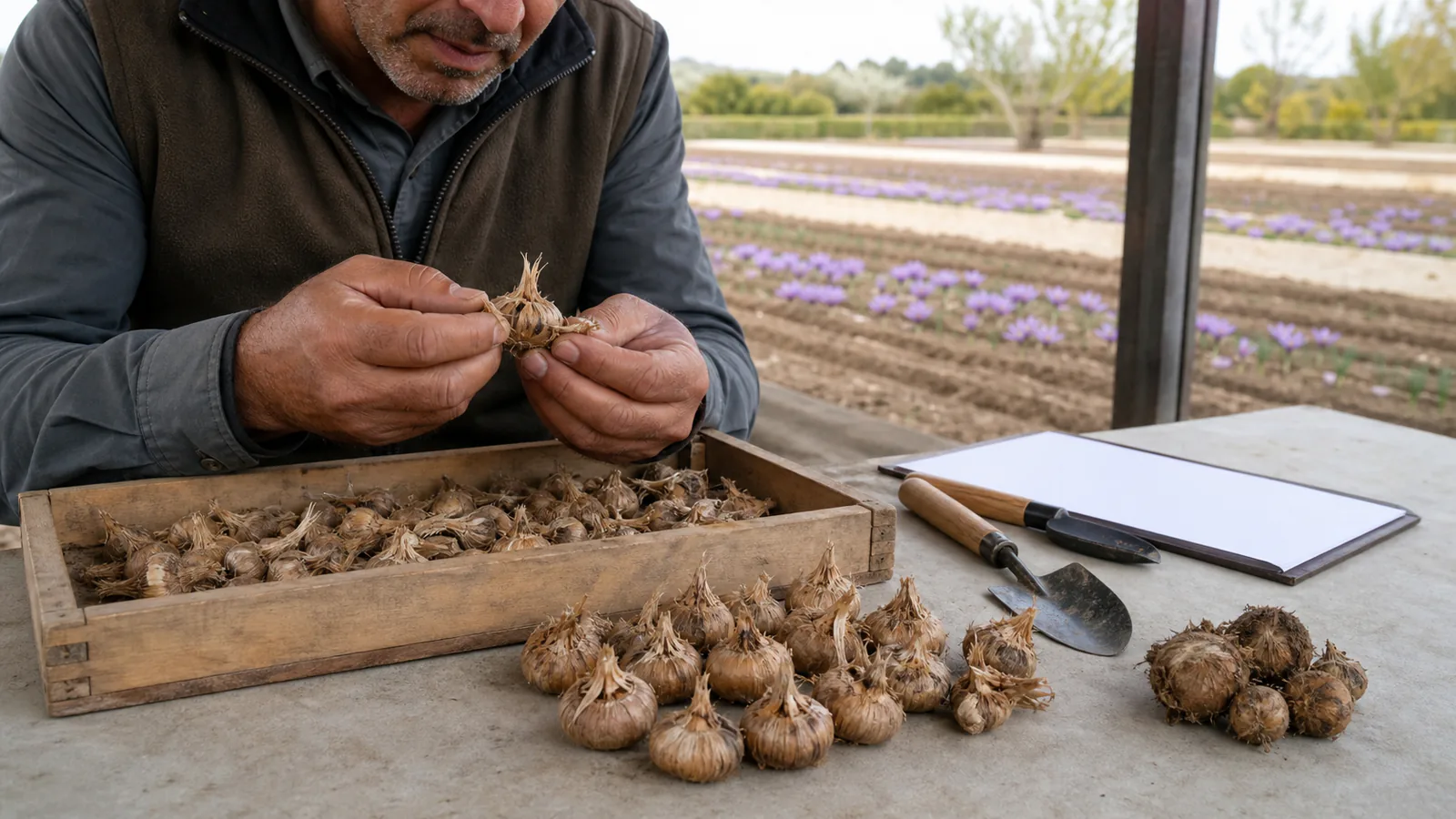
Buy corms from a supplier that can explain how the stock was propagated and inspected. Reject corms that are soft, badly cut, water-soaked, moldy, unusually discolored or collapsing. The University of Vermont saffron program advises growers to discard corms with dark or soft disease signs rather than planting them.
Injury matters. Research on saffron corm rot found that several fungi caused disease when corm tissue was wounded, emphasizing the importance of preventing cuts during lifting, grading, transport and planting. Use clean, suitable tools and do not throw or compress corms in deep containers.
Match planting depth and spacing to the site
There is no universal depth for every climate and soil. The older guidance on this page suggested 15 to 20 centimeters; an updated Penn State Extension guide for a colder North American setting suggests approximately 3 to 4 inches. This difference is a reminder to use regional agronomy rather than copying a number without context.
Depth influences soil temperature, moisture, daughter-corm position and ease of lifting. Spacing influences airflow, competition and how quickly the bed fills. A commercial producer should confirm the design with local research or extension advice, then keep it consistent enough to compare performance from one block to another.
Manage water, soil and dormancy
Saffron tolerates dry conditions and does not need continuously wet soil. The Food and Agriculture Organization describes Iran’s qanat-based saffron system as adapted to water scarcity. Adaptation does not mean the crop can follow one irrigation calendar everywhere.
The practical principles are:
- plant into soil that drains freely and does not hold water around corms;
- time irrigation to the local growth cycle, weather and soil moisture;
- avoid chronic wetness during dormancy, which can favor decay;
- use well-finished, weed-free organic matter where soil tests and local practice support it; and
- correct nutrients from soil and tissue evidence rather than treating every yellow leaf as a fertilizer shortage.
The old article rejected sheep and poultry manure categorically and recommended adding a thin layer of soil every two years. Those practices are too site-specific to serve as universal rules. Compost maturity, salinity, nutrient analysis, pathogen risk, soil texture and corm depth should guide the decision.
Why saffron corm rot is a production priority
Corm rot is a disease complex rather than one identical condition in every field. Fusarium and Rhizoctonia species are frequently associated with losses, while other fungi, bacteria, nematodes and secondary organisms may be present. A 2025 review described Fusarium oxysporum as a major threat and examined biological approaches to management.
Common warning signs include soft or sunken tissue, vascular browning, discoloration beneath the tunic, poor emergence, stunting, yellowing and patches of declining plants. None is diagnostic by itself. Waterlogging, physical injury and nutrient stress can look similar or make infection worse.
When a pattern develops:
- mark the affected area and stop moving corms or soil from it;
- photograph whole plants, roots and cut corms;
- submit representative material to a plant diagnostic laboratory;
- review irrigation, drainage, corm lot and field history; and
- base management on the confirmed organism and local product registrations.
Our dedicated guide to saffron pests and diseases covers diagnosis and management in greater depth. This page keeps the producer’s prevention workflow at the center.
Bulb mites and wounded corms
Bulb mites can feed in damaged or decaying corm tissue and may be associated with tunnels, cavities and secondary rot. They are difficult to diagnose with the naked eye. Population and damage can vary with location, season, storage and the condition of the corm.
The strongest preventive measures are clean planting stock, gentle handling, good drainage, removal of clearly compromised corms and sanitation between lots. Moving corms from a known infested field spreads both pests and the organisms associated with decaying material.
Thrips and leaf symptoms
Thrips are tiny insects that feed on plant tissue and flowers. They may be present without causing economically important injury, and local pressure varies. University of Vermont observations found thrips at a research site without obvious damage and recommended scouting rather than automatic treatment.
Leaves that yellow or die early can reduce the time available for daughter-corm growth, but thrips are only one possible cause. Examine the plant and field pattern before acting. Nutrient imbalance, root damage, poor drainage, corm disease, weather and normal seasonal senescence can produce similar symptoms.
Curled stigmas, chlorosis and other unusual growth
Older saffron literature describes curled or spring-like stigmas, stigma breakage, chlorosis and a condition called saffron smut. Names used in local reports may not correspond to one confirmed pathogen. Corm age, plant nutrition, physiology, viruses, phytoplasmas and environmental stress have all been proposed for unusual flower or leaf symptoms.
Do not choose a treatment from the symptom name alone. Record how many plants are affected, whether they share a corm lot, and whether the problem follows a wet area, soil type or field operation. Laboratory diagnosis is particularly important before destroying stock or treating a field.
Use pesticides only within a verified local program
The previous version recommended routine corm disinfection, a 5% copper-sulfate dip and soil treatment with carbon disulfide. Those instructions are not appropriate as general advice. A substance may be ineffective for the actual problem, phytotoxic, hazardous to workers, environmentally damaging or illegal on saffron in a particular country.
Use a fungicide, acaricide, insecticide, biological product or disinfectant only when the target has been identified, the product is registered for that crop and use, and the current label is followed. Local extension, a crop adviser or the pesticide authority can confirm what is permitted. Personal protective equipment, re-entry intervals, pre-harvest intervals and residue requirements matter for a food crop.
A producer checklist for a healthier field
- Source documented, firm and symptom-free corms.
- Keep lots separate until their health and performance are known.
- Prevent cuts and bruising during lifting and planting.
- Choose a well-drained site and a regionally appropriate depth.
- Base fertility on testing, not a fixed manure recipe.
- Scout by block and record mites, thrips, rot, chlorosis and weak growth.
- Quarantine suspect material and obtain a diagnosis.
- Use crop rotation, sanitation and only locally approved controls.
For saffron producers, yield begins below ground. A healthy corm population, protected from injury and planted into a well-understood field, creates the best chance of reliable flowers and a crop that remains productive over several seasons.

![Exporting Saffron to Turkey + Price Guide [Complete 0 to 100]](https://img.rowhanisaffron.com/20260827003933/saffron-export-turkey-quality-inspection.webp)



