


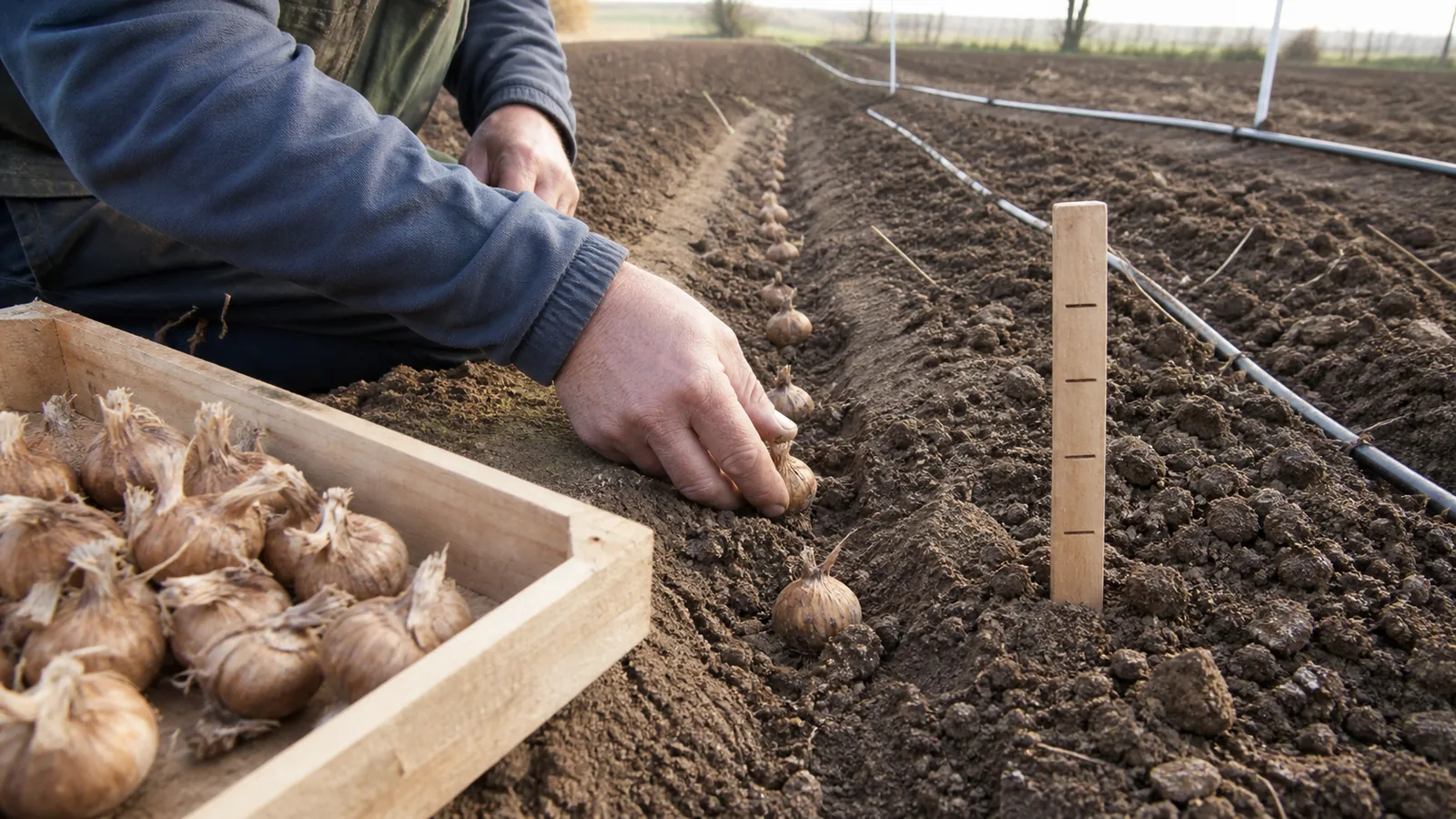
This Saffron Planting Guide explains how to evaluate a site, choose healthy corms, plan planting density, irrigate and manage a multi-year field. Saffron can perform in dry and highland environments, but it is not a plant-and-forget crop. Soil drainage, autumn temperature, water timing, corm health, labour and the market for the dried stigmas all affect the result.
Use the figures below as planning ranges, not universal prescriptions. Local trials and soil, water and plant-health advice should determine the final planting plan.
Understand the saffron crop cycle
Crocus sativus grows from a corm, not a true onion or seed. Corms are dormant through much of summer, begin active growth as conditions change in autumn, flower in a short seasonal window and carry green leaves through winter or spring before the foliage yellows.
That cycle explains why saffron often suits regions with dry summers and cool autumns, but “low water” does not mean “no water.” A scientific review of saffron water requirements notes that water quantity, quality and timing, field age and climate all affect the yield gap. Rainfed production exists, while dry regions often need supplemental irrigation.
Choose the site before buying corms
Start with a small representative plot and collect evidence for at least these factors:
- Drainage: water should not remain around the corms after irrigation or heavy rain.
- Soil structure: roots and daughter corms need a workable profile without a hard compacted layer.
- Temperature pattern: flowering responds to autumn conditions, not only an annual average.
- Water: test salinity and pH, and confirm when irrigation will be available.
- Previous crops and disease: record rot, nematode and weed problems before committing a perennial field.
- Access and labour: flowers must be picked and stigmas separated during a narrow period.
The old guide gave a maximum-temperature range of 35–40°C and an altitude range of 1,300–2,300 metres. Those ranges described successful Iranian highland conditions; they are not absolute global limits. A 2023 multi-environment field study found that temperature, altitude, soil texture and pH, irrigation events, growth-period length and field age all influenced yield. Suitability comes from the combination.
Soil preparation and fertility
Aim for a well-drained, friable seedbed that allows consistent depth and close soil contact without crushing the corms. Remove stones that obstruct planting and control perennial weeds before the field is established. Grade beds and irrigation runs so one end is not saturated while the other remains dry.
The previous article prescribed 40–80 tonnes of manure, 200 kilograms of ammonium phosphate and 250 kilograms of potassium sulphate per hectare. Those figures are not safe universal recommendations. Nutrient need depends on soil analysis, manure composition, previous cropping, expected yield and local environmental rules. Excess manure or fertiliser can waste money, increase salinity or create nutrient imbalance.
Use well-matured, clean organic material where it is appropriate and base phosphorus, potassium and other nutrients on a current soil test and regional agronomic advice.
Select healthy saffron corms
Corm quality determines the starting health and flowering potential of the field. Buy from a traceable supplier and keep lots identifiable. Choose firm corms without soft areas, deep cuts, mould, abnormal odour or visible mites. Larger corms often flower sooner than very small ones, but size does not compensate for disease or poor storage.
Handle corms gently after lifting. Keep them dry, ventilated and protected from overheating while they await planting. Long or poorly controlled storage can affect flower development, and warm damp piles encourage deterioration.
The inherited guide named old fungicides and a fixed treatment rate. Those instructions have been removed. If a pre-plant pesticide treatment is needed, it must be currently registered for saffron/corm treatment and the diagnosed organism in the grower’s jurisdiction. Follow its label and obtain licensed advice. Our saffron pest and disease guide explains the identification-first approach.
When to plant
Plant during the local dormant period early enough for the corms to establish before autumn growth. The older guide cited May as a preferred time in one Khorasan research context, while the Mazandaran case planted in September and other systems use a broader summer window. A single calendar date cannot serve regions with different heat, rainfall and field operations.
Avoid leaving lifted corms in uncontrolled storage merely to wait for a conventional date. Coordinate lifting, selection, site preparation and planting with a local crop adviser and the corms’ physiological stage.
How many saffron corms per hectare?
There is no one correct count because corms are sold and planted at different sizes, weights, row spacing and field duration. The old guide reported broad planting-material rates of 3–10 tonnes per hectare and described five-corm groups near five tonnes per hectare. The mountain Mazandaran report used approximately 2,500–3,500 kilograms per hectare.
Convert a weight target into a count only after weighing a representative sample:
Estimated corm count = total planting weight in grams ÷ average corm weight in grams.
For example, if a representative corm averages eight grams:
- 2,500 kg is about 312,500 corms;
- 3,500 kg is about 437,500 corms;
- 5,000 kg is about 625,000 corms; and
- 10,000 kg is about 1.25 million corms.
Those calculations are arithmetic examples, not a density recommendation. Higher density can increase early flower numbers but raises corm cost, crowding and the need to renew the field. Lower density takes longer to fill the rows. Decide density from corm size, machinery, intended field life, disease risk and local trials.
Planting depth and row layout
The historical Iranian guide used approximately 15–20 centimetres of depth and row or station distances around 25–30 centimetres. It also described a Spanish row system with corms 5–8 centimetres apart and rows 30–35 centimetres apart. These represent different production designs.
Set each corm upright, with the growing point facing upward, at a consistent depth selected for local soil, winter cold, summer heat and cultivation equipment. Very shallow planting can expose corms to temperature and mechanical injury; excessive depth can delay emergence and complicate lifting. In heavy soil, the same nominal depth behaves differently than in a loose sandy profile.
Close the furrow without compacting wet soil. Mark lot boundaries and keep a field map showing source, size grade, planting date, depth and density.
Irrigation, crust management and weeds
In parts of Khorasan, the first autumn irrigation has traditionally been timed from mid-September into October, with flowering following later. The right date should respond to soil temperature, forecast conditions, local flowering behaviour and water availability. Do not copy a fixed schedule across climates.
The old article also prescribed spring irrigation every 6–12 days. That interval could overwater one soil and under-water another. Check root-zone moisture, rainfall, growth stage, drainage and crop response. Stop irrigation when the crop enters dormancy according to local practice; summer waterlogging is a greater concern than a light, isolated rainfall event.
After irrigation, a sealed soil crust can obstruct emerging flowers. Break only the shallow crust with suitable equipment when the soil condition allows it, without cutting corms or bringing them to the surface.
Control weeds before they set seed and before they interfere with flower picking. Combine clean planting material, stale-seedbed or cultivation methods, hand or mechanical removal and, only where registered and justified, a labelled herbicide programme. Keep a record of every treatment.
Can saffron grow in Mazandaran?
Lowland Caspian conditions can create a difficult combination of summer moisture and poor drainage, but the source article documents a mountain exception. An agriculture official reported successful cultivation in the Yaneh Sar/Hezarjarib area of Mazandaran, with villages rendered in the translated report as Enduro and Pite-no.
Farmers planted about three hectares with corms brought from Khorasan. The report said 400 kilograms of flowers produced approximately four kilograms of dried saffron. Local planting took place in September at roughly 2,500–3,500 kilograms of corms per hectare, with harvest from late October into early November.
Those results demonstrate that a suitable mountain microclimate can differ from the humid lowlands. They do not establish that all land in Mazandaran is suitable. A new grower should verify summer soil moisture, drainage, autumn temperature, disease pressure and access to planting material, then run a local trial.
Flower harvest and stigma separation
Pick flowers frequently during the bloom while they are fresh. The Mazandaran report described harvest early in the morning, before sunrise. Cool early picking can reduce heat and wilting during transport, but safety, light and labour conditions also matter; it is not a universal requirement to work in darkness.
Move flowers in shallow, clean containers that do not crush the lower layers. Separate the red stigmas in a clean workspace, dry them with a controlled method and keep each field lot traceable. Harvest hygiene and drying consistency can matter as much as the number of flowers collected.
Plan for a multi-year field
Saffron corms produce daughter corms, so density and flowering change over time. The original guide expected fields to remain in place for roughly five to seven years. Other systems keep them longer or lift them annually. Review flower yield, corm size, crowding, disease, weed pressure and harvest cost each season rather than waiting for a fixed anniversary.
A sound planting plan records the baseline and defines what would justify expansion: healthy establishment, measured dried-stigma yield, acceptable quality, manageable labour, a realistic selling channel and no evidence that disease or water costs are rising faster than returns. Start small enough that the first seasons teach you something without putting the whole farm at risk.

![Exporting Saffron to Turkey + Price Guide [Complete 0 to 100]](https://img.rowhanisaffron.com/20260827003933/saffron-export-turkey-quality-inspection.webp)



