The “saffron weed killer fungus” reported from South Khorasan was Albugo arenosa, a newly described white blister rust organism found on two Strigosella weeds. The discovery was scientifically real, but the old headline compressed several different ideas into one. The published study identified a plant pathogen; it did not establish a ready-to-use weed killer for saffron farms.
There is another useful correction. Albugo species are oomycetes, or fungus-like organisms, rather than true fungi. That distinction may sound technical, yet it matters when researchers identify an organism, study its host range or consider whether it could ever become a biological control agent.
What the South Khorasan researchers identified
The peer-reviewed paper was titled “A new presumably widespread species of Albugo parasitic to Strigosella spp. (Brassicaceae).” It described Albugo arenosa Mirzaee & Thines as a new species that causes white blister rust on particular plants in the mustard family.
The journal record in Mycological Progress names Mohammad Reza Mirzaee, Sebastian Ploch, Fabian Runge, Sabine Telle, Lisa Nigrelli and Marco Thines as the authors. Mirzaee’s affiliation was the Plant Protection Department of the Agricultural and Natural Resources Research Center of Southern Khorasan in Birjand.
The paper appeared online on 28 March 2012 and in volume 12 of the journal in 2013. It assigned the name Albugo arenosa and the MycoBank identifier MB 564515. The original English post rendered the name as “ALBUGO ARENOSE MIRZAEE” and the journal as “Maikolozhikal”; those were translation or transcription errors, not separate organisms or publications.
The two host weeds and their current names
The study reported the organism on Strigosella africana in Iran and Spain and on Strigosella brevipes in Iran. Older plant names help explain the wording in the news report:
- Malcolmia africana is a synonym of the accepted name Strigosella africana;
- Malcolmia karelinii is treated as a synonym of Strigosella brevipes.
The original article connected the first weed with saffron fields and the second with rangeland. The taxonomic paper itself focused on the pathogen and its hosts, not on a commercial trial inside a saffron crop. The World Flora Online record for Strigosella africana confirms the accepted name, its older Malcolmia synonym and a broad native range that includes Iran and Spain.
That geography also clears up another awkward sentence in the old translation. The paper said the organism had a confirmed native distribution spanning several thousand kilometres. It did not say that a vehicle carried the organism for kilometres or that it had already spread through fields as an applied weed treatment.
How the species was distinguished
White blister rust symptoms alone do not identify Albugo arenosa. Several related organisms can produce superficially similar signs on plants in the Brassicaceae family. The research team combined the organism’s phylogenetic position with a distinctive pattern on its oospores, the thick-walled reproductive structures examined under magnification.
The journal’s author-contribution statement says the team collected pathogen material, carried out microscopic work and experiments, performed phylogenetic analysis, and interpreted the results together. That is much stronger evidence for a new species than a field observation by itself.
A grower who sees white raised areas, distorted leaves or unusual growth on a weed should therefore avoid naming the organism from a photograph. A diagnostic laboratory needs suitable plant material and may require microscopy or molecular work. The finding might be A. arenosa, another white rust, powdery mildew, insect damage or something unrelated.
Why “weed killer fungus” is too strong
A pathogen that infects a weed can be interesting to biological-control researchers. It is not automatically a bioherbicide. The 2013 paper established the identity, host association and known distribution of Albugo arenosa. Its abstract does not report a formulated product, a field application rate, saffron-crop safety, reliable weed suppression or an approved commercial use.
The old South Khorasan account described the organism as a potential biological control agent and said the project was still at an economic-estimation stage. That wording matters. “Potential” is a research direction, not evidence that farmers can culture, release or spray the organism.
Before a plant pathogen could be considered for intentional weed control, researchers would need to answer several practical questions:
- Does it consistently suppress the target weed under field conditions?
- Which plant species and varieties can it infect?
- Could it harm crops, native plants or other non-target vegetation?
- Can a stable, identifiable and uncontaminated preparation be produced?
- How do dose, weather and crop stage affect its performance?
- What environmental, worker and food-crop safeguards are required?
- Would the proposed use satisfy the law in the country where it is applied?
These are not formalities. The USDA APHIS risk-analysis manual for biological weed-control agents, for example, centres pre-release assessment on host specificity, exposure and potential damage to non-target plants. Requirements differ by jurisdiction, but the underlying caution is relevant anywhere a living organism might be deliberately released.
What the finding means for saffron fields
The discovery is useful because it adds a properly described organism to the science of plant disease and weed ecology in dry regions. It also shows why weeds in a saffron field deserve more than a generic label. Knowing the plant species and the organism affecting it can reveal ecological relationships that are invisible during routine hoeing.
It does not change the immediate job of weed management. Saffron grows from corms and has a distinctive seasonal cycle, so the timing and depth of cultivation have to protect both the active crop and dormant planting material. Our guide to saffron farming operations explains how shallow cultivation, field records and crop inspection fit into that cycle.
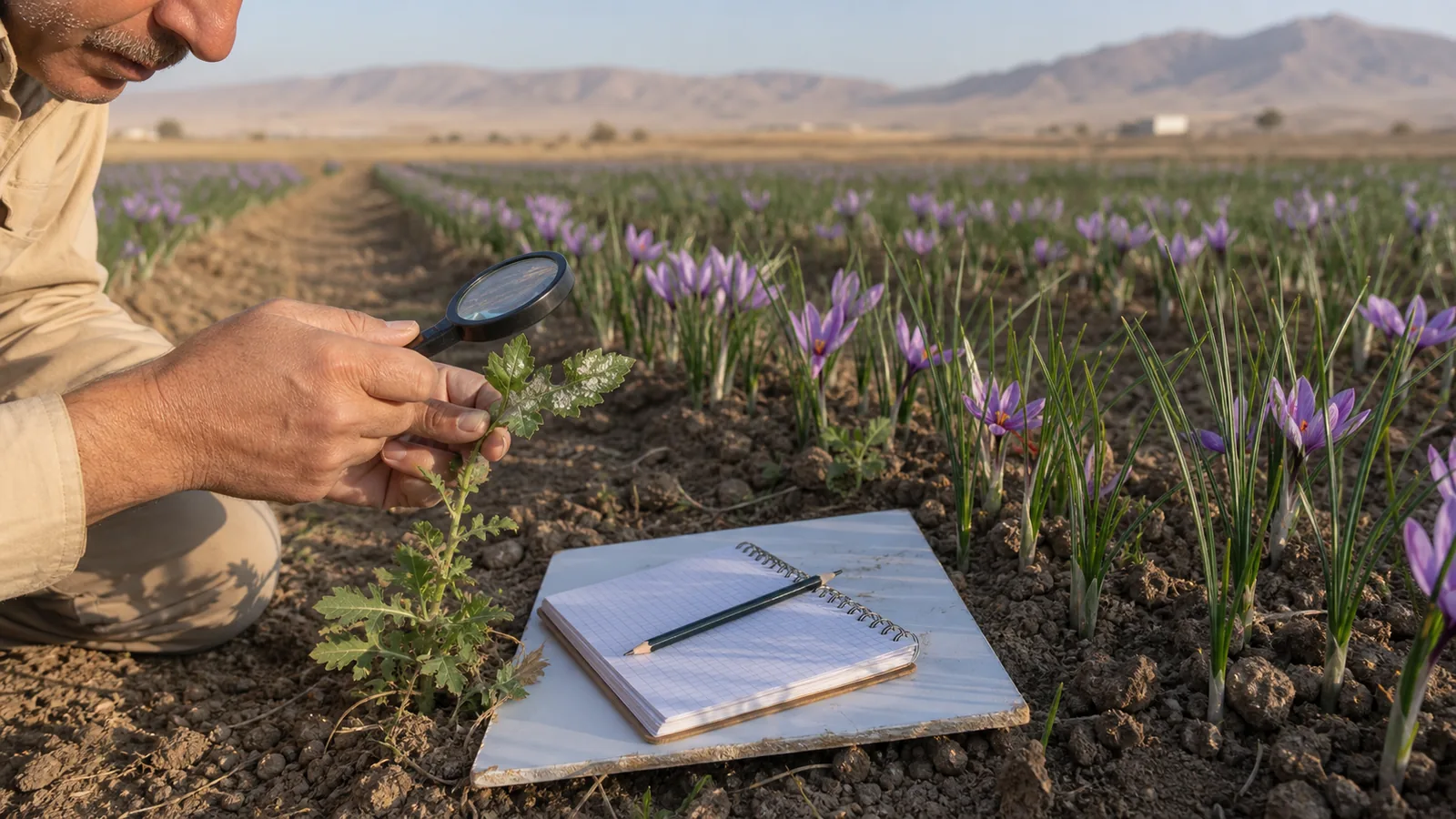
A grower should build a control plan around the weeds actually present, their growth stage and locally approved options. Remove or contain plants in a way that does not scatter seed or diseased tissue. Clean soil and plant debris from tools before moving between fields when a pathogen is under investigation. If an unusual disease seems to be reducing a weed, document the location and contact a plant-health specialist rather than attempting to multiply it.
Biological does not mean automatically safe
Microbial and other biological products are often discussed as alternatives to conventional herbicides. Their origin does not remove the need for identification, efficacy evidence, non-target testing or legal approval.
The US Environmental Protection Agency’s pesticide data guidance describes the types of evidence used to assess product performance, effects on people and non-target organisms, exposure and environmental fate. That is a United States framework, not a rule for Iranian farms, but it illustrates the distance between discovering an organism and authorising a product.
There is also a crop-specific issue. Saffron is a food product harvested by hand and valued for purity. Any proposed biological control programme would have to consider workers, residues or contaminants, handling surfaces, nearby plants and the final spice—not only whether a weed looks damaged.
How to document a suspected white blister rust
Good field notes help a diagnostic laboratory and preserve the context that a loose specimen cannot show. Record:
- the field and exact location of the affected plants;
- the suspected weed species and growth stage;
- which side of the leaf or stem carries the symptoms;
- the proportion of nearby plants that appear affected;
- recent rain, irrigation and temperature conditions;
- whether saffron or other neighbouring plants show symptoms;
- clear photographs of the whole plant and close views of the affected tissue.
Do not mail, transport or culture plant pathogens without instructions from the relevant laboratory or plant-health authority. Movement of diseased material can be regulated, and a poor sample may be useless for diagnosis.
What remains from the original report
The historical post attributed the announcement to the South Khorasan Agricultural and Natural Resources Research Center under Agricultural Jihad. It referred to Mohammad Reza Mirzaee’s role, said the local work followed about seven months of research, named the two weeds using their older Malcolmia names and reported that an economic assessment was still under way.
Those details are retained as the account given at the time. The peer-reviewed record supplies the firmer scientific facts: the correct name Albugo arenosa Mirzaee & Thines, six listed authors, two Strigosella hosts, specimens from Iran and Spain, and a taxonomic description based on phylogeny and oospore features.
The best reading of “Saffron weed killer fungus was identified” is therefore cautious. Researchers associated with South Khorasan helped describe a fungus-like white rust found on weeds, including one reported from saffron fields. The organism may have prompted interest in biological control, but the cited study does not make it a proven or approved saffron-field weed killer.
Scientific names and source records reviewed 28 August 2026. Pesticide and biological-control decisions require current local approval and qualified plant-health advice.