


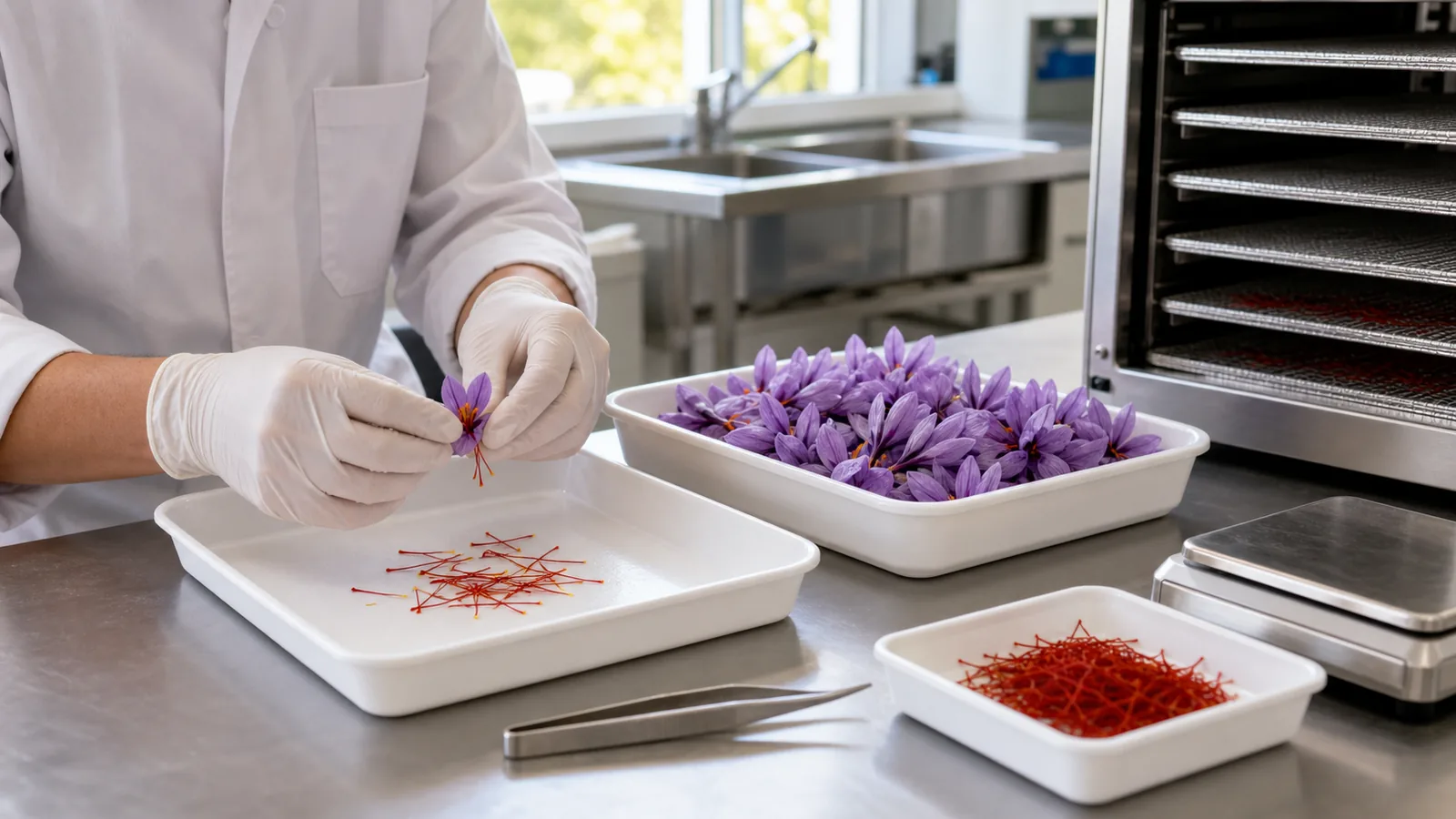
Saffron processing begins as soon as the flowers are picked. The aim is simple: separate the stigmas cleanly, dry them consistently, and protect the finished threads from moisture, light, heat and contamination. The work is time-sensitive because a pile of fresh flowers continues to warm and deteriorate after harvest.
The farm economics explain the urgency. A new field may produce little in its first season, while established corms flower during a short autumn window. One archived farm account described about 15 days of flowering in November. The exact dates vary with climate, field and year, but the labour demand is always concentrated: flowers that open together have to be picked and processed together.
Plan the harvest before flowering starts
Set up the clean processing area, trays, scales, dryer, containers and lot records before the first flower arrives. Confirm who will pick, transport, separate and dry each day’s crop. If the field produces more flowers than the team can process promptly, quality can fall even when the harvest itself is good.
The source article gave an average of roughly 10 pounds of dry saffron per acre, equivalent to about 11.2 kilograms per hectare. That is not a safe universal yield assumption. Saffron yield changes markedly with corm size and density, field age, soil, water, climate and management. Use local multi-year field records for a business plan, and treat the old figure as one farm-context estimate rather than a guaranteed average.
1. Pick flowers in the cool morning
Collect flowers early, preferably before prolonged sun and heat. Use clean, shallow baskets or ventilated food-grade containers. Do not compress flowers into deep sacks: pressure bruises the material and a dense mass retains heat.
Move each batch to the processing area promptly. Keep it shaded, cool and protected from dust, soil, animals and vehicle exhaust. If flowers must wait, spread them in shallow layers on raised, clean food-contact trays rather than on the ground. The old guidance allowed holding for up to ten hours, but that should not be treated as a target; shorter, cooler holding is safer for quality.
2. Separate the stigmas hygienically
Work in a clean room with washable surfaces and good lighting. Anyone handling the flowers should wash and dry their hands, keep nails clean and short, restrain hair and avoid touching the face, phone or unclean equipment during the task. A worker who is ill or has an uncovered hand wound should not handle the product.
Open each flower and separate the three red stigmas from the petals and stamens. The amount of yellow or white style retained depends on the intended commercial cut. Keep each lot and grade in its own clean container so a traceable batch is not lost during sorting.
Pollen can irritate sensitive workers. Ventilation, task rotation and appropriate protective equipment are more reliable controls than the old suggestion to cover the face with an improvised cloth.
3. Dry saffron promptly and consistently
Drying makes the spice shelf-stable and develops much of its characteristic aroma, but both under-drying and excessive heat cause problems. Wet saffron is vulnerable to deterioration; harsh or prolonged treatment can reduce quality.
A controlled food dehydrator or purpose-built saffron dryer gives better repeatability than open shade drying. Spread the fresh stigmas in a thin, even layer on clean food-grade trays. Record the load, time and temperature, and avoid repeatedly stirring or crushing the threads.
There is no single temperature-and-time setting for every machine, layer depth and batch. Research on saffron drying shows that conditions influence volatile formation and other quality attributes; the detailed review in Molecules describes the trade-offs and the importance of controlling heat and humidity. Validate a procedure for the actual dryer and product rather than copying an isolated number.
The destination’s old instruction to collect 150–200 grams before drying is likewise contextual, not a standard batch size. The correct load is the amount the dryer can handle in a shallow, uniform layer without slowing the process or producing uneven results.
4. Cool without reabsorbing moisture
After drying, allow the saffron to cool in a clean, protected area. Do not leave it exposed on coloured fabric, printed paper or an absorbent surface that can shed fibres, ink or odour. Use a white food-grade tray or other inert contact material.
Pack only after the threads have cooled; sealing warm product can create local condensation. Limit the cooling time so dry saffron does not pull moisture from humid room air.
5. Grade and inspect the finished threads
Remove foreign matter and separate the commercial cuts without fragmenting the saffron unnecessarily. Visual sorting is useful, but colour alone does not prove purity or grade. Representative sampling and documented testing are needed when a buyer requires a specification.
The current ISO 3632-1:2025 specification covers saffron as filaments, cut filaments and powder and includes recommendations for storage and transport. Keep the laboratory sample tied to the lot that will actually be packed and sold.
6. Pack for the quantity and destination
Use clean, food-compatible packaging that limits moisture and odour transfer. The closure should remain airtight through storage and transport. Bulk packs need a liner and outer protection appropriate to the shipment; consumer packs also need accurate net weight and the food information required in the destination market.
Record the lot number, packing date, net weight and pack count. Traceability should allow a complaint or test result to be followed back to the grower lot and processing day without involving unrelated stock.
7. Store dry saffron away from light and heat
Keep sealed saffron in a dry, dark, stable environment, away from strong-smelling materials. Metal, foil-laminate or suitable opaque containers can provide good light protection, but the material and seal must be food-compatible and appropriate to the market.
For small quantities and opened packs, see our saffron storage guide. The main rule is to reduce repeated exposure: open only what is needed and reseal promptly.
Can saffron processing be mechanised?
Some stages can be made more consistent with equipment. Shallow collection crates, stainless work surfaces, calibrated scales, controlled dryers, sealers and environmental monitoring all reduce avoidable variation. Optical or mechanical aids may help with sorting at larger scale.
No single “saffron processing machine” turns mixed flowers into a finished premium lot without careful handling and quality control. Stigma separation remains highly labour-intensive in many operations, and mechanisation must not trade speed for broken threads, mixed foreign material or lost traceability.
What determines saffron processing plant cost?
A responsible estimate starts with expected daily flower volume and the time available to process it. Cost then depends on building hygiene, water and power, washable surfaces, separation labour, dryer capacity and redundancy, climate control, testing, packaging format, traceability systems, storage and the regulatory requirements of the sales market.
Size the plant for the concentrated harvest peak, not only annual dry-saffron output. A bottleneck in separation or drying can idle every later piece of equipment. Start with a process-flow plan and validated batch sizes before pricing machines.
A compact quality-control record
For every batch, record:
- grower or field, harvest date and flower-receipt time;
- fresh flower or stigma weight and assigned lot code;
- separation team, grade decision and foreign-matter observations;
- dryer, load, time, temperature and completion check;
- cooled dry weight, representative sample and test reference;
- pack material, net weight, pack count and storage location.
Good saffron processing is not a cosmetic finishing step. It is the controlled bridge between a short, expensive harvest and a stable, traceable spice. Clean handling, prompt drying and accurate records protect both the farmer’s work and the buyer’s specification.

![Exporting Saffron to Turkey + Price Guide [Complete 0 to 100]](https://img.rowhanisaffron.com/20260827003933/saffron-export-turkey-quality-inspection.webp)



