


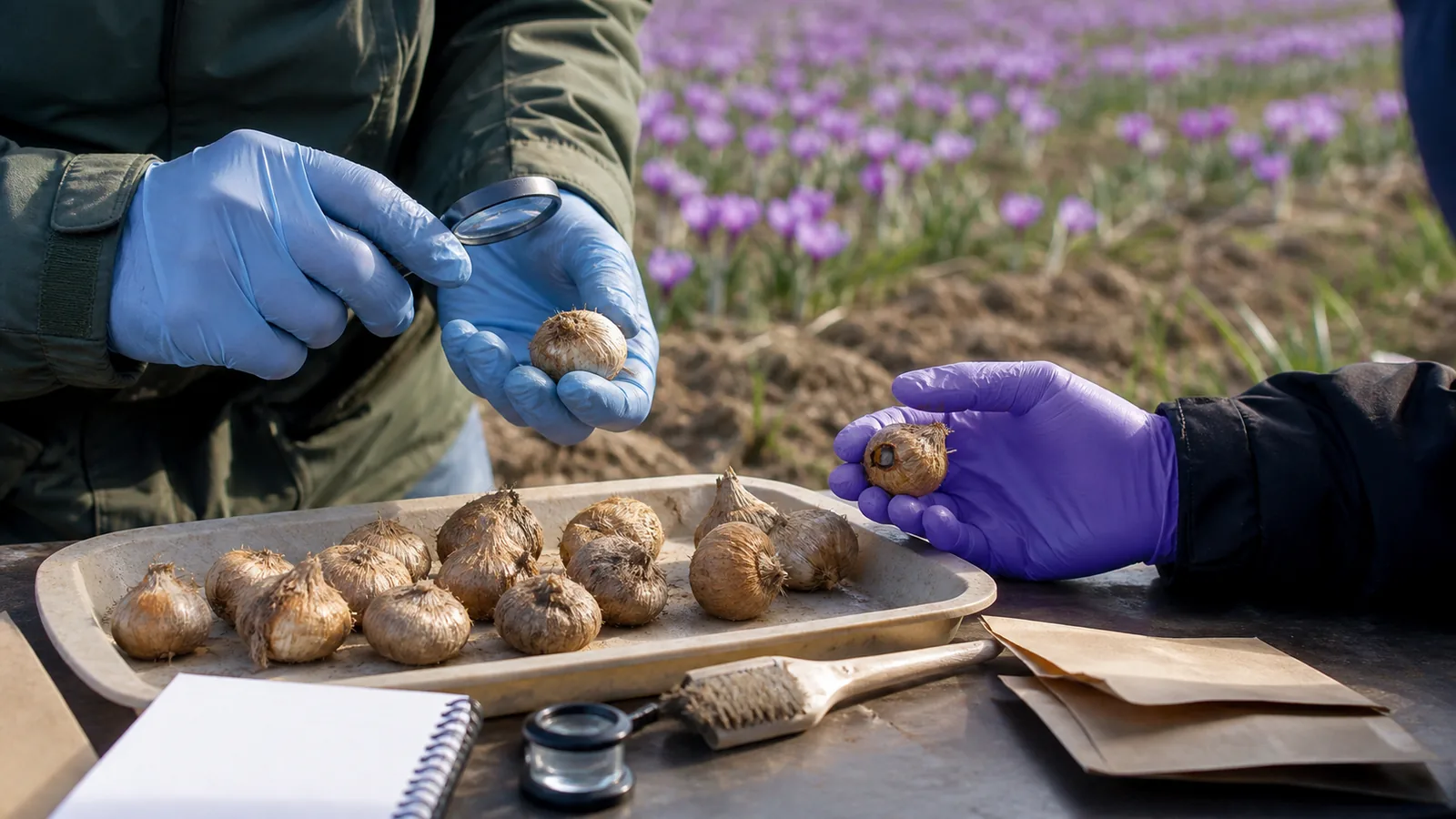
Good saffron pest and disease management starts with identification, not a pesticide. Yellow leaves, missing shoots and soft corms can have several causes, including animals, mites, fungi, planting injury, poor drainage or normal seasonal decline. Record where the problem occurs, inspect representative plants and confirm the cause before choosing a control.
This matters for safety as well as crop protection. The previous version of this article included improvised poison-gas, exhaust and bait instructions. Those methods can kill people, pets and non-target wildlife and may be illegal. They have been removed. Any pesticide or fumigant must be authorised for the crop, pest, location and user in the country where it is applied, and its current label is the controlling instruction.
A field-diagnosis routine
Walk the field in a consistent pattern and mark affected patches. Compare the edge and centre of each patch with healthy plants. Photograph above-ground symptoms, then lift a small number of corms with enough surrounding soil to preserve evidence. Note irrigation, recent weather, planting depth, field age and any chemical treatment.
Look for clues rather than relying on one symptom:
- cleanly grazed leaves or missing shoots may point to a vertebrate;
- burrows, runs, droppings, tracks and gnaw marks help distinguish animals;
- fine stippling or silvery leaf damage may justify checking for thrips or mites;
- surface wounds and tunnels in corms may indicate feeding or mechanical injury;
- soft, discoloured or foul-smelling corms need disease assessment; and
- widespread yellowing after poor drainage may be an agronomic problem rather than one pest.
A local plant-diagnostic laboratory or crop adviser can examine affected tissue. That is especially valuable when a field has repeated losses or when a treatment decision could affect food safety, beneficial organisms or future planting material.
Rodents, rabbits and other digging animals
Animals can damage saffron in different ways. Rabbits may graze green shoots. Rats, mice, voles, gophers or other burrowing rodents can feed on vegetation or corms, disturb roots and irrigation, and use tunnels across the field. The species varies by region; a hole in the soil is not enough to identify it.
The older Iranian source used translated names such as “hedgehog,” “porcupine,” “mole” and “real mouse” inconsistently. It described one animal digging up and eating corms and leaves, another making long tunnel networks roughly 15–20 centimetres below ground in hilly land, and a mouse said to remain active year-round and produce up to six generations. These observations can help a scout notice patterns, but the animal must be identified locally before control. Moles, rodents, hedgehogs and porcupines have different diets, legal status and appropriate management.
Start with lower-risk integrated pest management:
- map active burrows and confirm activity rather than treating every old opening;
- remove avoidable food, rubbish and dense harbourage around storage and packing areas;
- protect stored corms in sound containers or structures;
- repair irrigation leaks that create shelter or easy digging conditions;
- use species-appropriate exclusion at vulnerable beds; and
- consult a licensed wildlife or pest professional when damage continues.
What about a buried mesh barrier?
The historical source proposed a fine barrier about one metre above ground and 30 centimetres below it. A physical barrier can help in a small high-value planting, but the design must match the confirmed animal and avoid entangling wildlife. Rigid wildlife-safe mesh, secure gates and careful inspection are generally more defensible than loose bird netting. On a large field, installation and maintenance costs may make another strategy more practical.
The same source mentioned pumpkin seeds as bait for a digging animal. Food bait can attract non-target wildlife, so it is not included here as a control recipe. Traps, if lawful, should be designed for the identified species, protected from children and non-target animals, and checked as local welfare rules require.
Why improvised poison and exhaust methods are excluded
Do not pump motorcycle, car or other engine exhaust into burrows. The University of California Statewide IPM guidance notes that using a gas-powered engine to generate carbon monoxide for this purpose is illegal in its jurisdiction; registered devices are intended for pest professionals, and carbon monoxide can kill people as well as rodents.
Do not place chloropicrin-soaked cloth, unknown tablets or loose poison in a tunnel. Fumigants can move through connected burrows and into occupied spaces. The US Environmental Protection Agency’s rodenticide guidance requires label compliance and warns about access by children, pets and wildlife. Regulations differ by country, but the safety principle does not: only a registered product may be used, only for the listed site and species, by a person legally allowed to apply it.
Bulb mites and corm injury
Bulb mites can be associated with darkened, decaying areas and weakened plants, but damage is easier to establish by examining corms and identifying the organism than by leaf symptoms alone. Mites may exploit injured or rotting tissue. Poorly handled planting material can therefore carry both physical damage and biological risk into a clean field.
Preventive practice is more reliable than a generic “mite treatment”:
- buy planting material from a traceable source;
- reject soft, wounded, discoloured or visibly infested corms;
- handle and transport corms without bruising or prolonged damp storage;
- keep questionable lots separate from healthy planting material;
- avoid moving soil and corm debris from affected areas into clean fields; and
- use planting depth and field renewal intervals suited to local soil and agronomy, not a universal fixed number.
A 2023 study of saffron corm rot and injury found that physical injury could be central to rot development in the material it tested. The result does not rule out pathogens in other regions; it strengthens the case for careful handling and diagnosis.
Thrips and other leaf-feeding insects
Thrips are small, narrow insects that feed on plant tissue and can leave pale or silvery marks. The original article placed most concern late in the growing season, after flowers had been harvested, and said chemical treatment was not usually required. That is a sensible starting point: confirm the insect, measure the extent and consider crop stage before intervening.
Do not spray solely because one damaged leaf is present. Check several sites, look for live insects and compare with untreated healthy areas. If a threshold or locally validated recommendation exists, follow the regional crop-protection service. Broad-spectrum applications can harm beneficial organisms and may not improve the harvested spice when the timing and pest pressure do not justify them.
The old text also referred to a white “saffron bulbworm” that tunnels in corms and causes wilting, yellowing and dry leaves, but it did not supply a scientific species name. Keep that as a field symptom category, not a confirmed diagnosis. A species-level identification is necessary before selecting an insecticide.
Corm rot, wilt and the problem with one-name diagnoses
Dark spots, soft rot, yellowing and wilt can arise from a disease complex. The previous page assigned “wilt” to Rhizoctonia and Ulocladium and a “smut” condition to Fumago. Symptoms alone do not establish those organisms, and current studies show why a simple label is risky.
A 2023 pathogen-identification study of saffron corm rot found Fusarium oxysporum in diseased corms from the study area and identified infected corms as the main primary infection source there. Other work has reported several fungal genera in association with saffron rot. The dominant organism and the role of injury, soil and secondary colonisers may differ among regions.
Practical risk reduction includes planting sound corms, preventing wounds, ensuring drainage, separating suspect lots, cleaning tools and containers, and removing badly affected material in a way that does not spread soil or corm fragments. Do not compost diseased corms back into a saffron field unless an appropriate local plant-health authority says the process controls the relevant pathogen.
Long rotations may be useful for some soil-borne problems, but “six to eight years” should not be treated as a universal cure. Rotation choice, duration and alternative crop depend on the confirmed pathogen and how long it survives locally.
Use pesticides only after the problem is defined
A brand name or percentage copied from an old article is not a safe recommendation. Product registrations, maximum residue limits, pre-harvest intervals, personal protective equipment and allowed application methods change by country and over time. A product approved for ornamental crocus, onions or rodents near buildings may not be approved for saffron grown as food.
Before any treatment, confirm all of the following:
- the target organism has been identified;
- the product is currently registered for that organism, crop and site;
- the intended user holds any required licence;
- the label covers dose, timing, protective equipment and re-entry;
- food-residue and harvest restrictions can be met; and
- children, workers, livestock, water and non-target wildlife are protected.
Rodenticides can also poison predators or scavengers that eat contaminated animals. The EPA’s rodenticide safety review explains primary and secondary wildlife risks and why bait formulation and placement controls matter. Local law, not this article, determines which products are available.
A season-long saffron IPM plan
- Before planting: review field history and drainage; inspect corm lots; clean equipment; document source and lot identity.
- After emergence: walk fixed routes, map missing or weak patches and record animal signs and leaf symptoms.
- When damage appears: inspect above and below ground; obtain diagnostic help; isolate affected planting material.
- Before treatment: compare cultural, physical, biological and chemical options; choose the least disruptive effective method.
- After treatment: record what was done, where, when and by whom; revisit the same marked areas to measure the result.
- After the season: compare yield and damage maps, review storage losses and change the next planting plan based on evidence.
Our saffron planting guide covers site preparation and crop establishment. For pests and diseases, the durable rule is to identify first, prevent movement second and treat only when the diagnosis and local rules support it. That approach protects the crop without turning an uncertain symptom into a dangerous control decision.

![Exporting Saffron to Turkey + Price Guide [Complete 0 to 100]](https://img.rowhanisaffron.com/20260827003933/saffron-export-turkey-quality-inspection.webp)



