


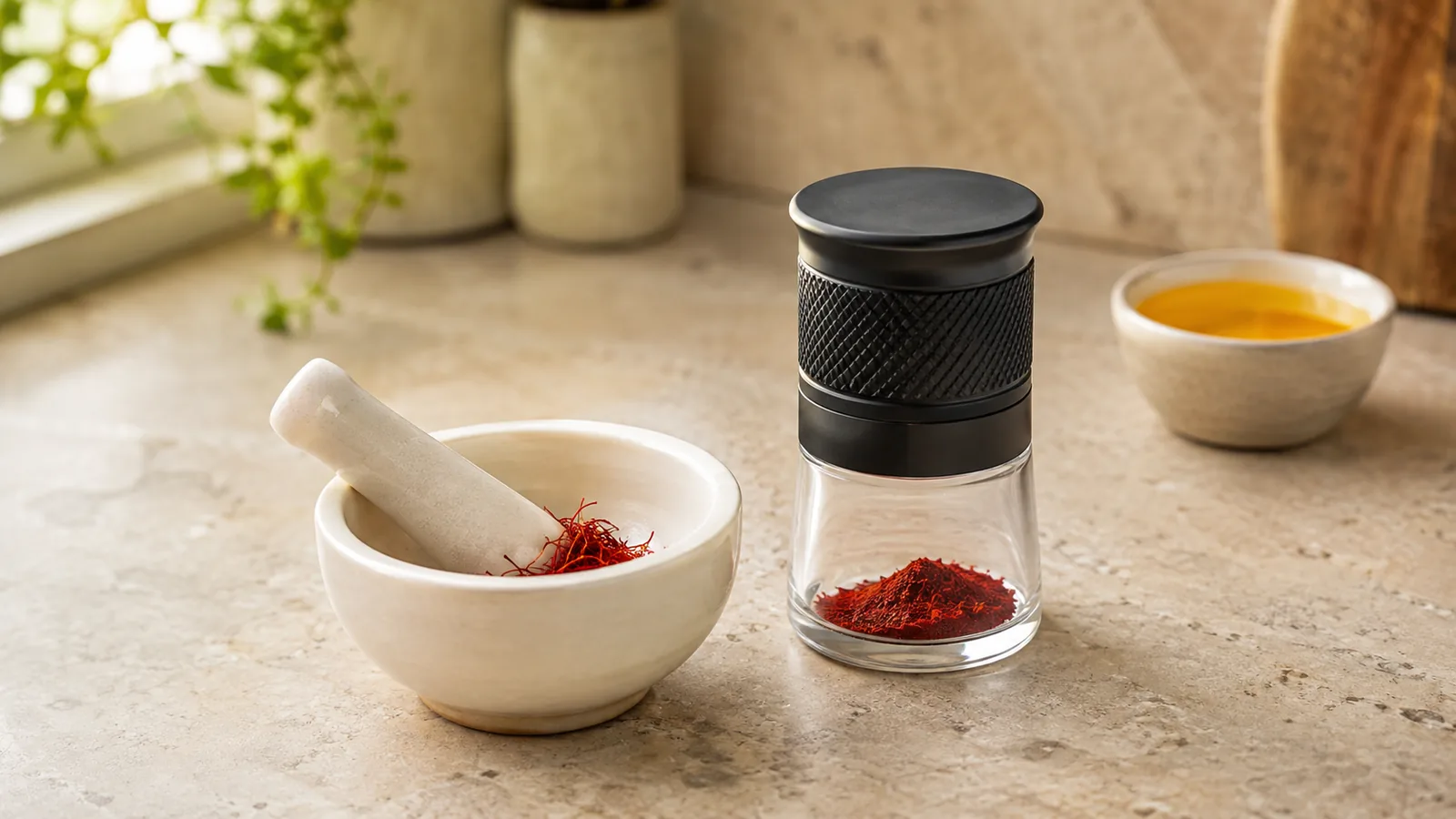
The main saffron grinder benefit is control: a small tool turns brittle threads into an even powder without scattering an expensive ingredient across the worktop. A mortar and pestle can do the same job just as well. The better choice depends on how much saffron you grind, how often you use it and how easily the tool can be cleaned.
Comparing Saffron Grinder Benefits with Mortars
For a home cook preparing one dish, a small mortar is usually the simplest option. It lets you see and feel the threads break down, works with very small quantities and has no hidden mechanism to trap powder. A dedicated hand grinder or saffron crusher becomes convenient when the same process is repeated often, especially if its chamber keeps the powder contained.
Neither tool automatically produces better saffron. A grinder cannot recover 100% of the powder, and an ordinary metal mortar does not generate enough friction in a few seconds to burn dry threads. Surface texture, cleanliness, chamber design and technique matter more than a blanket rule about stone, metal or glass.
What is a saffron grinder?
A saffron grinder is a small manual device made to crush threads in a contained chamber. Some use a twist top or handle; others resemble compact spice mills. The useful designs have a chamber small enough for a pinch of saffron, surfaces the user can reach, and an opening that lets the powder fall out without repeated tapping.
The term saffron crusher is often used for the same tool. Before buying one, look beyond the name. A large general-purpose mill may let a tiny amount sit below its blades or between teeth. A transparent container is helpful for seeing the grind, but it does not prevent residue by itself.
Useful saffron grinder benefits
- Containment: a closed chamber reduces the chance of threads jumping out while they are crushed.
- Speed: a twist mechanism can process repeated small portions with little hand pressure.
- Repeatability: the same number of turns can help a regular user produce a similar texture each time.
- Clean transfer: a well-designed removable cup makes it easier to add the powder to blooming liquid.
Those are practical advantages, not proof that every grinder prevents waste. Fine saffron can cling through static, moisture or an awkward seam. If the chamber cannot be opened fully, the tool may retain more spice than a smooth mortar.
Why many cooks still use a mortar and pestle
A mortar gives direct control over a small quantity. Pressing and rubbing, rather than striking hard, breaks the dry threads while keeping them inside the bowl. A pinch of sugar can act as a visible abrasive when the recipe can accommodate it; an Ohio State University feature on saffron in an Iranian kitchen records this technique with a brass mortar.
Wooden, metal and stone mortars all exist, but no one material is always best. Wood can carry aromas or stains if it is porous. Rough stone may hold powder in its texture. Reactive, rusting or damaged metal should not touch food, while a clean, food-safe metal mortar is not inherently too hot for saffron. Smooth glazed ceramic, glass, well-finished stone and food-safe metal can all work.
For saffron, size matters. A broad mortar designed for several tablespoons of spices gives a pinch too much room to escape. Choose a small bowl with sides high enough to contain the threads and a pestle that reaches the curve at the bottom.
How to grind saffron threads
- Measure only what the recipe needs. Keep the remaining saffron as whole threads in its storage container.
- Check the threads. Properly dried saffron should feel dry and become brittle under pressure. Do not grind over steam or beside a wet sink.
- Use a clean, dry tool. Smell the mortar or grinder first. Coffee, pepper, soap or stale spice aromas can transfer.
- Crush gently. In a mortar, press and rotate the pestle until the threads form a reasonably even powder. In a grinder, use short turns and inspect between them.
- Transfer promptly. Brush the powder into the dish or blooming liquid with a small dry food-safe brush or spatula. Do not use fingers if moisture is present.
A perfectly microscopic powder is unnecessary for most cooking. The aim is to expose more surface area so water can reach the saffron evenly. The scientific literature on saffron drying and volatile compounds notes that pulverising plant tissue releases aromatic compounds; that is useful at the point of cooking, but it is also a reason not to grind a large supply far in advance.
Do not dry saffron over a gas flame
Commercial culinary saffron should already have been dried under controlled conditions. If threads are soft, clumped or damp, do not hold them over an open gas flame or place an uncertain amount in a hot oven. Direct heat is uneven, a tiny quantity can scorch quickly, and a flame introduces a needless fire risk.
Moisture may indicate poor storage or a compromised container. Inspect the product for off odours, visible mould or other deterioration. When in doubt, replace it rather than trying to rescue it with uncontrolled heat. Drying newly harvested stigmas is a separate production process in which temperature and time influence the compounds associated with colour, taste and aroma.
The current ISO 3632-1 saffron specification covers dried saffron in filament, cut-filament and powder forms and includes storage and transport recommendations. A kitchen grinder is for portion preparation; it is not a substitute for correct commercial drying.
Does grinding unlock saffron’s colour and aroma?
Grinding increases the surface exposed to liquid, so colour and flavour can disperse more evenly. It does not create quality that was absent from the threads, and no tool can promise the full colour and aroma under every recipe condition. Water temperature, steeping time, recipe volume and when the infusion is added all affect the result.
After grinding, add a small amount of warm liquid and allow the colour to spread before using it in the main dish. Our guide to grinding and brewing saffron explains the infusion step and when whole threads may be preferable. Boiling the powder aggressively is not required.
Which method wastes less saffron?
The lowest-waste method is the one that matches the portion. A tiny smooth mortar can outperform a large mechanical grinder because every surface is visible and reachable. A dedicated grinder can outperform a rough or oversized mortar because it keeps the threads enclosed. No method is completely without waste; claims of a waste-free process or 100% recovery should be treated as advertising, not measurement.
To compare tools fairly, measure the same mass of threads, grind to the same practical texture, transfer the powder and inspect what remains. Also count washing and drying time. A device that saves ten seconds but traps saffron in an inaccessible joint is not more efficient.
Cleaning a saffron grinder or mortar
Use the maker’s food-contact cleaning instructions. Removable glass or ceramic parts may tolerate washing, while a mill mechanism may need a dry brush. Whatever the material, it must be completely dry before the next portion goes in. Do not grind saffron immediately after oily spices or coffee unless the tool has been cleaned and aired.
If saffron is visibly caught in a smooth mortar, a little of the recipe’s warm water can rinse the remaining colour into the dish. Do this only when liquid belongs in the recipe. For a dry preparation, use a clean soft brush instead.
Grind now or store as powder?
Keep most saffron as threads and grind the required amount close to use. Whole threads are easier to inspect for identity and give less exposed surface during storage. Research following changes in saffron during storage confirms that its chemical and volatile profile changes with time, even though individual aroma components do not all move in the same direction.
Store the remaining threads tightly closed, dry, away from light and away from strong kitchen odours. Label the container with the purchase or harvest date rather than relying on memory. If you do keep ground saffron, use a small airtight container and avoid opening it over steam.
Grinder or mortar: the practical choice
Choose a small mortar and pestle when you grind one recipe at a time and want maximum control. Choose a purpose-built saffron grinder when containment and repeated use justify another tool. In either case, a clean, dry, appropriately sized device and a careful transfer matter more than the sales name.
Saffron grinder benefits are real when the design suits the quantity: speed, containment and repeatable texture. A mortar offers equally real benefits in visibility, simplicity and recovery. Neither is automatically superior. The best result comes from grinding dry threads gently, blooming them appropriately and storing the rest whole.

![Exporting Saffron to Turkey + Price Guide [Complete 0 to 100]](https://img.rowhanisaffron.com/20260827003933/saffron-export-turkey-quality-inspection.webp)



