


History of Saffron Cultivation in Iran
The history of saffron cultivation in Iran is not a straight line from one birthplace to one modern growing region. Saffron appears in accounts of Persian food, trade, dyeing and medicine across many centuries. Western districts near Hamadan were once celebrated for their crop, while Khorasan later became the name most closely associated with Iranian saffron farming and production.
It helps to separate three questions that are often folded into one: where the cultivated plant first emerged, where saffron was grown in historical Iran, and where most Iranian saffron is produced today. The evidence does not give the same answer to all three.
Ancient saffron: use, cultivation and an unsettled origin
Saffron has been used across the eastern Mediterranean and western Asia for more than three millennia. Ancient art, written records and plant genetics all contribute evidence, but they do not support every traditional origin story equally.
A modern review combining historical material with genetic research argues that cultivated Crocus sativus most likely emerged from Greek populations of Crocus cartwrightianus. The same review also describes early Persian cultivation and the place of saffron in Persian art and material culture. That distinction matters: a probable botanical origin outside modern Iran does not erase Iran’s very old cultivation tradition, nor does a long Iranian tradition prove that one present-day village was the first place on earth to grow the plant.
Encyclopaedia Iranica notes indications that saffron was cultivated on the Iranian plateau in antiquity. Historical discussions also record its use as a food ingredient, fragrance, colorant and textile or painting dye. Because saffron is sterile and propagated by corms, its spread depended on people carrying planting material and cultivation knowledge from one region to another.
Rudavar and the western Iranian saffron record
Rudavar—also rendered Rudhrawar, Ruzdar or Roosdavar in different transliterations—lay between Nehavand and Hamadan, close to the Alvand mountain region. It is an important part of the documented history of saffron farming in Iran.
Medieval geographers described high-quality saffron from this district and a trade that carried it beyond the immediate area. Encyclopaedia Iranica’s history of Nehavand identifies Rudavar as a neighboring saffron-growing district, while Guy Le Strange’s historical geography, drawing on writers including Yaqut and Hamdallah Mustawfi, calls the district famous for saffron and describes its network of villages.
This evidence supports a careful claim: Rudavar was a notable western production center in the medieval record. It does not establish that Rudavar was the uncontested birthplace of all saffron cultivation in Iran, and it does not justify assigning that beginning specifically to the Sasanian period without stronger direct evidence. The region’s real historical importance is substantial enough without turning it into a certainty the sources cannot prove.
How Khorasan became the centre of saffron farming in Iran
Over time, the centre of production shifted east. Today, the word “Iranian saffron” is closely linked with Khorasan, especially Razavi and South Khorasan. The crop suits parts of this dry continental landscape: hot summers coincide with corm dormancy, autumn cooling supports emergence and flowering, and winters allow the leaves and daughter corms to develop.
Climate alone does not explain the region’s success. Farmers built knowledge around corm selection, irrigation timing, harvest at daybreak, fast flower handling and stigma drying. Water systems mattered as well. The Food and Agriculture Organization recognizes the qanat-based saffron farming system of Gonabad as a Globally Important Agricultural Heritage System. Qanats move groundwater by gravity and have helped farming communities manage scarce water in an arid and semi-arid landscape.
A 2014–2015 production table submitted through the FAO/WHO Codex process shows how concentrated the sector had become: Razavi Khorasan accounted for by far the largest recorded area and output in that dataset, followed by South Khorasan. Smaller areas were reported in provinces including Isfahan, North Khorasan, Kerman, Fars and Yazd. Those figures are a dated snapshot, not a current production forecast, but they clearly show the modern geography behind Khorasan’s reputation.
Which country is the leading producer of saffron?
Iran is the leading producer of saffron in the official sources reviewed for this article. The FAO page for the Gonabad heritage system describes Iran as the world’s largest producer and says it supplied more than 90 percent of global production when the system was recognized in 2018.
That figure should be read with its date and source attached. Annual production changes with weather, corm condition, field age, prices and reporting methods. Other countries—including Afghanistan, India, Greece, Morocco and Spain—also grow saffron, and Spain has long played a major role in grading, packing and international trade. Saying Iran leads production is well supported; saying no other country could ever surpass it is not.
What made saffron production in Iran durable?
A crop adapted to dry-season farming
Saffron does not need irrigation throughout summer because the corm is dormant, although it still depends on suitable soil conditions and carefully timed water when growth resumes. This seasonal pattern gave the crop a place in regions where water was limited and had to be allocated with care. It was never “water-free”: establishing corms, triggering autumn growth and supporting winter leaves still require sound moisture management.
Skilled work at harvest
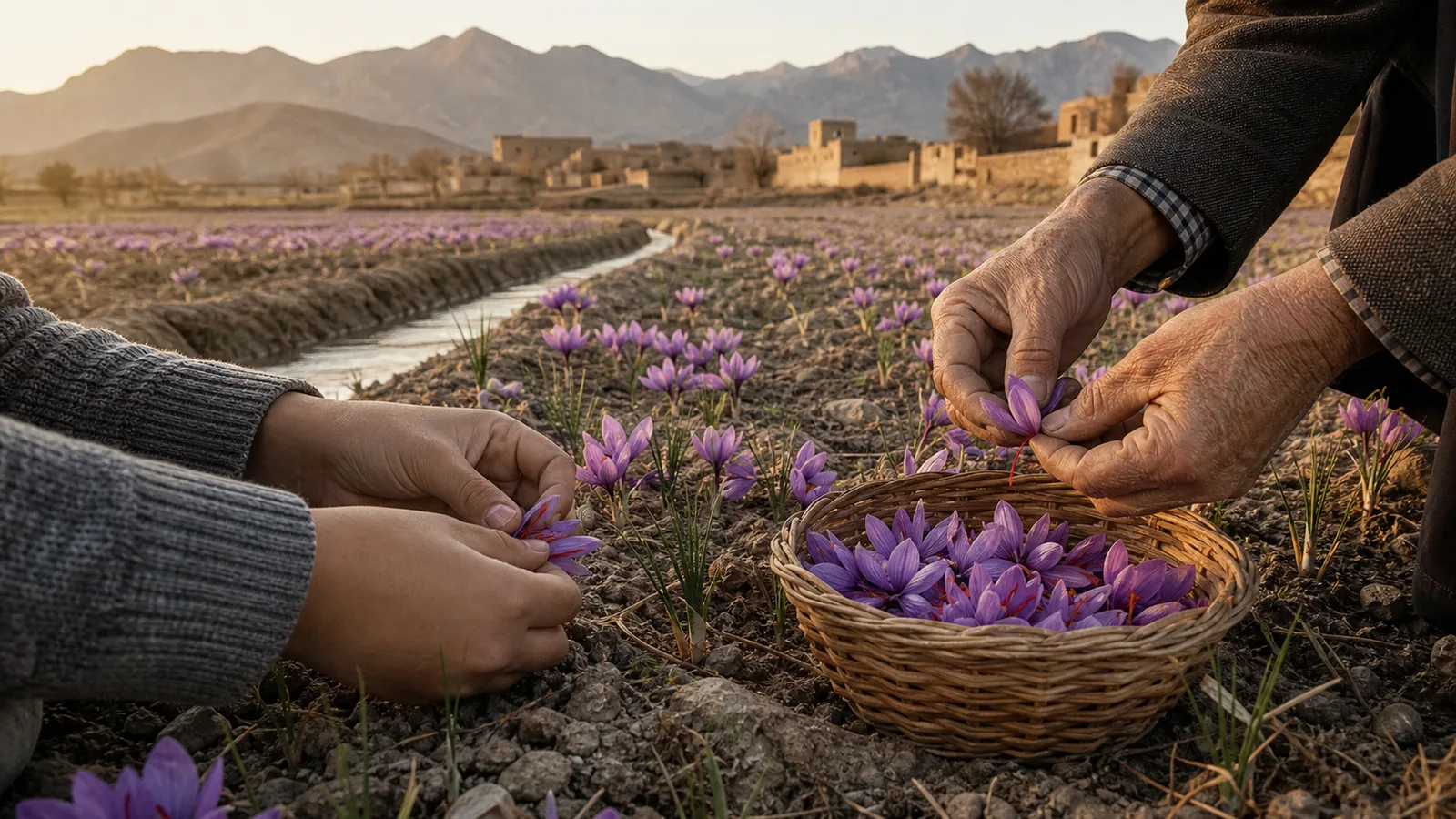
The commercial spice is made from the three red stigmas inside each flower. Flowers open over a short season and are usually collected in repeated early harvests before heat and handling damage reduce quality. Separating the stigmas and drying them well requires speed and judgement. That labor, repeated across many small farms and villages, is part of the history just as much as acreage or export figures.
Trade, quality and regional knowledge
Historical references to Rudavar show that saffron was already a traded regional specialty. Modern supply chains are longer, but the basic challenge remains: buyers cannot judge origin or quality from a romantic story alone. Moisture, foreign matter, aroma and the compounds associated with color, flavor and fragrance need proper control. Geographic reputation has value only when handling, testing and traceability support it.
For readers interested in how cultivation choices affect the crop itself, our guide to the ideal method of saffron cultivation explains field preparation and seasonal care. The page on Iranian saffron producers looks more closely at the people and production network behind the market.
The future of saffron cultivation in Iran
Iran’s historical lead does not make its future automatic. Water scarcity, soil degradation, rising labor costs, adulteration and uneven returns to growers all put pressure on the sector. Climate shifts can also change the temperature and moisture sequence that controls corm growth and flowering.
The practical response is less dramatic than claims about permanent dominance. Farms can keep field-level records, renew overcrowded plots, select healthy corms, improve drying hygiene and use water according to measured soil conditions. Producers and traders can strengthen lot identification, laboratory testing and honest origin records. Research matters most when it reaches growers in a form they can test locally.
The Qanat system offers a useful historical lesson here. Iranian saffron farming lasted because communities adapted a valuable crop to the limits of their landscape. Preserving that knowledge does not mean freezing production in the past. It means carrying forward the parts that still work while using better evidence to solve today’s problems.
Sources and further reading
- Ancient artworks and Crocus genetics on saffron’s origin, peer-reviewed open-access review.
- Nehavand and the Rudavar saffron district, Encyclopaedia Iranica.
- Historical geography of Rudavar between Hamadan and Nehavand, Qatar Digital Library.
- Iranian foodstuffs and early cultivation references, Encyclopaedia Iranica.
- Qanat-based Saffron Farming System in Gonabad, Food and Agriculture Organization of the United Nations.
- Iranian production and export data submitted to Codex, FAO/WHO Codex Alimentarius.
Iran’s saffron story is therefore broader than a single origin claim. It runs from early cultivation and use on the Iranian plateau, through the documented saffron trade of western districts such as Rudavar, to the qanat-supported farms and concentrated production of Khorasan. The geography changed; the crop’s place in Iranian agricultural life endured.

![Exporting Saffron to Turkey + Price Guide [Complete 0 to 100]](https://img.rowhanisaffron.com/20260827003933/saffron-export-turkey-quality-inspection.webp)



