


An ideal saffron farming method is not one fixed recipe. It is a field plan built around local soil, drainage, climate, corm quality, water and labour, then adjusted with records from each season. A method is only “ideal” when it improves a particular farm without trading short-term flowers for weak corms, avoidable cost or future disease.
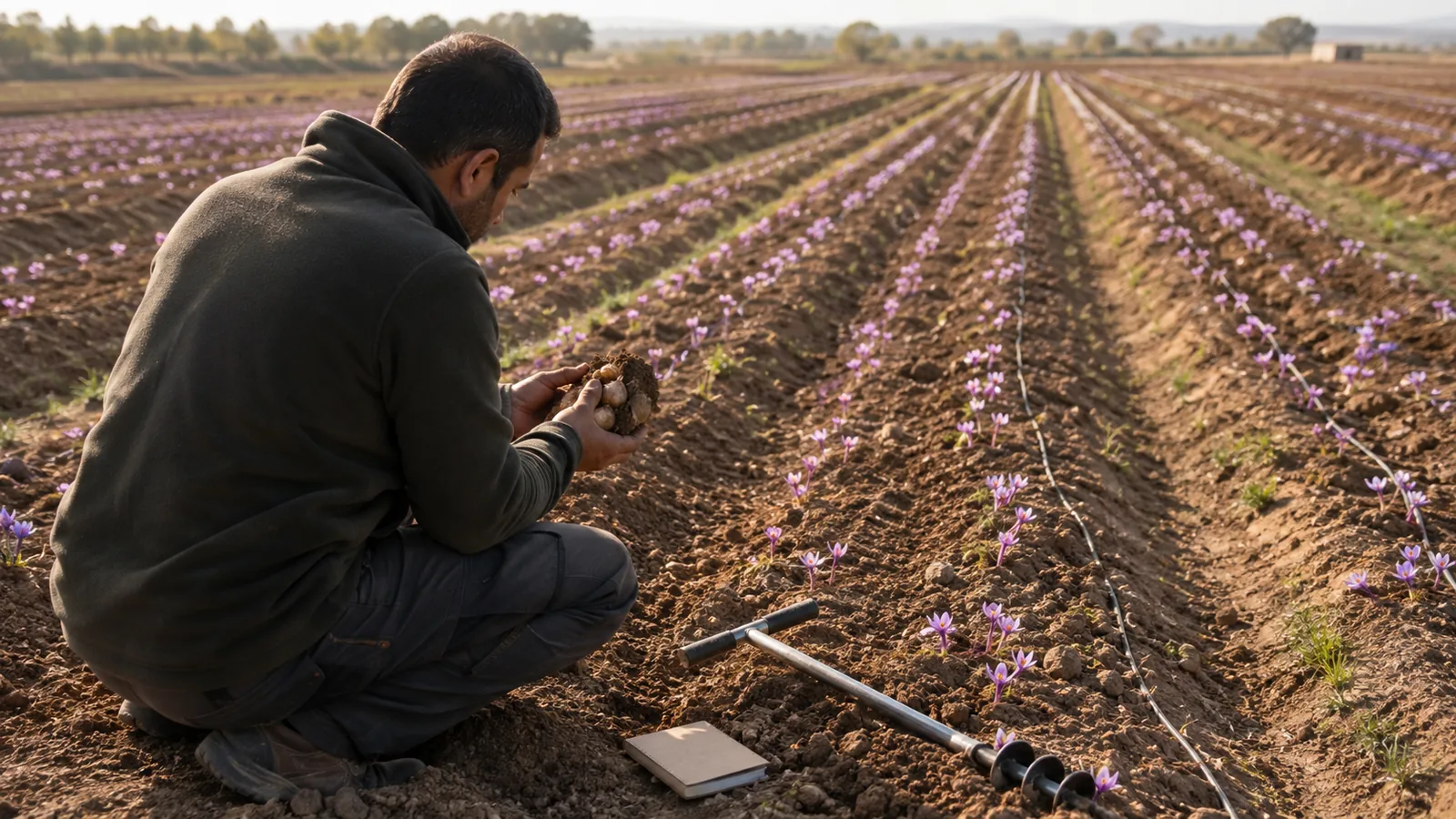
Ideal Saffron Farming Method
The phrase is sometimes used for “innovative farming”: denser or more orderly planting, selected corms, planned irrigation and fertilisation, and machinery where it genuinely saves work. Those ideas can be useful, but they do not form a universal package with a guaranteed yield. Saffron responds to the interaction between the site and the crop, not to a fashionable label.
A practical modern method begins with a baseline. Record the soil texture and drainage, salinity, available water and its quality, previous crop, corm size, planting density, planting depth and the age of the field. After flowering, record flower number and dry stigma yield separately. Without those measurements, “better” may mean only that one unusually good harvest was compared with a poor traditional field.
Start with the field, not a yield promise
Saffron needs soil that allows roots to develop while excess water moves away. Compacted or waterlogged ground raises a different set of risks from a freely drained, drought-prone field. Soil chemistry matters too, but a single pH, salinity or fertiliser target should not be copied across farms without testing.
Before planting, inspect drainage after irrigation, obtain a representative soil analysis and map any visibly uneven areas. This is also the time to consider crop history and weed pressure. Correcting a structural problem after a perennial saffron bed is established is harder and more expensive than dealing with it before the corms go in.
Research on soil properties, saffron growth and quality shows why the whole environment matters: yield reflects planting, nutrition, irrigation, climate and site conditions together. The ideal method therefore begins with diagnosis rather than a standard input list.
Choose corms for the farm’s time horizon
Healthy planting material is one of the strongest early decisions. Corms should be sound, appropriately graded and free of visible rot or injury. Large mother corms often have more reserves and can support stronger early flowering, but that does not mean “largest at any cost” is the right commercial rule.
A six-year field study of corm size, planting density and saffron-field longevity found that larger corms yielded more during the first three years, while smaller corms performed better in years four to six under that experiment’s conditions. Density itself did not significantly change stigma yield across the full six years. The useful lesson is not a new universal spacing: corm size, field age and environment must be evaluated together.
Set density and depth deliberately
Closer spacing puts more corms into each square metre and can increase the number of potential flowering units at the start. It also raises the cost of planting material and changes how quickly daughter corms compete for room. Wider spacing uses fewer corms and may make field operations easier, but early yield per area can be lower.
Planting depth affects emergence, soil-temperature exposure, daughter-corm development and lifting. A controlled study of corm size and planting depth found meaningful interactions, which is another reason not to lift one depth from a trial and call it ideal everywhere. Use local extension experience and a small comparison strip before changing a whole farm.
The older description of this method said that the “growing season shortens from 9–10 years to 7 years.” That wording confuses the annual growing season with the productive life of a perennial bed. Seven years is better treated as a possible renovation interval, not an automatic benefit. Rotation or lifting may be justified when crowding, disease, declining yield or soil management calls for it; a calendar alone does not prove that the field should be replaced, and a shorter cycle does not by itself prevent soil erosion.
Plan irrigation around growth and local weather
Saffron is often described as a low-water crop, yet low water use is not the same as no need for irrigation. The response depends on rainfall, soil storage, temperature, field age and the timing of water relative to flowering and vegetative growth. Too little water can limit flowers and daughter-corm development; too much, especially in poorly drained ground, creates other problems.
A two-year field experiment on irrigation rounds and mother-corm size found that both influenced flower number, stigma yield, daughter corms and phosphorus uptake. It also found a trade-off: the treatment with the highest stigma yield was not the one with the highest crocin and picrocrocin percentages. “Maximum yield” and “maximum measured quality component” were not interchangeable goals.
For a working schedule, use soil moisture, current weather and the crop stage rather than a copied number of irrigations. Keep each field’s water dates and amounts with its harvest record. Our detailed guide to factors affecting saffron flowering explains why rooting, corm development and flowering need to be interpreted as a sequence.
Fertilise from evidence, not density alone
The claim that more corms per unit of land require less fertiliser is not a safe rule. Higher density can increase total crop demand and competition, while available nutrients depend on the soil, organic matter, irrigation and previous management. Applying less without measurement can weaken daughter corms; applying more by routine can waste money, increase salinity risk or create nutrient imbalance.
Use a representative soil test before establishment, then combine it with leaf or crop observations and field records where local advisers recommend them. Products, rates and timing should respond to a diagnosed need. “Fertilisation and spraying solutions” is too vague to be an agronomic instruction, and spraying should never be treated as a compulsory feature of innovative farming.
The companion article on nutritional management of a saffron farm sets out the same principle in more detail: testing and crop stage come before a calendar or a universal fertiliser formula.
Use machinery where it solves a real bottleneck
Mechanisation can help with soil preparation, bed formation, planting, cultivation and lifting when equipment fits the soil and row system. It does not make every operation faster. Flower picking and stigma separation remain delicate, time-sensitive jobs in most production systems, so labour planning for the flowering peak is still essential.
Reduced spacing can sometimes make flowers quicker to collect within a compact area; it can also make access awkward if beds and paths were not designed for workers. An ideal layout accounts for people carrying flowers out of the field, not only the maximum number of corms that can be placed in the ground.
How to treat the old yield and profit claims
This method has been promoted with claims of two to three times the traditional yield and 20–30 kilograms of dry saffron per hectare in the third or fourth year. The earlier account also said that Iran’s Ministry of Agricultural Jihad introduced the approach to farmers in 2011. Those details are part of the method’s published history, but no named programme, region, trial design or official circular accompanied them here.
They should therefore be treated as claims to verify, not as a farm budget. “Traditional” needs a measured baseline; kilograms must refer to dry stigma, not flowers; and the year of the bed must be recorded. Weather, planting material and management can produce large variation. A high result from one trial cannot promise 20–30 kilograms on another farm.
The same applies to lower maintenance, fertiliser, water and labour costs, maximum yield, reduced risk and stable profits. Each is a possible outcome under the right conditions, not an inherent property of a method. Profit also depends on corm cost, labour during the short harvest window, drying losses, quality grade and the sale price actually received.
A better way to test an innovative method
- Define the proposed change. Specify corm grade, density, depth, irrigation, nutrition or equipment rather than testing a bundle called “modern farming.”
- Keep a comparison. Use a representative strip under the farm’s current method so weather affects both treatments.
- Measure the right outputs. Record flowers, dry stigma yield, quality results where available, daughter-corm size, water, inputs and labour hours.
- Follow more than one season. Saffron is perennial, and a treatment that looks strong in year one may change as corms multiply.
- Calculate cost per saleable unit. Yield alone does not show whether extra corms, water or labour paid for themselves.
The ideal saffron farming method is the one a grower can explain with field evidence. It combines healthy corms, suitable soil, intentional spacing, timely water, measured nutrition and realistic labour planning. Most importantly, it remains open to correction: records from the farm decide what to keep, what to change and what not to scale.

![Exporting Saffron to Turkey + Price Guide [Complete 0 to 100]](https://img.rowhanisaffron.com/20260827003933/saffron-export-turkey-quality-inspection.webp)



