


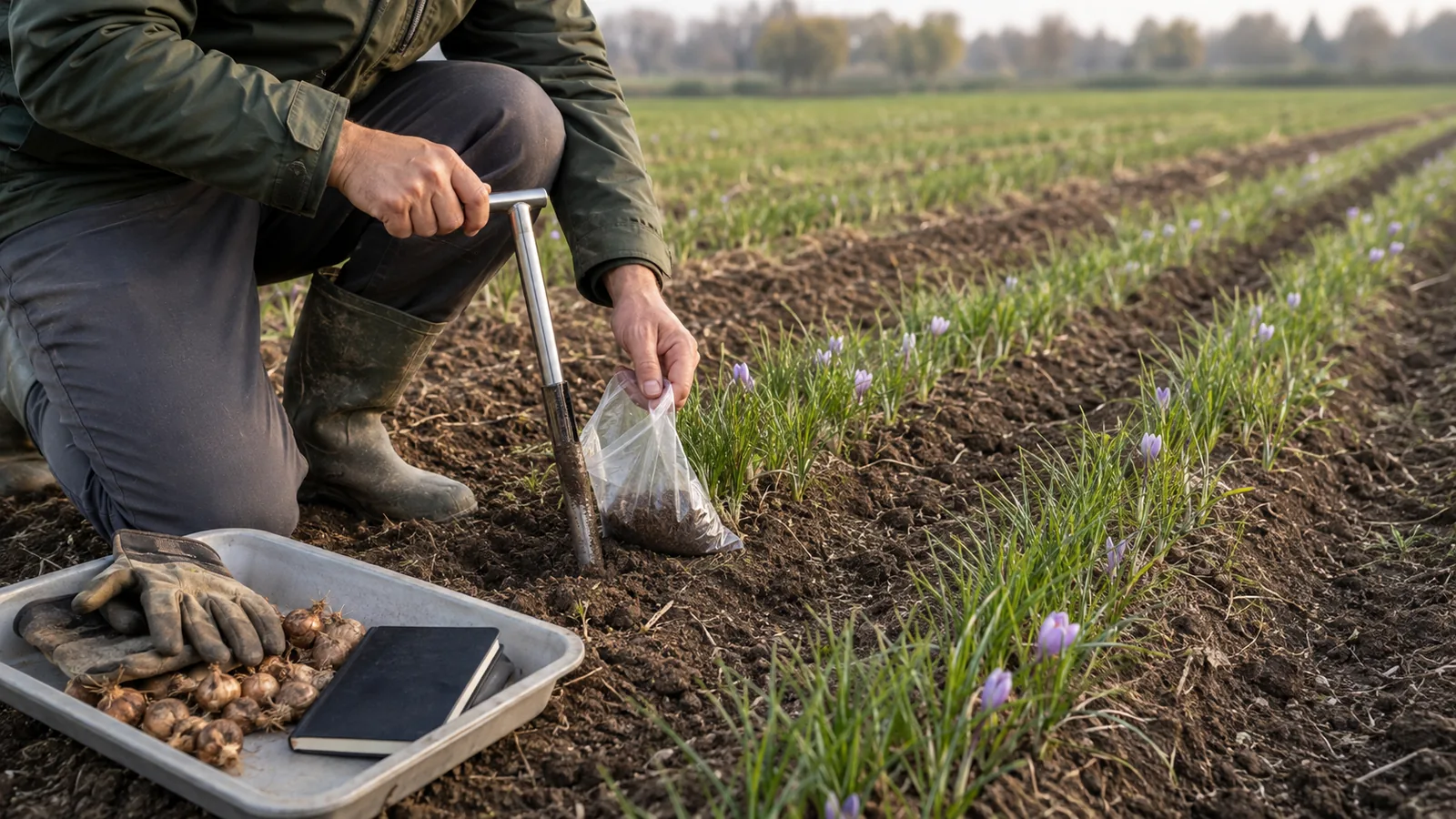
A Saffron nutritional program should begin with the field, not a fertilizer calendar. Soil and irrigation-water tests, crop stage, corm condition and the nutrients already present determine what to apply; a copied monthly dose cannot do that safely.
Farming with Saffron: Nutritional Management of a Saffron Farm
Saffron grows on an unusual rhythm. It flowers in autumn, maintains leaves through the cooler months, develops daughter corms during winter and spring, then loses its foliage and enters summer dormancy. Nutritional management should follow that living cycle.
The practical goal is not to make the soil as rich as possible. It is to correct measured limitations while protecting drainage, soil structure, salinity and the roots that take nutrients up. Research trials have obtained different results under different soils, climates, corm sizes and fertilizer systems. That variation is exactly why no single rate belongs on every saffron farm.
The Essentials of a Saffron Farm’s Nutritional Program
A useful plan has three parts: evidence from the field, a product calculation and a record of the crop’s response. Before buying inputs, collect a representative soil sample from the active rooting depth and ask an accredited laboratory for pH, electrical conductivity, organic matter, available nitrogen, phosphorus and potassium. Sulfur, calcium, magnesium, boron, zinc and iron may also matter, but only the local soil, water and plant evidence can show whether they are limiting.
Test irrigation water where salinity or alkalinity is a concern. Record field age, planting density, corm size, drainage, irrigation method, previous manure and fertilizer applications, leaf symptoms, disease patches and last season’s flower and daughter-corm yield. These details keep a laboratory result connected to the actual crop.
Agronomist review is valuable, especially for commercial acreage. Give the adviser the reports and product labels rather than asking for a generic shopping list. Fertilizer names such as “liquid calcium” or “humic acid” do not reveal nutrient concentration, salt index, pH effect or compatibility with irrigation water.
Start with the saffron growth cycle
Peer-reviewed work on saffron corm development places autumn flowering before the winter vegetative period. Daughter corms develop below the shoots, with their main growth supported by leaf photosynthesis later in winter and spring. Leaves then senesce around the start of the dry season and the corms become dormant.
This matters because an input spread on a dormant field is not the same as a nutrient absorbed by an actively growing plant. Timing must also shift with location. Mordad, Shahrivar, Mehr and Esfand are Persian calendar months, not universal crop stages: in rough Gregorian terms they span mid-July to mid-August, mid-August to mid-September, mid-September to mid-October and mid-February to mid-March. Weather, elevation and irrigation can move emergence and flowering.
The Timing of Nutritional Interventions
Plan backward from the crop stage rather than treating a date as a command.
- Before planting or while the field is dormant: test soil and water, correct drainage, calculate amendments and incorporate fully matured organic matter only where it is appropriate.
- Before emergence and flowering: complete irrigation-system checks and apply only the preplant or early-season nutrients justified by the plan.
- After flowering and during leaf growth: monitor leaf color, stand uniformity and root-zone moisture. This active period is more relevant to daughter-corm development than the leafless summer.
- Late winter and spring: reassess the crop before adding nitrogen or other soluble nutrients. Avoid late excesses that cannot be justified by soil or tissue evidence.
- At senescence: record results and avoid trying to “green up” foliage that is naturally finishing its cycle.
Our broader guide to the ideal method of saffron cultivation puts the nutrition work alongside corm selection, drainage, planting and irrigation. Those decisions are connected; fertilizer cannot repair a waterlogged bed or unhealthy planting stock.
Monthly Program Details for Saffron Farming
The former article offered four month-specific product rates. They are preserved below because growers may have arrived here looking for them, but they should be read as an old example, not a prescription. Each rate lacks a soil analysis, product nutrient concentration, application history and stated field condition.
July Program
The old July Program said to use 600 to 800 kilograms of specialized organic fertilizer to increase food reserves in the corms. In many saffron regions, however, July falls within dormancy. The leafless plant is not actively taking up a foliar feed, and “specialized organic fertilizer” is too vague to calculate a nutrient application.
If this quantity describes a mature compost or organic amendment for one hectare, its value depends on laboratory analysis, stability, salinity and the soil’s existing organic matter. Incorporation before planting can improve a suitable soil, but fresh or poorly matured manure can add weed seed, salts or hygiene problems. Confirm the material and the rate locally before it reaches the field.
August Program
The old August Program recommended 2 to 5 liters of liquid sulfur per hectare with the first irrigation, describing it as soil disinfection and a way to prevent pest and fungal damage. That explanation is not reliable. Sulfur can be a plant nutrient or a soil-acidifying amendment depending on its chemical form, but a fertilizer label is not proof that it controls a diagnosed pathogen.
Do not use liquid sulfur as a catch-all disinfectant. Check soil pH and sulfur status, identify the product’s concentration and follow its registered label. If corm rot is suspected, examine corms and drainage and obtain a diagnosis. Research on saffron corm rot and field conditions shows why disease investigation includes corm injury, pathogens and soil properties rather than one universal liquid treatment.
Potassium should likewise be supplied according to available potassium, yield removal and the laboratory recommendation. It participates in plant water relations and metabolism, but adding it to a field that already tests high is not automatically beneficial.
September Program
The former September Program specified 10 to 15 liters of liquid humic acid per hectare with the second irrigation to improve sprouting potential. A humic product may be used as a soil amendment, but it does not replace nitrogen, phosphorus, potassium or sound irrigation. Products vary in source and concentration, so liters alone cannot describe an agronomic dose.
At the approach to emergence, protect the root zone from both drought and waterlogging. Apply a humic product only where the adviser has a clear purpose for it, the label permits the method, and a jar test confirms compatibility with the irrigation water and other inputs.
March Program
The old March Program called for 1.5 to 2 liters of liquid calcium per hectare with the last irrigation. March or Esfand can overlap active leaf and daughter-corm development, making crop observation important, but the need for calcium cannot be established from the month. Soil pH, exchangeable calcium, water chemistry and the actual percentage of calcium in the product must come first.
If the test shows adequate calcium, another bottle may add cost without correcting a limitation. If a deficiency or structural soil problem is confirmed, choose the form and rate with a qualified local adviser. Do not assume that every calcium product has the same behavior or that it will “strengthen” corms at any dose.
What the main nutrients do
Nitrogen
Nitrogen supports green leaf growth, and those leaves supply carbohydrates to the developing daughter corms. The useful amount depends on soil reserves, organic matter, crop age and loss risk. Split placement can be more efficient than an indiscriminate broadcast application under some conditions. A five-year saffron field experiment on nitrogen placement and nutrient-loss reduction demonstrates that application method matters as well as total rate; its treatment rates belong to that study’s Kashmir soil and should not be copied as a worldwide recommendation.
Phosphorus and potassium
Phosphorus is involved in energy transfer and root development, while potassium contributes to water regulation and many enzyme processes. Both can accumulate in repeatedly amended soil. Base additions on an appropriate local extraction method and its interpretation, not merely on the assumption that saffron needs a “complete” fertilizer each year.
Calcium, sulfur and micronutrients
These nutrients are essential, but deficiency is not established by marketing language or a single yellow leaf. Root damage, salinity, waterlogging, pH and natural senescence can produce similar symptoms. Use soil and, where locally validated, tissue analysis to separate a real shortage from an uptake problem.
Organic matter is useful, but the source matters
Mature compost and well-managed manure can contribute nutrients and organic matter. Their composition is variable, so ask for moisture, organic matter, total nitrogen, available phosphorus and potassium, pH, electrical conductivity and a maturity or stability measure. Account for nutrients already applied through the material when calculating mineral fertilizer.
More is not always better. High-salt amendments can raise root-zone electrical conductivity, and excessive phosphorus may build up over repeated applications. Keep batches traceable and exclude material contaminated with persistent herbicides, plastics or untreated waste.
Turn the test into a field plan
- Mark management zones. Separate different soil types, slopes, drainage patterns and field histories instead of averaging unlike areas.
- Sample consistently. Use clean tools, a representative pattern and the same depth and season when comparing years.
- Set a realistic target. Use crop age, stand density, corm size and recent harvested yield rather than a promotional maximum.
- Calculate actual nutrients. Convert the label’s percentage into kilograms of nutrient per hectare. Include manure, compost and irrigation-water contributions.
- Choose timing and placement. Match them to roots, irrigation and local loss risks. Keep concentrated material away from direct contact with corms unless the registered label and adviser explicitly permit it.
- Leave a comparison strip. Where practical, an untreated or standard-practice strip helps show whether the change produced a useful response.
- Record the season. Note product, analysis, batch, rate, date, area, weather, irrigation and final flower and daughter-corm results.
Warning signs that need diagnosis, not more fertilizer
Uneven emergence, soft or discolored corm tissue, collapsing patches, poor drainage and foul odor point toward planting-stock, water or disease problems. Uniform pale leaves may justify a nutrition investigation, but yellowing at the natural end of the cycle is not automatically a deficiency.
Pause before adding another input when the cause is uncertain. Photograph the pattern, inspect roots and corms, review irrigation and send appropriate samples to a plant-diagnostic laboratory. Pesticides and disease-control products must be selected for a confirmed problem, registered for the crop and location, and used exactly as the label requires.
Conclusion: The Importance of a Proper Nutritional Plan for Saffron
A sound saffron nutritional program is specific enough to name the field, test, product analysis, rate, crop stage and expected response. It also knows when not to apply anything. Use the old July, August, September and March schedule only as a list of questions to investigate. Let current measurements and the crop’s real growth cycle write the final plan.

![Exporting Saffron to Turkey + Price Guide [Complete 0 to 100]](https://img.rowhanisaffron.com/20260827003933/saffron-export-turkey-quality-inspection.webp)



