


Factors Affecting Saffron Flowering: Part One
The saffron flowering process depends on more than the fertilizer applied in the previous season. Corm size and health matter, but so do planting density, depth, soil drainage, moisture and temperature. When a field flowers late or gives fewer blooms than expected, the useful question is not “Which single input failed?” It is “Which part of the corm’s annual cycle was under stress?”
The weeks after flowering are a good time to compare the harvest with the field record. Note which beds emerged first, where flowers were sparse, whether water collected after irrigation, and whether the weak areas follow a soil or planting-depth pattern. Those observations are more useful than guessing from the final yield alone.
How the saffron flowering process works
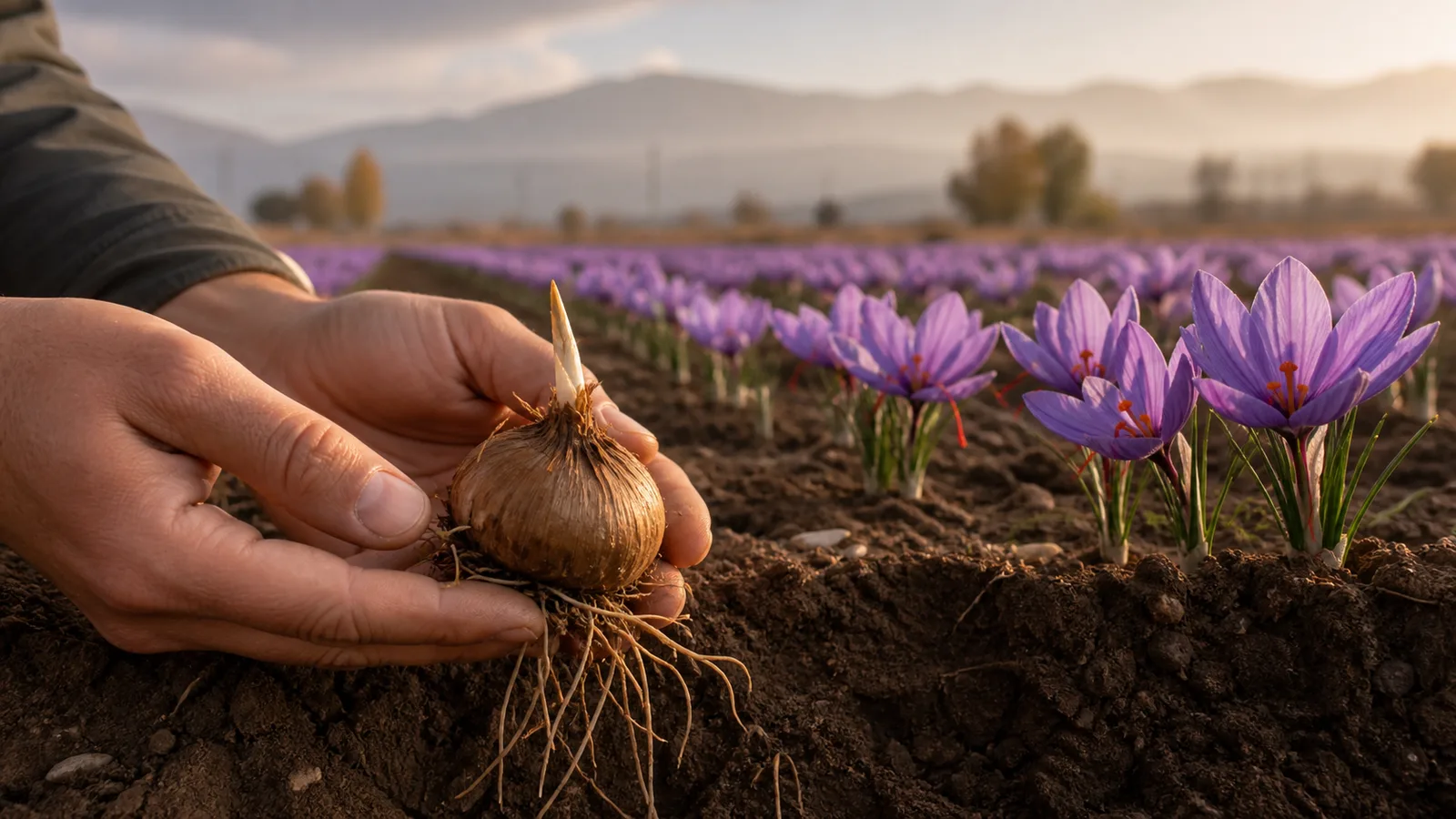
Saffron is an autumn-flowering plant grown from corms. The flower bud begins developing while the corm is dormant, before anything is visible above the soil. Cooler autumn conditions then support sprouting and flower emergence. After flowering, leaves and roots continue to grow through the cooler months while replacement daughter corms develop for the following season.
This timing explains why a problem seen at bloom may have started months earlier. Research on saffron corm development shows that the mother corm’s reserves support early growth, while the post-flowering leaf-and-root period is important for building the next generation of corms. A weak harvest can therefore reflect corm quality at planting, summer temperature, autumn conditions, disease, poor drainage or weak daughter-corm growth in the preceding season—not simply a late fertilizer decision.
Does rooting of saffron corms before flowering reduce yield?
Root growth before a flower appears does not, by itself, show that yield will fall. Roots are part of normal establishment, and the timing of visible rooting can shift with soil moisture, temperature, planting date and storage conditions. Flower initiation occurs inside the corm during dormancy, and the emerging flower initially depends heavily on reserves already stored in that corm. Rooting and flowering are related parts of the same cycle, not a simple contest in which one automatically prevents the other.
If rooting appears unusually early but flowering is weak, do not cut the roots or disturb the planted corms. Check the evidence around them: corm weight and health, planting date and depth, temperature history, irrigation timing, waterlogging, emergence rate and flower count. The root timing is an observation; it is not a diagnosis. The available phenology and corm-development research does not support the blanket claim that rooting of saffron corms before flowering reduces yield.
Saffron flower growing conditions
Blooming saffron needs a seasonal rhythm: a warm dormant period for flower development, followed by cooler conditions for emergence, with enough moisture to start growth but no prolonged waterlogging. The exact calendar differs by climate and elevation. A grower should use local soil temperature, weather and previous flowering dates rather than copy one irrigation date from a distant region.
Well-drained loam is generally easier to manage than either very heavy clay or very loose sand. Clay can hold useful moisture in a hot, dry season, but it can also stay saturated and poorly aerated. Sandy soil drains quickly, yet may lose water and heat more rapidly. Neither soil is automatically good or bad. Irrigation frequency, organic matter, bed shape and planting depth have to suit the soil actually present.
The main factors behind flower number and timing
1. Corm size and stored reserves
Larger, mature corms generally flower more reliably and can produce more flowers than small corms because they carry more stored reserves and are more likely to contain flower-capable buds. The old rule that every corm must weigh more than 8 grams is a useful field-screening shortcut in some production systems, but it is not a biological law. Published trials report different flowering thresholds under different climates and management, including flowering from some corms below 8 grams.
For a new field, grade corms into reasonably consistent size bands and record their average weight. Do not mix a large number of undersized corms into the same yield forecast as mature planting stock. For an established field, poor daughter-corm growth in winter and spring can reduce the stock capable of flowering the next autumn. Nutrition matters here, but it should be considered alongside leaf health, weed competition, moisture and disease.
2. Planting density and field age
A greater number of flower-capable corms can raise flower yield per unit of land in the early years. That does not mean the densest possible planting is always best. As daughter corms multiply, crowding increases and individual corms may receive less space, water and nutrition. A field that performed well when young can decline later even though it now contains more corms.
There is no single correct answer to how many saffron bulbs per hectare. The number implied by a spacing plan can be calculated as:
Corms per hectare = 10,000 ÷ row spacing in metres ÷ in-row spacing in metres.
For example, 20 cm between rows and 10 cm within a row gives a theoretical 500,000 planting positions per hectare. That is arithmetic, not a universal recommendation. Corm size, bed system, machinery, expected field life, water supply and local trial results should determine whether that density makes sense. Research comparing density treatments often finds a trade-off: higher density can improve early yield per area, while lower density gives each initial corm more room to multiply.
3. Planting depth and movement in the soil
Depth changes the temperature and moisture experienced by a corm. Planting too deeply can slow or reduce emergence in some conditions; planting too shallowly can expose corms to wider temperature swings, drying and physical damage. Studies have produced different best-performing depths because the soils, climates, corm sizes and outcomes being measured were different. Fixed claims such as “20–25 cm in sand” or “15–20 cm in clay” should not be treated as universal prescriptions.
The mother corm is replaced by daughter corms during the season, and the new corms form above it. Over several years, the active corm layer can become shallower and more crowded. Instead of assuming that every field rises by a fixed number of centimetres, dig small inspection points after dormancy begins and measure the real depth distribution. Use those observations, along with emergence and yield records, when deciding whether a field needs renovation.
4. Corm health, mites and fungal disease
A corm may be large enough to flower and still fail because it is damaged or diseased. Before planting, look for firm, intact corms and separate material showing rot, unusual softness, wounds or pest damage. Mites and corm-rotting fungi need proper identification because the remedy depends on the organism and local regulations. If symptoms repeat in patches, ask an agronomist or plant-diagnostic laboratory to examine both corm and soil samples rather than treating the entire field on appearance alone.
5. Soil structure, drainage and irrigation
Saffron needs moisture to resume growth, but corms sitting in saturated soil are vulnerable. Check how quickly water enters the bed, where it pools and whether compacted layers prevent drainage. In lighter soil, the problem may be the opposite: the wetted zone dries before roots can use it. Irrigation should respond to soil moisture and forecast conditions, not simply repeat last year’s date and volume.
Temperature also affects flower formation and emergence. Controlled studies show that the warm period during dormancy and the later cooling period both influence the flowering sequence, but their results should not be converted into one exact field temperature for every region. Soil depth, corm origin, storage, elevation and weather all change what a planted corm experiences.
How many saffron flowers per acre should a field produce?
There is no dependable universal flower count per acre. A young planting with small corms, a mature dense field and a renovated field can produce very different numbers even in the same district. To estimate your own crop, count flowers in several representative one-square-metre sampling areas on each harvest day. Average the seasonal totals, then multiply by 4,046.86 to estimate flowers per acre.
Sample weak, average and strong parts of the field instead of choosing only the best row. Keep the daily counts because one visit can miss an early or late flowering flush. For management decisions, compare this year’s flower count with corm density, corm-size distribution and the previous season from the same field. That comparison is much more informative than a promotional yield figure from another climate.
A practical flowering-field check
- Map the field: mark late, sparse and waterlogged patches rather than relying on a field-wide average.
- Count consistently: use the same sampling areas through the whole flowering period.
- Inspect corms carefully: after the appropriate lifting period, compare size, firmness, disease symptoms and actual planting depth between strong and weak patches.
- Review the season: note planting or irrigation dates, heat and cold events, drainage problems and any loss of leaf growth after flowering.
- Test before prescribing: use soil analysis and a local plant-health diagnosis before changing fertilizer or pest treatment.
For a broader view of field preparation and seasonal care, see the ideal method of saffron cultivation. The next article, Factors Affecting Saffron Flowering: Part Two, continues the diagnosis beyond the corm, density, depth and soil factors covered here.
Sources and further reading
- Mother corm size, multiplication, flower and stigma production, Scientia Horticulturae.
- Corm size and planting depth effects on saffron growth and yield, peer-reviewed open-access field study.
- Irrigation, corm size, planting depth and density in saffron production, Industrial Crops and Products.
- Histological and metabolic development of saffron corms, peer-reviewed open-access study.
- Cultivation of saffron in cold climates, Canadian Journal of Plant Science.
The central lesson is simple: low flowering is a field-diagnosis problem, not a reason to reach immediately for one product. Protect healthy corms, measure what is happening in the soil, and compare like with like across seasons. That gives the next management decision a sound basis.

![Exporting Saffron to Turkey + Price Guide [Complete 0 to 100]](https://img.rowhanisaffron.com/20260827003933/saffron-export-turkey-quality-inspection.webp)



