


Factors Affecting Saffron Growth include corm health, temperature, soil and water, planting depth, leaf duration, weeds and field density. Normal rooting before flowering does not itself reduce yield; it is part of the corm’s return to active growth.
Factors Affecting Saffron Growth: Part Two
Saffron flowering is prepared long before a purple flower appears. The replacement corm forms its flower structures during the warm dormant period, then cooling and moisture help the shoot and root system resume growth. The flower crop available in autumn therefore reflects last season’s daughter-corm development as well as current pre-flowering conditions.
This second part focuses on the field decisions growers can observe and manage: root timing, water and salinity, irrigation, weed pressure, leaf protection, companion crops, planting depth, leveling and the age of the stand. None works alone. A large healthy corm in a well-drained bed can respond differently from a small or damaged corm under the same calendar.
Does rooting of saffron corms before flowering reduce yield?
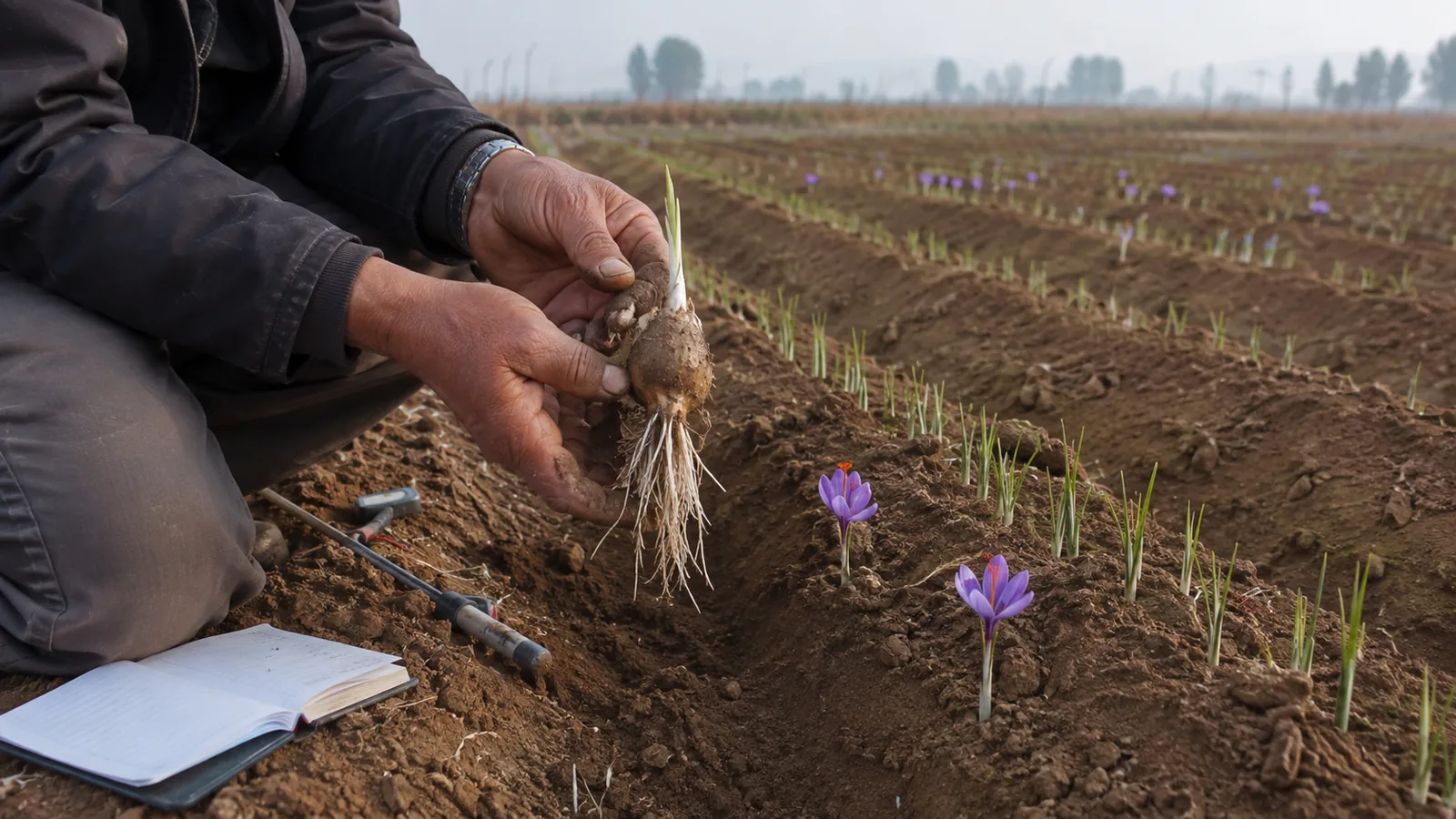
No, not by itself. Root primordia appearing as the corm leaves dormancy are normal. Roots anchor the plant and support water and nutrient uptake. Recent controlled-environment research notes that lower pre-flowering temperatures can induce central buds and the appearance of root primordia; it does not identify ordinary rooting as a cause of yield loss. The study also shows that temperature, planting density and depth affect flowering and corm results together: see the saffron flowering and corm-quality experiment.
The better question is why a particular batch rooted early and what happened next. In stored-corm or controlled systems, temperature, humidity and forcing schedules can change the timing of shoots, roots and flowers. In an open field, local cooling and irrigation can start emergence. Early roots become a concern when they dry out, break during handling, sit in waterlogged soil or accompany a management regime that favors weak vegetative growth at the expense of successful flowering. The roots are evidence to investigate, not damage to remove.
Do not trim healthy new roots simply because they appeared before a flower. Record corm weight and health, storage conditions, soil temperature, irrigation date, emergence date and flower count. Compare those records with an undisturbed section before blaming rooting.
Importance of Soil and Water Quality for Saffron
Electrical conductivity needs a unit and a sampling method. The old rule that soil and water EC should be “below 4000” is incomplete. If the writer meant 4,000 µS/cm, that equals 4 dS/m, but irrigation-water EC and saturated-soil extract EC are not interchangeable measurements. Texture, drainage, rainfall, irrigation amount and the pattern of salt accumulation all influence the root-zone exposure.
Likewise, “pH should not exceed 7.5” is too rigid as a universal cutoff. Alkaline soil can reduce the availability of some nutrients, yet saffron is grown in calcareous soils and a pH number alone does not predict flowering. Test soil pH, EC, organic matter and available nutrients through a qualified laboratory; test irrigation water separately. Interpret both for the local soil and crop.
Long-term field research has compared saffron under several water salinities, irrigation levels and planting systems. Its results show interactions rather than a single EC cliff, which is why the measured root-zone water and salinity approach is more useful than an unlabelled number.
How Irrigation Frequency Impacts Saffron Yield
The old recommendation of at least 4 to 5 irrigations annually may resemble a local schedule, but it is not a universal requirement. A heavy soil after rainfall and a fast-draining bed in a dry climate do not need the same frequency. Irrigate according to crop stage, effective rain, soil water-holding capacity, rooting depth, salinity and the amount applied at each event.
“Zaj Water,” described in the former article as post-harvest irrigation, and “Yellow Water,” applied near natural leaf yellowing, are local management terms. Preserve the purpose behind each name, then verify whether the field actually needs water. After flowering, leaves and roots remain active and daughter corms begin developing. Near senescence, excessive water can be as unhelpful as a severe deficit, especially where drainage is slow.
- Before flowering, use soil moisture and the local emergence stage rather than the date alone.
- During leaf growth, avoid repeated cycles of severe water stress and saturation.
- As leaves yellow naturally, confirm root-zone moisture before applying the traditional final irrigation.
- During dormancy, keep drainage open and do not maintain a wet bed without a specific local reason.
Weed Management for Healthy Saffron Fields
Saffron has narrow leaves and leaves much of the soil surface open, so vigorous weeds can compete for light, water and nutrients. Late-winter and spring rain often brings a new flush just while leaves are feeding daughter corms. Walk the field regularly and remove weeds before they set seed, using a method that does not cut or expose the saffron corms.
Deep-rooted perennial weeds such as camel thorn need a plan before saffron is planted. The former advice to remove camel thorn only before October irrigation reflects concern about disturbing an established bed, but a calendar alone does not solve the root system. Map perennial patches, control them during site preparation and seek a locally approved method for escapes. Deep cultivation inside a planted saffron row can cause more harm than the weed it targets.
Keep a simple weed record by species, patch and date. That makes it possible to separate weeds emerging before flowering from those building pressure during spring corm growth, and to judge whether a change actually reduced the seed bank.
Preserving Saffron Leaves for Optimal Growth
Green saffron leaves are the source of carbohydrates for developing daughter corms. A detailed study of saffron corm development and leaf support found that daughter-corm growth later in the season relies predominantly on leaf photosynthesis. Cutting or grazing green leaves early removes part of that source.
Leave foliage in place until it yellows and dries naturally. Do not confuse normal senescence with a nutrient deficiency that needs late fertilizer. If leaves die in patches or substantially earlier than the rest of the field, inspect moisture, roots, corm tissue, salinity and disease rather than cutting everything to make the stand look even.
The Impact of Mixed Cropping
The earlier article warned that barley or turnip planted among saffron would always reduce later yield through competition. Competition is possible, particularly when a vigorous companion shades the leaves, shares the same rooting zone or changes irrigation timing. However, “saffron must always be alone” is also too broad.
A field experiment on saffron–chickpea intercropping and weed communities found that selected row ratios reduced weed density and biomass under the tested semiarid conditions. That does not prove that chickpea, barley, turnip or any other companion will work everywhere. It shows that the species, row arrangement, water regime and production goal need to be tested as a system.
Before mixed cropping, compare a small strip with the saffron-only practice. Record flower yield, saffron leaf growth, daughter-corm size, weeds, labor and water. A companion crop is useful only if the whole system performs better for the farm’s stated goal.
Using Soil and Sand to Adjust Planting Depth
Adding material over a shallow stand changes more than depth. It can alter drainage, aeration, surface crusting, temperature and the distance a shoot must travel. Poor-quality clayey fill may seal the surface; a thin layer of sand over clay does not automatically create a well-drained soil. Unscreened material can also introduce weeds or debris.
Measure the existing corm depth in several representative spots before adding anything. Consider corm size, soil texture, winter conditions and the thickness of the proposed layer. Research confirms that corm size and planting depth interact with growth and yield, rather than supporting one magic depth for all fields. If renovation is needed, test a strip or lift and replant at the locally supported depth instead of repeatedly burying an established stand.
Farm Leveling After Planting
Major leveling is best completed before planting. Driving a tractor across an established saffron field can compact wet soil, crush shallow corms and shear emerging shoots or roots. Moving soil from high points to low points also changes planting depth unevenly.
If an old field no longer distributes irrigation evenly, survey it before choosing equipment. Minor surface repairs may be possible during dormancy with light tools and clearly marked rows, but deep grading calls for a renovation plan. Correct the underlying slope, inflow or drainage problem rather than smoothing the visible symptom each summer.
The Effect of Farm Age on Saffron Yield
The earlier timeline said yield typically rises for the first five years, stays level from the sixth to the eighth year, then declines. That sequence can occur, but it is not a clock shared by every field. Daughter corms multiply, increasing the number of potential flowering units. Eventually crowding can produce more small corms, competition, uneven depth, nutrient pressure and greater difficulty managing disease and weeds.
Track field age together with flower count, dry stigma yield, the number and weight distribution of daughter corms, missing patches and disease. Renovate or rotate when the measured decline and field condition justify it. Do not wait for a numbered anniversary if the stand has already become crowded, and do not lift a healthy productive field merely because a generic chart says it is old.
A soil-test-based saffron nutritional program can address a measured limitation, but fertilizer cannot reverse crowding, poor drainage or damaged corms.
How much saffron can you grow per acre?
There is no responsible single yield-per-acre answer without the crop year and production system. Corm size and density, field age, climate, flower survival, picking speed and drying all affect the final weight. A research yield from a dense greenhouse plot cannot be transferred directly to an open field, and fresh flower weight is not dry stigma weight.
For a useful farm estimate, count flowers in several known areas during the full harvest, record dry stigma weight from those same areas, and report the method and moisture endpoint. Convert the measured plot result to an acre only after checking that the sample represents the field. Keep optimistic budgets separate from observed production.
A field checklist before flowering
- Inspect stored or planted corms for size, injury, decay and premature drying of new roots.
- Record soil temperature, first irrigation, emergence and the start of flowering.
- Test soil and water with named EC units and methods.
- Check low spots, surface crusting and blocked drainage before adding more water.
- Remove weeds without deep cultivation around corms.
- Protect green leaves through their natural season.
- Measure results in comparison strips whenever changing depth, irrigation or mixed cropping.
Conclusion: Ensuring Optimal Conditions for Factors Affecting Saffron Growth
Strong flowering comes from a sequence of sound decisions, not one input. Healthy corms must form flower structures, leave dormancy, root, emerge and flower under suitable conditions; later, intact leaves must build the next generation of corms. Measure those stages, keep the soil drained, manage water and weeds by evidence, and test major changes on a small area. Most importantly, treat roots before flowering as a normal biological signal to understand, not an automatic cause of lost yield.

![Exporting Saffron to Turkey + Price Guide [Complete 0 to 100]](https://img.rowhanisaffron.com/20260827003933/saffron-export-turkey-quality-inspection.webp)



