


Zaj Ab in Saffron Farming is a regional name for irrigation around the transition from flower harvest to active leaf growth. Its role is to manage root-zone moisture at that stage, not to “restore” soil energy through an automatic dose of water and fertilizer.
The Role of “Zaj Ab” in Saffron Farming
The term is written in several English forms, including Zaj Ab, Zajab and Zajaab. Growers may use it for a light post-flowering irrigation, often in late November or early December in Iranian production calendars. The exact date and amount change with flowering time, rain, soil texture, drainage and the water already stored below the surface.
A traditional explanation compares the land to a mother who has just given birth: after producing flowers, it needs care before supporting the next generation. The image is memorable, but it is a farming metaphor rather than plant physiology. Soil does not spend or regain “vitality” in one irrigation. What changes is the crop stage. Green leaves and roots continue working after the flowers are gone, and new daughter corms begin the development that matters for a later harvest.
Why is Zaj Ab Important?
Flower picking is not the end of the saffron growing season. Peer-reviewed work on saffron corm development places daughter-corm growth after flowering, continuing through winter and spring. Leaves later provide much of the carbohydrate used to enlarge those replacement corms.
Zaj Ab can be useful when the root zone is becoming too dry as the crop enters this vegetative stage. Timely water helps maintain active leaves and roots. It cannot guarantee larger corms or more flowers, and it may be unnecessary after effective rain or a sufficiently deep pre-flowering irrigation.
The old practice sometimes combines water with urea, known locally as white fertilizer, or with potassium-rich fertilizers. Neither input belongs in every Zaj Ab application. A soil or locally validated tissue test, previous inputs, crop age and realistic yield target should determine whether nutrients are needed.
How to Apply Zaj Ab Correctly?
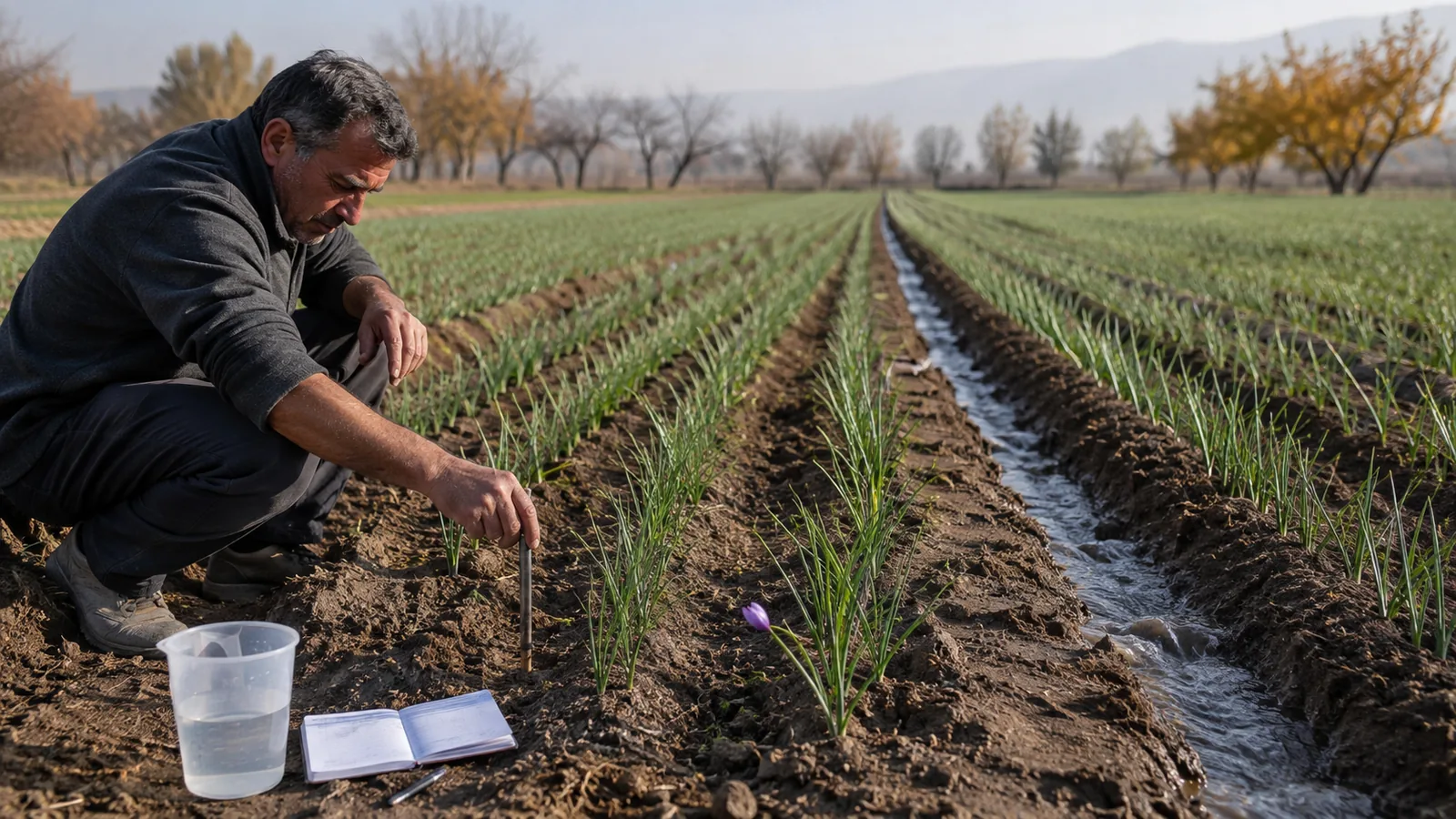
Begin by checking soil, not the calendar. Inspect several representative points, including high areas, low areas and the ends of irrigation runs. Note the moisture at corm and active-root depth, not only the color of the upper few centimeters.
The former instruction was to moisten only the soil surface because pre-flowering irrigation had already filled deeper layers. That may be adequate in a particular heavy soil after rain, but it is not a reliable definition of correct watering. A surface wetting that never reaches active roots may add little value; excessive water can fill pore space, move salts or expose poorly drained corms to prolonged saturation.
- Confirm the crop stage. Record the last flower-picking date, leaf emergence and recent rain.
- Inspect root-zone moisture. Use a soil probe, auger or another locally calibrated method at more than one point.
- Check the forecast and drainage. Delay an optional irrigation if substantial rain is imminent or low areas remain wet.
- Set a measured target. Base run time or water depth on the irrigation system, soil intake and the deficit you observed.
- Watch distribution. Make sure the head and tail of each run receive a useful amount without ponding.
- Recheck after application. Confirm how far water moved and record dry or saturated zones.
Long-term saffron field research on irrigation depth, salinity and planting method found interacting effects rather than one universal schedule. The study’s treatments belong to its measured soil and climate; the useful lesson is to manage water amount, salinity and field layout together.
The Role of Nitrogen in Zaj Ab
Standard fertilizer-grade urea contains about 46% nitrogen by weight. Nitrogen is involved in proteins, chlorophyll and many growth processes, but the percentage on a bag does not show how much the field needs. It only allows the required nutrient rate to be converted into a product rate after that requirement is established.
A blanket urea application can waste money and increase nitrogen-loss risk. It can also encourage growth that the available water or other nutrients cannot support. Research measuring nitrogen leaching in saffron systems illustrates why nitrogen source, placement, irrigation and cropping system must be considered together.
Potassium has important roles in plant water relations and metabolism, but a potassium-rich fertilizer is not automatically safer or more appropriate. Test available potassium and account for manure, compost and earlier fertilizer before adding more. For a field-specific calculation, use the separate saffron nutritional program guide.
When Should You Apply Zaj Ab Fertilizer?
Separate the water decision from the fertilizer decision. A field can need irrigation without needing urea, and it can need a nutrient correction at a different time or placement.
The former rule said that a field which had not flowered should receive Zaj Ab fertilizer once leaves were about 10 cm long and dark green. Leaf development can help confirm that the crop has moved beyond its flowering window, but dark green foliage is not evidence of nitrogen deficiency. In fact, it may indicate adequate nitrogen. A non-flowering field also needs diagnosis: small corms, temperature, planting date or depth, storage history, disease and water can all affect flowering.
Apply fertilizer only when the following are known:
- the measured nutrient requirement and the test method used;
- the fertilizer analysis and kilograms of nutrient delivered per hectare;
- what manure, compost and mineral fertilizer the field already received;
- root-zone moisture and enough water to place the nutrient without creating runoff or saturation;
- product compatibility, local registration and label instructions.
Do not place concentrated fertilizer directly against saffron corms unless the registered label and qualified local recommendation specifically allow that method.
How Zaj Ab Affects Future Saffron Harvests
Zaj Ab does not change the flowers that have already been picked. Its plausible value is supporting the leaf-and-corm phase that follows. A healthy leaf canopy, suitable root-zone moisture and balanced nutrition can contribute to daughter-corm development, while waterlogging, salinity, severe deficit, disease and crowding can limit it.
The effect should be measured rather than assumed. Record dry stigma yield for the completed harvest, then track leaf duration, missing plants, daughter-corm number and size, and next season’s flower count. Compare those results with a similar area under the farm’s standard practice. Without that comparison, a good or poor next harvest cannot be credited to one irrigation with confidence.
Water saving also needs a number. Report the area, flow rate and run time or measured water depth. Calling every shallow application efficient does not show whether enough water reached roots or whether distribution was even.
What to record during a Zaj Ab irrigation
- Date, field and management zone
- Last flower-picking date and approximate leaf height
- Rain since the pre-flowering irrigation
- Root-zone moisture before and after watering
- Water EC and volume or run time
- Standing water, runoff and uneven distribution
- Fertilizer product, analysis, batch and actual nutrient rate, if used
- Leaf condition two weeks later and daughter-corm measurements at lifting
These notes turn a named tradition into a management practice the farm can evaluate. They also reveal whether high and low parts of the field need different run times, drainage work or a redesigned irrigation layout.
Common signs that the plan needs adjustment
Revisit the application when water ponds for a long period, the tail of a run stays dry, salt crust appears, leaves yellow in irregular patches or corm tissue becomes soft or discolored. These symptoms do not all mean the same thing. Check roots, corms, soil moisture and salinity, and send disease samples to a diagnostic service where appropriate.
If the crop looks healthy but the soil remains moist at root depth, skipping an optional Zaj Ab irrigation may be better than following the calendar. If only part of the field is dry, correct distribution rather than soaking the entire area.
Consulting Experts for Better Saffron Farming
A local irrigation or crop adviser can translate the soil, water and fertilizer analyses into a field rate. Bring actual records: plot area, irrigation-system flow, soil texture, rooting depth, test results, product label and the last two seasons of yield. Advice is far more useful when it explains the calculation and the conditions under which the recommendation should change.
Zaj Ab remains a helpful name for a recognizable point in the saffron calendar. Its best use is as a reminder to inspect the field after flowering. Water when the root zone needs water, fertilize only for a measured reason, and judge the practice by leaf and daughter-corm performance rather than by tradition alone.

![Exporting Saffron to Turkey + Price Guide [Complete 0 to 100]](https://img.rowhanisaffron.com/20260827003933/saffron-export-turkey-quality-inspection.webp)



