


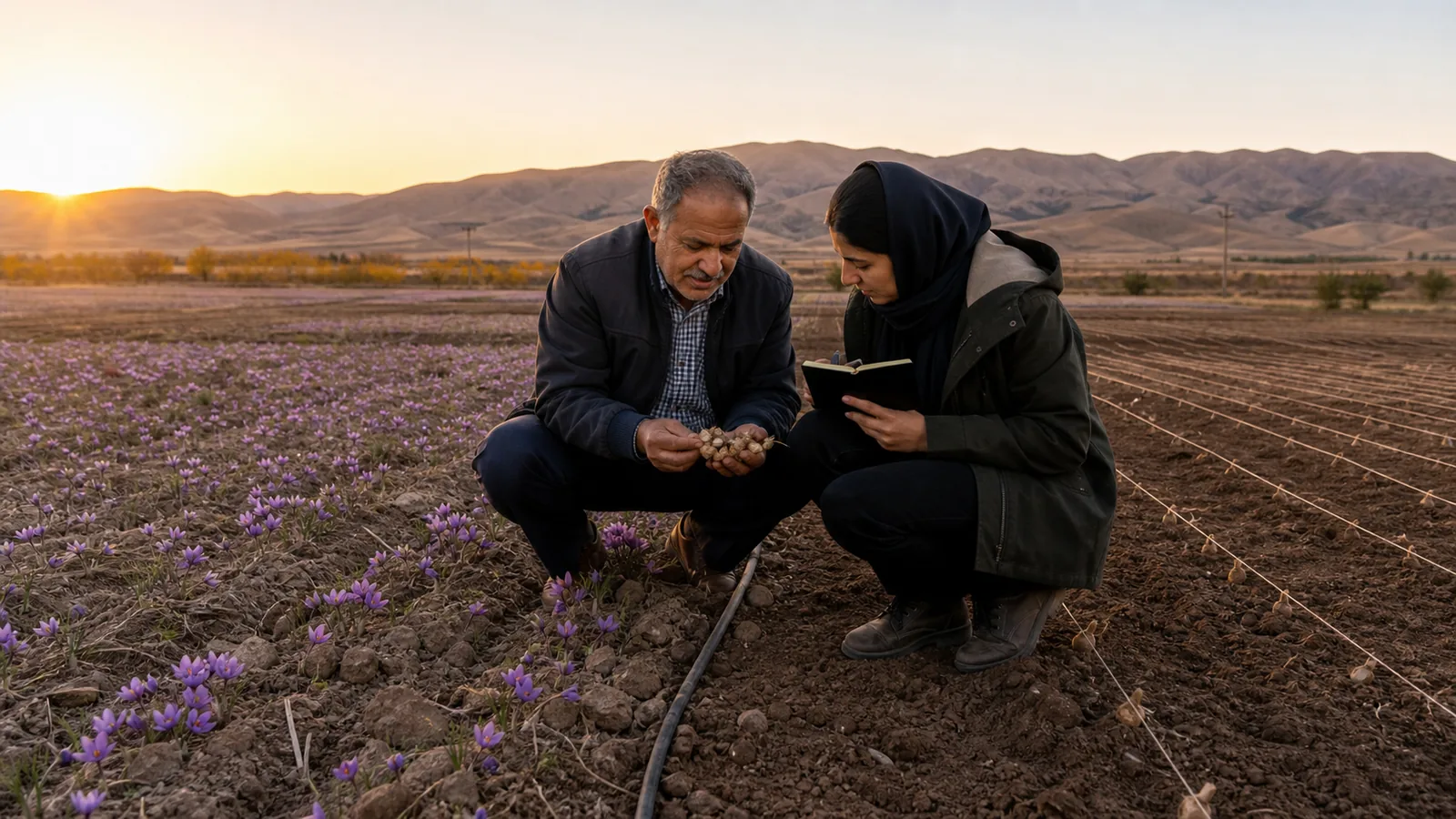
Saffron cultivation in Iran has expanded far beyond its historic center in Greater Khorasan, yet Khorasan still produces most of the crop. Recent official estimates place the national planted area at roughly 123,000–127,000 hectares, spread across more than 20 provinces. The Food and Agriculture Organization of the United Nations continues to describe Iran as the world’s largest producer, responsible for more than 90% of global saffron output.
Those headline numbers need dates and definitions. Planted area is not always the same as productive harvested area, annual output changes with weather and field age, and official forecasts are often revised after harvest. This article keeps the national scale in view while showing what expansion means at farm level, including the training and corm-supply model used around Shahrood in Semnan Province.
How much saffron does Iran produce?
There is no single timeless production number. In January 2024, an official responsible for medicinal plants at Iran’s Ministry of Agriculture said the country had about 123,000 hectares under saffron and forecast roughly 250 tonnes for the Iranian year ending March 2024. The same report said 150 tonnes had been exported during the first eight months of that year. These are dated figures, not a current live estimate.
Later reporting attributed to the same ministry program forecast about 350–400 tonnes from 127,000 hectares for the following harvest period. Differences of that size can reflect weather, the share of young or resting fields, the point in the season when a forecast was made, and the way productive area is counted. They are a reason to state the reporting year, not to select the largest number and call it permanent.
The FAO’s 2024 announcement with Iran’s Ministry of Agriculture described Iran as contributing approximately 90% of world production. A 2025 FAO authenticity initiative used the stronger wording “more than 90 percent.” These institutional statements support Iran’s dominant position without implying that every year’s tonnage or market share is identical.
Average yield is not 15–20 kilograms per hectare
The previous version of this article paired 125,000 hectares with 500 tonnes and then claimed an average yield of 15–20 kilograms per hectare. The arithmetic does not work: 500,000 kilograms divided by 125,000 hectares is four kilograms per hectare. Using the 2023–24 forecast of 250 tonnes over 123,000 hectares gives roughly two kilograms per planted hectare.
Historic figures submitted by Iran to the FAO/WHO Codex Committee also show ordinary provincial averages in single digits. For the 2014–15 season, the official statistical table reported about 3.1 kg/ha in Razavi Khorasan, 3.4 in South Khorasan, 4.9 in North Khorasan, 5.2 in Kerman, and 6.1 in Isfahan.
Individual well-managed fields can yield more than a provincial or national average. That does not justify presenting an exceptional result as typical. Field age, corm size and density, irrigation timing, temperature, soil, disease, weeds, harvest labor, and drying losses all affect the dried-stigma yield. A national average based on total planted area may also include young or temporarily unproductive fields.
Khorasan remains the production center
Razavi Khorasan, South Khorasan, and North Khorasan form the core of Iranian saffron production. The older Codex submission recorded 69,407 hectares and 218.348 tonnes in Razavi Khorasan, plus 14,727 hectares and 48.019 tonnes in South Khorasan for 2014–15. North Khorasan added a smaller but established crop.
A 2024 ministry statement reported that Greater Khorasan accounted for more than 93% of national production, with Razavi Khorasan alone contributing more than 70%. Exact shares change by season, but the structural reasons for Khorasan’s lead are durable: generations of field knowledge, established corm supply, experienced harvest labor, processors, testing and trading networks, and a name already recognized by buyers.
Expansion in another province does not erase those advantages. New regions often depend on Khorasan for planting material, training, processing, or market access even when their climate can produce good saffron.
Where cultivation has expanded
Saffron is now grown across much of Iran, including parts of Kerman, Isfahan, Yazd, Fars, Semnan, Hamadan, Qazvin, Markazi, and other provinces. Older figures in the destination article listed 1,600 hectares in Kerman, 1,300 in Isfahan, 270 in Hamadan, and 80 in Qazvin. Because the stored text did not provide a traceable year and acreage changes, those values should be treated as historical snapshots rather than current totals.
Local suitability is more specific than a province name. Saffron needs well-drained ground, an appropriate temperature cycle for corm development and flowering, manageable salinity, access to irrigation at critical stages, and enough labor during the short flowering period. Elevation, slope, soil texture, and frost timing can differ sharply within one province.
Why drought encourages expansion—but does not remove water needs
Saffron is attractive in dry regions because a high-value dried product can be produced with less water than many competing crops. The FAO’s profile of Gonabad’s qanat-based saffron system highlights the crop’s role in a region with severe water shortages and its relatively low water requirement.
“Low water” is not “no water.” Establishment and seasonal irrigation still matter, and groundwater or qanat availability must remain within a sustainable budget. Expansion can worsen pressure if total planted area rises faster than water efficiency improves. A sound crop-switch decision compares water per unit of saleable output, local aquifer conditions, labor, price risk, and the farmer’s alternatives.
Example: Shahrood, Semnan Province
An archived report from Shahrood shows how a newer region tried to institutionalize saffron cultivation. Speaking in Sa’d Abad village, Mohammad Reza Ghasemi, head of Shahrood Agricultural Jihad, said interest was growing because of recent drought and saffron’s economics relative to available water.
The machine-translated source says 18,000 hectares of Sa’d Abad village were “covered by saffron.” That scale is implausible in the context of the rest of the report and may describe the village’s broader land area rather than saffron fields. It is not repeated here as a cultivation statistic.
Ghasemi announced a Saffron Promotion Center or extension office and a Saffron-Karan growers’ association. He said many local operators lacked technical knowledge because cultivation had not previously occurred at a broad scale. Early training therefore became a priority.
The office also helped farmers obtain saffron corms from established producing provinces, especially Khorasan. The stored translation calls them “onions,” but corm is the correct horticultural term. Supplying healthy, traceable corms matters because poor planting material can carry disease, flower weakly, or make a new field uneconomic before growers have developed their own daughter-corm stock.
What an effective promotion center should teach
Expansion succeeds when training covers the whole production chain, not merely planting. Growers need to match corm size and density to field conditions, prepare drainage, time irrigation, monitor weeds and disease, organize rapid flower collection, and separate and dry stigmas consistently.
Post-harvest handling deserves equal attention. Fresh flowers lose quality if they wait. Excess heat can damage aroma and color compounds, while inadequate drying leaves moisture and storage risk. Clear batch identity, hygienic facilities, suitable packaging, and test results help a new region sell on quality instead of sending anonymous product into another region’s supply chain.
A growers’ association can coordinate training, corm procurement, labor, shared equipment, testing, and market information. It should not guarantee profit or encourage acreage without demand. Its value lies in reducing avoidable variation and helping farmers make decisions from measured costs and results.
Expansion creates a traceability challenge
When cultivation spreads, saffron may travel to established hubs for processing and export. That can give growers access to buyers, but it can also blur origin and make national statistics harder to interpret. A shipment route through Spain, the United Arab Emirates, or Hong Kong does not change where the saffron was grown.
FAO and Iran’s Ministry of Agriculture launched a project in 2024 focused on authenticity, traceability, and sustainable saffron supply chains. The follow-on work with Mashhad University of Medical Sciences emphasizes better testing and field-ready post-harvest guidance. These priorities are directly relevant to expansion: more producing districts increase the need for verifiable origin and consistent quality, not less.
What sustainable expansion looks like
Iran’s position in world saffron is substantial, but dominance does not make every new field profitable or every published statistic reliable. Sustainable expansion starts with suitable land and water, then adds healthy corms, trained growers, realistic yield expectations, harvest labor, controlled drying, testing, traceability, and a buyer.
The Shahrood model captures the institutional part of that process: an extension office and growers’ association can help a new district learn from established regions without pretending to become Khorasan overnight. National leadership is preserved when expansion improves the quality and transparency of the crop, not simply the number of planted hectares.

![Exporting Saffron to Turkey + Price Guide [Complete 0 to 100]](https://img.rowhanisaffron.com/20260827003933/saffron-export-turkey-quality-inspection.webp)



