


How Many Grams Are in One Mishkal of Saffron?
One commercial Iranian mesghal of saffron weighs 4.6083 grams. In everyday saffron trade, that is usually written as 4.608 g or rounded to 4.6 g. “Mesghal,” “mishkal,” “mithqal,” “misqal” and “mesqal” are transliterations of related terms, but the value has not been identical in every place or historical period. For an Iranian saffron sale, confirm that both parties mean the modern commercial, or sarrafi, mesghal.
As a saffron measurement unit, the mesghal is useful only when its definition is clear. The rest of the article explains how to calculate other amounts, why older sources give different figures, and how to weigh saffron without introducing an avoidable pricing error.
Mesghal-to-gram conversion
To convert mesghal to grams, multiply by 4.6083:
Grams = mesghal × 4.6083
- 0.5 mesghal = 2.30415 g
- 1 mesghal = 4.6083 g
- 2 mesghal = 9.2166 g
- 5 mesghal = 23.0415 g
- 10 mesghal = 46.083 g
For normal retail labeling, the number of decimal places should match the accuracy of the scale and the rules that apply in the place of sale. Writing more digits does not make a measurement more accurate if the instrument cannot resolve them.
Gram-to-mesghal conversion
To convert grams to mesghal, divide by 4.6083:
Mesghal = grams ÷ 4.6083
One gram is approximately 0.217 mesghal. A 10 g pack is about 2.170 mesghal, while 100 g is about 21.700 mesghal. Keep the unrounded figure through the calculation and round only the final result; repeated early rounding becomes noticeable in larger transactions.
How many mesghals are in one kilogram of saffron?
One kilogram is 1,000 grams. Using the Iranian commercial conversion:
1,000 ÷ 4.6083 = approximately 217.0 mesghal.
The older estimate of “210 to 220” is close enough for a rough conversation, but it is too broad for pricing, stock control or package reconciliation. Use the actual gram weight from a calibrated scale. If a seller rounds one mesghal to 4.6 g by agreement, the corresponding calculation changes slightly, which is another reason to state the conversion basis on an invoice.
Why can a mishkal have more than one value?
Mishkal or mithqal is an old family of weight units. Its value changed across regions, commodities and periods. Historical coinage sources discuss standards near 4 g, 4.25 g and other local values. A religious or historical text may therefore use “mishkal” differently from a present-day Iranian saffron merchant.
The modern Iranian commercial mesghal is often called the sarrafi or money-changer’s mesghal. The London Bullion Market Association records the Iranian trade unit as 4.6083 g, and historical reference material describes a little over 4.6 g as the canonical modern Persian form. This same mass unit is familiar in Iran’s gold trade, although gold purity and saffron quality are separate matters.
Terms such as “Sharia mishkal” should always be accompanied by the definition used in that source. Converting every historical or religious mishkal as 4.6083 g can be wrong; converting a modern Iranian saffron mesghal using an unrelated historical value can also be wrong. Name the variant first, then do the arithmetic.
How to measure saffron accurately
Choose a suitable saffron weight machine
A digital precision scale that reads to 0.01 g is a sensible minimum for small saffron packs. A scale that changes only in 0.1 g steps can be off by a meaningful fraction of a 4.6083 g mesghal. Commercial transactions may require an approved-for-trade instrument under local metrology law, so a household kitchen scale should not automatically be treated as a legal sales scale.
Calibrate and check the scale
Place the instrument on a firm, level surface away from vibration, drafts and direct heat. Let it stabilize according to the manufacturer’s instructions. Check it with the correct calibration or verification weight; do not substitute a coin or another object whose mass is assumed. If the reading drifts or fails the check, do not use it for a sale.
Tare the weighing container
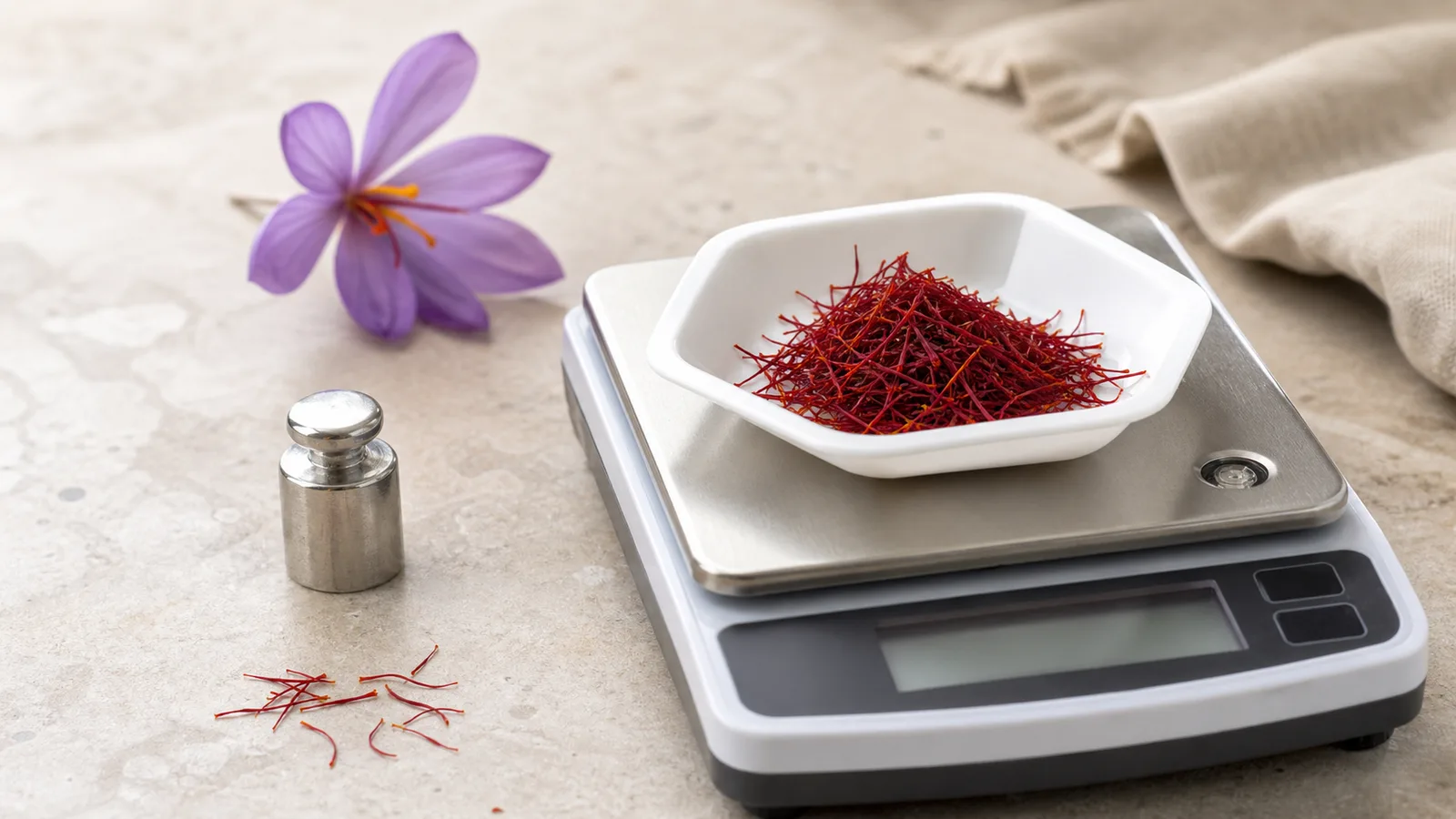
Put a clean, dry weighing dish on the scale and press tare so the display returns to zero. Add the saffron without touching it with wet hands or placing it directly on a surface that may hold dust or moisture. Wait for a stable reading, record it, then repeat the measurement once. The net saffron weight must exclude the dish and any packaging.
Keep units and rounding visible
Record the original result in grams, because the gram is an SI unit and is the clearest basis for labels and calculations. If the transaction also uses mesghal, show both values and the factor used. For example: “4.608 g, calculated as 1 Iranian commercial mesghal.” This prevents a later disagreement over which mishkal definition or rounding rule applied.
How much does one saffron thread weigh?
A single saffron thread does not have one dependable universal weight. Threads vary in length, thickness, moisture and the amount of yellow style attached. A normal retail scale may not register one thread at all. For a useful estimate, count a larger sample, weigh the group on a suitable analytical balance, and divide the net mass by the number of threads.
Thread count is therefore a poor substitute for a declared gram weight in a sale. If your question is about quantity rather than the mesghal unit, see how many saffron threads may be in one gram; the answer is a range because the threads are not uniform.
Why precise saffron weighing matters
Saffron is sold in small, valuable quantities. A difference that looks trivial on a kitchen scale can affect price, package compliance and inventory when repeated across many units. Accurate net weight also makes comparisons fair: a low price for a vaguely defined “mishkal” is not necessarily a better offer than a clearly labeled 4.608 g pack.
Weight does not prove quality. Color, aroma, moisture, foreign material, origin and laboratory grading are different questions. A precise scale can confirm how much saffron is present; it cannot show whether the saffron is authentic or well processed.
Sources and measurement references
- Iran’s commercial mesghal recorded as 4.6083 g, London Bullion Market Association.
- Historical Persian coin and mithqal standards, Encyclopaedia Iranica.
- Regional and historical variation in the mithqal, Encyclopaedia Iranica.
- The International System of Units, International Bureau of Weights and Measures.
For a modern Iranian saffron purchase, the practical result remains straightforward: one mesghal is 4.6083 grams, commonly rounded to 4.608 g or 4.6 g when the rounding is stated. Use a calibrated scale, tare the container, and put the gram weight on the record.

![Exporting Saffron to Turkey + Price Guide [Complete 0 to 100]](https://img.rowhanisaffron.com/20260827003933/saffron-export-turkey-quality-inspection.webp)



