


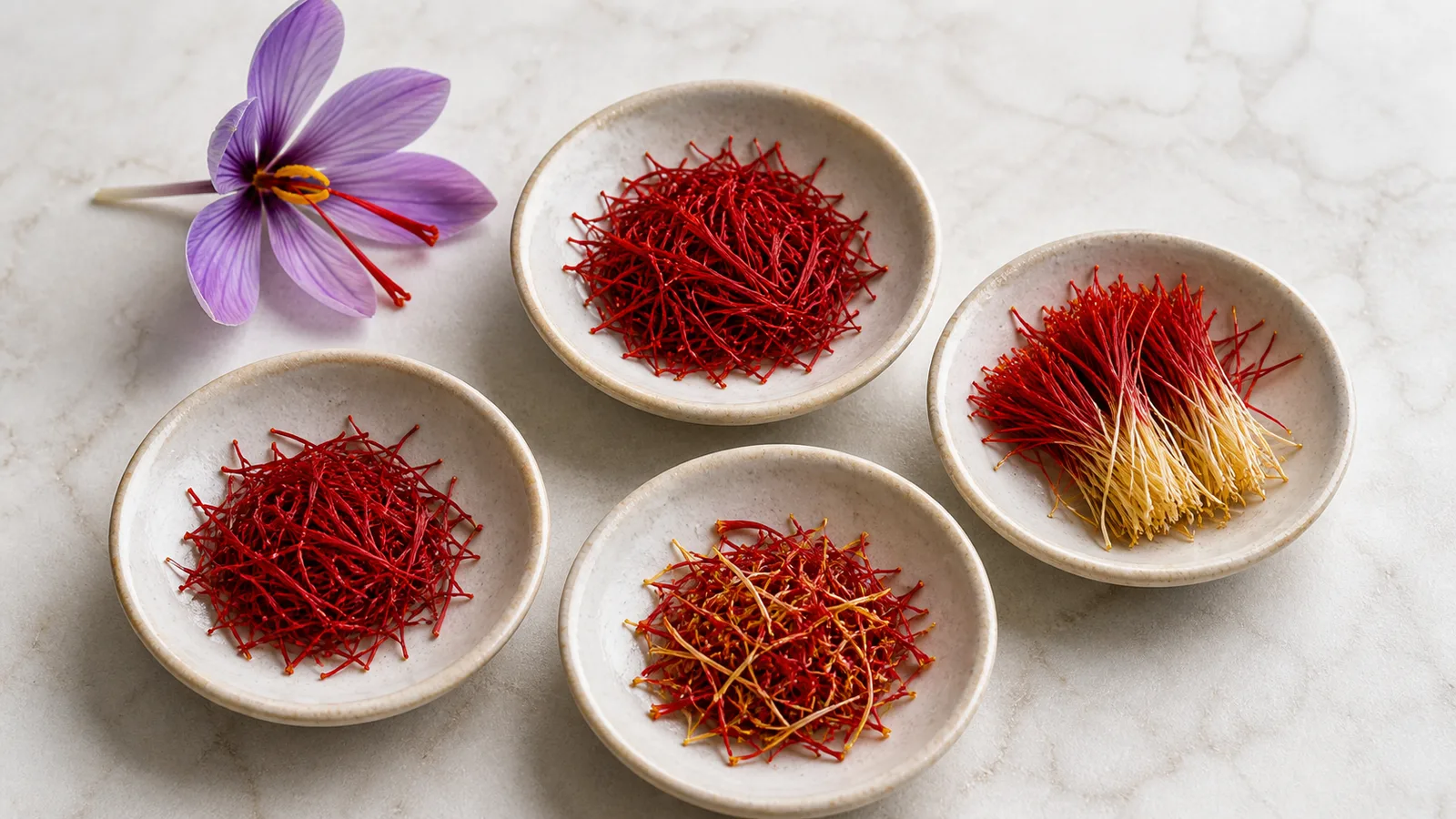
Understanding the Different Types of Saffron
Saffron types and their quality are related, but they are not the same thing. Names such as Negin, Sargol, Pushal and Dasteh usually describe how the red stigma and pale style of Crocus sativus were separated, trimmed and presented. A saffron grade is based on measurable specifications such as coloring strength, moisture and foreign matter. A beautiful thread cut can be high quality, but appearance alone cannot prove its grade or purity.
This distinction makes the market easier to understand. First identify the commercial cut in front of you. Then look for evidence of freshness, handling, authenticity and laboratory testing before deciding which type of saffron is best for your purpose.
Are there different varieties of saffron?
Most spice sold as true saffron comes from one cultivated plant species, Crocus sativus L. The familiar market names are therefore better understood as commercial thread types or cuts, not separate saffron varieties in the botanical sense. They come from different parts or presentations of the same flower’s stigma and style.
Regional trade terms add another layer. Iranian sellers commonly use Negin, Sargol, Pushal and Dasteh. In Kashmir, terms such as Mongra and Lacha describe local presentations. Kesar is a regional word for saffron, so “kesar types” usually asks this same commercial question. Spanish and other markets have their own categories. A name should tell you how the saffron is prepared; it should not be treated as a worldwide scientific grade unless a specification defines it.
The main Iranian saffron types
Negin saffron
Negin consists of long, mostly intact red stigmas separated from one another, with little or no pale style. Its straight, substantial threads give it a clean and uniform appearance that is valued for presentation and export. “Super Negin” is a market term generally used for especially long, thick, well-aligned red threads, but the name itself is not an ISO laboratory grade.
Negin is often presented as the highest-quality saffron available. That is too broad. It may be the preferred cut when a buyer wants intact red threads and an impressive appearance, yet a Negin label does not reveal moisture, age, storage history, coloring strength or adulteration.
Sargol or Serkel saffron
Sargol—sometimes written Sargol, Sarghol or Serkel—contains the red stigma without the pale style. Compared with Negin, the threads are more likely to be shorter or broken because Sargol is defined by the all-red portion rather than long, intact presentation.
This is a practical culinary and retail type: it offers red stigma material without paying only for visual uniformity. It is also commonly exported. As with Negin, the all-red appearance is useful information, not a complete purity certificate.
Pushal or Poushal saffron
Pushal retains a small amount of the yellow or pale style attached to each red stigma. The connection can make the flower structure easier to recognize and may reduce opportunities to substitute loose red fibers, although it does not rule out every form of adulteration. Pushal usually costs less than a comparable all-red cut because part of its weight is style rather than red stigma.
The presence of some style does not automatically make Pushal “bad” saffron. It describes the trim. A fresh, correctly dried Pushal sample may be a better purchase than a poorly stored or adulterated product carrying a premium name.
Dasteh, Dokhtarpich or bunch saffron
Dasteh keeps the red stigma and a longer section of pale style together, traditionally arranged in small bundles. It is one of the least processed-looking presentations and shows more of the stigma-to-style relationship. Because the pale portion contributes more weight and less color than the red stigma, Dasteh is usually priced below red-only cuts.
The old article called a basic mixed red-and-yellow type “Taghzi.” Market spellings and definitions vary, so a buyer should ask for a photograph or written specification rather than rely on that name alone.
Kalhandar and other seller terms
Kalhandar, Poushal Kalhandar and similar names are used by some sellers for particular thread thickness, straightness or preparation. They are not consistently defined across the international market. Treat them as supplier descriptions and ask what physical cut, style content and test results the term represents.
What are saffron grades?
Saffron grades assess the product against defined physical and chemical limits. In formal saffron grading, a saffron category comes from test results rather than the most attractive seller name. ISO 3632 covers saffron in filaments, cut filaments and powder, and uses specifications that include:
- coloring strength associated with crocin;
- bitterness or flavor-related measurement associated with picrocrocin;
- an aroma-related measurement associated with safranal;
- moisture and volatile matter;
- floral waste, foreign matter and mineral residue; and
- checks relevant to added colorants and purity.
The standard separates quality categories by test results. It does not say that every Negin lot automatically belongs to the best grade or that every Pushal lot belongs to a lower one. Research comparing saffron products also warns that one analytical method may not answer every authenticity question; microscopy, targeted chemistry or DNA methods can add information when fraud is suspected.
How to identify pure saffron
At home, visual inspection can reveal reasons to pause, but it cannot certify purity. Real saffron threads are fine dried stigmas with natural variation, a widened trumpet-like end and a deep red tone that is not perfectly uniform. Obvious foreign fibers, excessive pale material, oily or damp clumps, surface dye that rubs off, and a musty smell are warning signs.
Simple water demonstrations online are easy to overinterpret. Release of yellow color is expected because saffron’s crocins are water-soluble; the speed depends on thread size, temperature, agitation and processing. A convincing-looking water test cannot establish botanical identity or prove that no coloring agent was added. For a high-value or commercial purchase, supplier traceability and laboratory analysis are stronger evidence. Our guide to recognizing fake saffron explains what a home check can and cannot show.
Which type of saffron is best?
The best type of saffron depends on what you are buying it for.
- For visual presentation: long, intact Negin or Super Negin threads are often preferred.
- For everyday cooking: a tested Sargol lot can provide red stigma material without paying only for thread length.
- For a recognizable flower structure: Pushal retains a small style connection and can offer good value.
- For traditional bundled presentation: Dasteh shows the red stigma with a longer pale style.
These are buying preferences, not guarantees. For tea or cooking, the decisive qualities are a clean product, suitable aroma and flavor, useful coloring strength and proper storage. No commercial cut guarantees “medicinal” performance, and an expensive appearance should not be used to make a health claim.
What determines saffron quality?
Harvest and separation
Flowers need prompt, clean handling. Delay, crushing and contamination can damage the raw material before drying starts. Careful separation determines the thread cut, but it does not compensate for a poor flower or dirty working conditions.
Drying
Drying controls moisture and helps shape saffron’s aroma, color and shelf stability. Too much residual moisture increases deterioration risk and adds weight that is not dry spice. Excessive heat or uncontrolled exposure can also damage quality. A producer needs a repeatable process rather than a claim that one country’s method is always superior.
Storage and packaging
Light, oxygen, heat and moisture gradually weaken saffron. Keep it sealed, dry and away from sunlight and strong surrounding odors. A prestigious type name cannot protect a badly stored lot.
Evidence behind the label
Ask for the harvest or packing date, origin, lot number and relevant test report when the purchase justifies it. Read the report itself: confirm that the sample identity matches the package and that the laboratory method and result are stated. “Premium,” “Grade A” and “export quality” mean little when no specification sits behind them.
Sources and further reading
- Nondestructive classification of Negin, Sargol, Pushal and Dasteh saffron, peer-reviewed open-access research.
- ISO 3632-1 specification for saffron, International Organization for Standardization.
- Chemical characterization of Sargol, Negin, Pushal, Bunch, Style and Powder trims, Food Chemistry.
- Combined testing for saffron quality and authenticity, Food Chemistry.
So, how many types of saffron are there? There is no single worldwide count because commercial names differ by market and because “type,” “variety” and “grade” are often mixed together. In the Iranian thread market, Negin, Sargol, Pushal and Dasteh are the clearest starting point. Choose the cut that suits the use, then judge the lot on evidence rather than the name alone.

![Exporting Saffron to Turkey + Price Guide [Complete 0 to 100]](https://img.rowhanisaffron.com/20260827003933/saffron-export-turkey-quality-inspection.webp)



