The price of saffron in Spain is not one fixed number. It changes with origin, thread or powder form, laboratory grade, harvest year, package size, seller margin, tax and whether the quote is retail or wholesale. A useful comparison starts with the price per gram for the same product specification—not the largest or smallest number shown on a search page.
Spain has its own protected saffron production and also sells imported saffron, including Iranian product. The country where a seller operates is not automatically the origin of the spice. Buyers should look for a clear origin statement, traceable lot, harvest information and evidence behind any grade or protected-name claim.
How to compare saffron prices in Spain
Before comparing two offers, make the units equivalent. Divide the final pack price by the net grams and include VAT and delivery if they change the amount paid. Then check whether the offers match on the factors that influence value:
- whole threads, cut threads or powder;
- net weight and retail versus wholesale terms;
- country and region of origin;
- harvest or packing date and storage condition;
- stigma-to-style composition;
- moisture, purity and laboratory results;
- traceability, certification and seller responsibility.
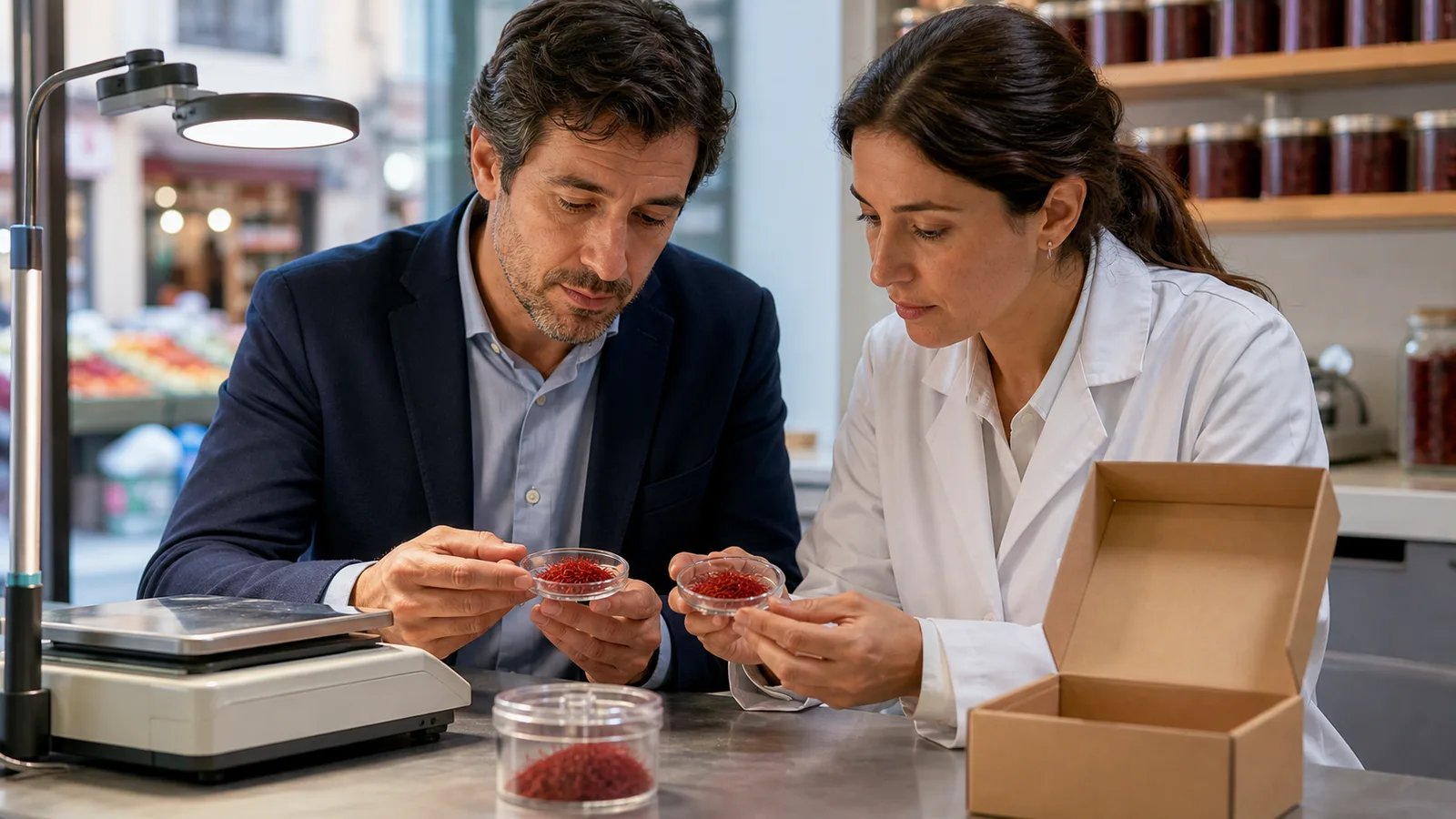
Powder is convenient but makes visual inspection harder. ISO notes that powdered saffron is more vulnerable to adulteration, while excess moisture can also inflate sale weight. Threads still need testing when a purchase is material; appearance alone cannot establish colouring strength, aroma-related characteristics or purity.
What “Spanish saffron” should mean
Azafrán de la Mancha is a protected designation of origin, not a generic phrase for every pack sold in Spain. The current EU product specification describes it as threads made by roasting stigmas of Crocus sativus and sets physical and chemical requirements.
Under the published specification, qualifying packs carry the protected designation, harvest year, best-before date, an origin statement identifying Spain and a coded secondary label. Those details provide a stronger basis for a premium than a Spanish-looking brand name alone.
Imported Iranian saffron can also be a legitimate, high-quality product in the Spanish market. It should be sold under its true origin and actual test evidence. A supplier in Madrid or Barcelona does not turn imported saffron into Azafrán de la Mancha, and a high price does not make an unsupported origin claim valid.
Why research and processing affect value
The original article behind this page was not really a live Spanish price list. It was a criticism of how little value Iran retained from a crop it produced at large scale. A food-science faculty member argued that Iran needed to move beyond selling raw saffron and mentioned beverage ingredients, spray-dried products and higher-value formulations as possible routes.
The archive also referred to Spanish cosmetic and pharmaceutical examples, but it did not identify the products, formulations or approvals. It made broad anticancer and antidepressant statements from saffron constituents without clinical evidence. Those claims are not repeated here. A laboratory effect, an ingredient under study and an approved treatment are three different things.
Research can still add real commercial value without medical overstatement. It can improve:
- cultivation and corm-health guidance;
- drying and storage control;
- authenticity and adulteration testing;
- consistent food formulations;
- traceability and origin verification;
- packaging that protects aroma, colour and moisture balance.
Those capabilities make a price easier to defend because a buyer can see what the lot is, how it was handled and which specification it meets.
The scientific-capacity critique from Birjand
At a historical saffron conference in Birjand, Mohammad Ali Behdani argued that the sector had seen too little practical scientific progress over roughly 50 years. He cited limited farmer education, weak packaging, inconsistent strategic pricing, poor commercial presentation and insufficient advertising as barriers to international value.
The report said about 80 percent of producing farmers at the time had only basic reading and writing skills. That is a dated conference statistic, not a current national literacy measure. Its policy point was that technical guidance must be usable by the people managing fields and harvests.
Behdani called for coordinated research, modern production methods, processing and packaging industries, better links between growers and packers, and a comprehensive production-and-export strategy. He also announced an agreement to establish a Saffron Research Center at Birjand University. The source records the announcement, not evidence that every planned activity was later completed.
What buyers should ask a saffron supplier
A Spanish saffron supplier should be able to answer straightforward questions: Where was this lot grown? Is it threads or powder? What is the net weight and price per gram? Which harvest and packing dates apply? Is a PDO or other certification being claimed? What laboratory specification supports the grade? How has the pack been stored?
For a wholesale quote, also confirm Incoterms, minimum order, sample and test method, packaging format, shelf-life responsibility and what happens if the delivered lot does not match the agreed specification. That comparison is more meaningful than asking for “the price of saffron in Spain” without a grade, origin or quantity.
References: EU product specification for Azafrán de la Mancha PDO; ISO 3632-1:2025 saffron specification; ISO guidance on recognizing quality saffron. The Iranian research and capacity discussion is retained as historical conference commentary from the two archived posts consolidated here.