Iranian saffron production was forecast to rise by about 15 percent in the 2017 season, taking output close to 400 tonnes. The estimate came from Ali Hosseini of Iran’s National Saffron Council shortly before harvest. It was a forecast, not a final production count, and should not be read as today’s market data.
The interview connected higher production with a harder task: finding well-managed export demand without weakening growers’ position. It also discussed renewed US buying, banking constraints after the nuclear agreement, yield improvement and the risk of increasing supply faster than the market could absorb.
How the 400-tonne forecast was calculated
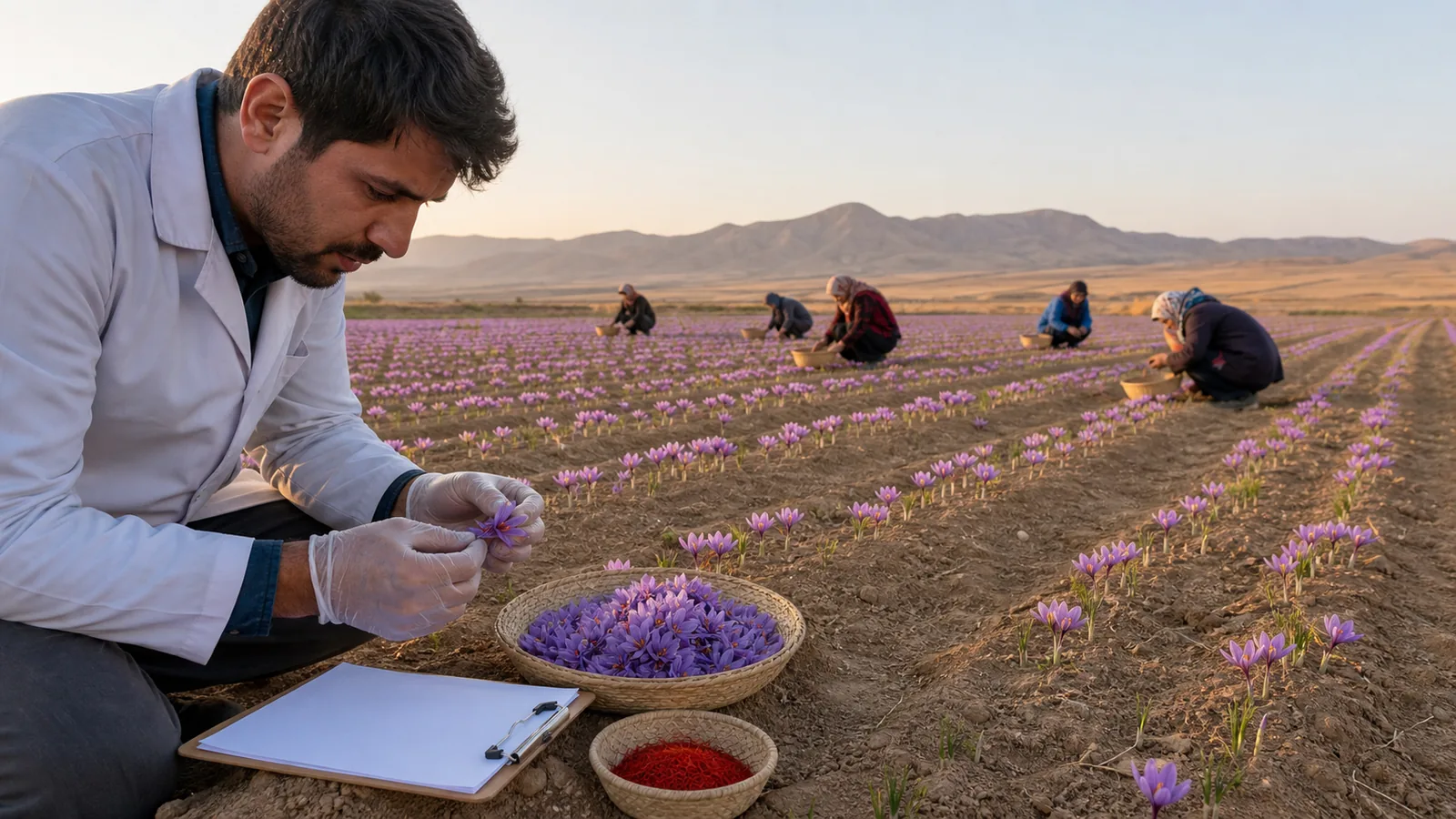
Hosseini described more than 90,000 hectares under saffron, concentrated mainly in Iran’s Khorasan provinces. He placed the average dry-saffron harvest at approximately 3.5 to 4 kilograms per hectare. Against that background, the council expected national output to approach 400 tonnes and said about 300 tonnes would need carefully targeted export markets.
Those numbers form a historical snapshot. Area, weather, field age, corm health and harvest conditions change from season to season, while preliminary estimates may differ from final results. Current comparisons should use dated datasets on our saffron production statistics page.
The 10-kilogram yield target
The report mentioned a longer-term aim of raising average yield to 10 kilograms per hectare, equivalent to one gram per square metre. It also said that some individual growers were already obtaining 3 to 4 grams per square metre. These are not equivalent claims: a result achieved in selected fields does not establish a national average.
Yield depends on more than planting density. Drainage, soil fertility, corm size and health, irrigation timing, weeds, pests, field age, climate and the speed of flower collection all have an effect. Drying losses and grading also determine how much saleable saffron remains. A farmer considering a new field should use local trials and realistic cost assumptions rather than treating the 10-kilogram target as a promise.
Why higher production needs stronger marketing
Hosseini warned that production could grow by around 10 percent a year. Without coordinated marketing, he argued, that expansion might harm the crop’s future and allow other trading countries to capture more of the value associated with Iranian saffron.
The danger is not simply “too much saffron.” It is a mismatch between supply and qualified demand. Fresh production arrives over a short harvest period, when growers and processors face labour bills and need working capital. If buyers cannot distinguish one lot from another, price becomes the only visible difference. Traceability, laboratory results, consistent grading and reliable delivery allow good lots to compete on evidence instead.
For exporters, planning 300 tonnes of sales requires several channels rather than dependence on one destination. Retail packs, food manufacturing, private label, ingredient distribution and hospitality buyers have different specifications and order sizes. The sale is stronger when the chosen channel matches the lot and its documentation.
Renewed US demand in the 2017 report
The National Saffron Council representative said the United States had recently returned as a customer after almost 15 years. He estimated a potential market of 50 to 60 tonnes and suggested that the US could become a leading customer. That was an expectation voiced at the time, not a verified current demand figure.
Sanctions, banking access, food-import rules and logistics can change quickly. A current shipment must be checked against the laws and restrictions in force for the parties, banks, origin and destination involved. The US Food and Drug Administration also requires imported food to comply with its applicable registration, prior-notice, safety and labelling rules.
Banking and payment were still obstacles
The interview followed implementation of the JCPOA, often called the Iran nuclear agreement. Hosseini said some banking settlement arrangements had improved, but exporters still found it difficult to transfer foreign earnings into Iran. He believed intermediaries benefited from those frictions.
That observation is dated, but the commercial lesson is broader. Before goods move, buyer and seller need a lawful payment route, clearly allocated fees, documentary requirements and a plan for delays or rejected transfers. Neither side should assume that a method used for one shipment will remain available for the next.
What the report means for saffron in Italy
This article’s legacy address refers to Iranian saffron in Italy. The original report did not provide an Italian price or a list of Italian companies. It did, however, describe the production-and-export balance that affects importers everywhere: a larger crop can create buying opportunities, but only if quality and origin remain visible through the supply chain.
An Italian food business comparing lots should request the botanical identity, origin, harvest period, lot number, ISO 3632 test results, contaminant and microbiological checks, packaging specification and retained sample. The offer should state whether the price includes freight, insurance, customs and testing. Our guide to wholesale saffron explains how to compare commercial quotations on the same basis.
Production growth should reward quality
A 15 percent increase sounds positive, but volume alone does not strengthen a saffron sector. The crop creates durable value when growers can sell carefully handled saffron into a market that recognises verified quality. If production expands without finance, processing discipline and demand planning, the extra output can increase harvest-season pressure instead.
The 2017 forecast is therefore best read as both an opportunity and a warning. Iran had the land, knowledge and expected crop to serve large markets. Converting that capacity into stable income required accurate targeting, lawful payment, traceable lots and customers prepared to buy on more than price.
Sources and context
- The 15 percent, 90,000-hectare, 3.5–4kg/ha, 400-tonne, 300-tonne, 10kg/ha, 50–60-tonne and banking statements preserve the substance of the original 2017 ISNA interview with Ali Hosseini; all are presented as dated claims or forecasts.
- ISO 3632-1:2011 and ISO 3632-2:2010 cover saffron specifications and test methods.
- US Food and Drug Administration: Importing food products into the United States.