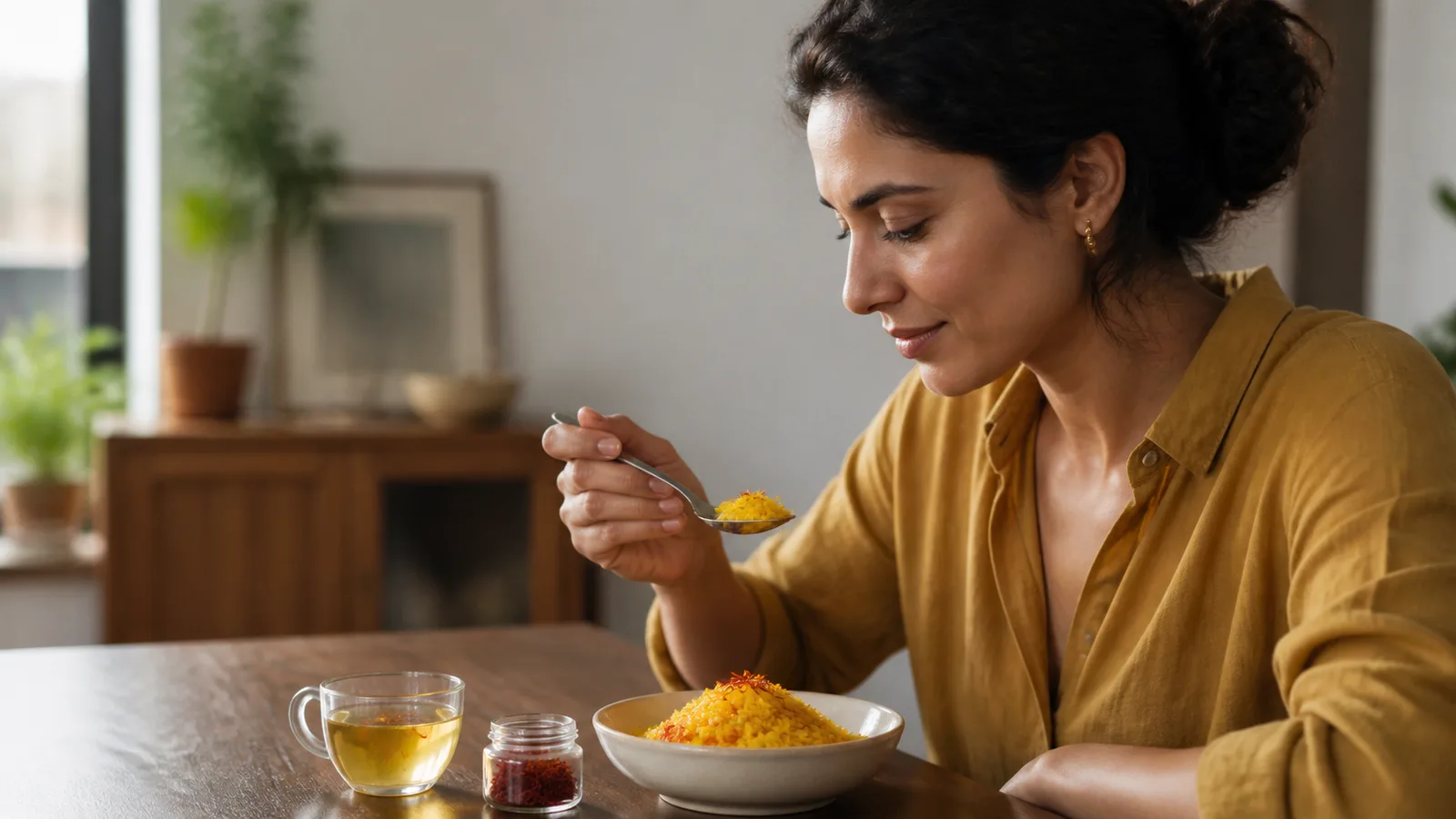
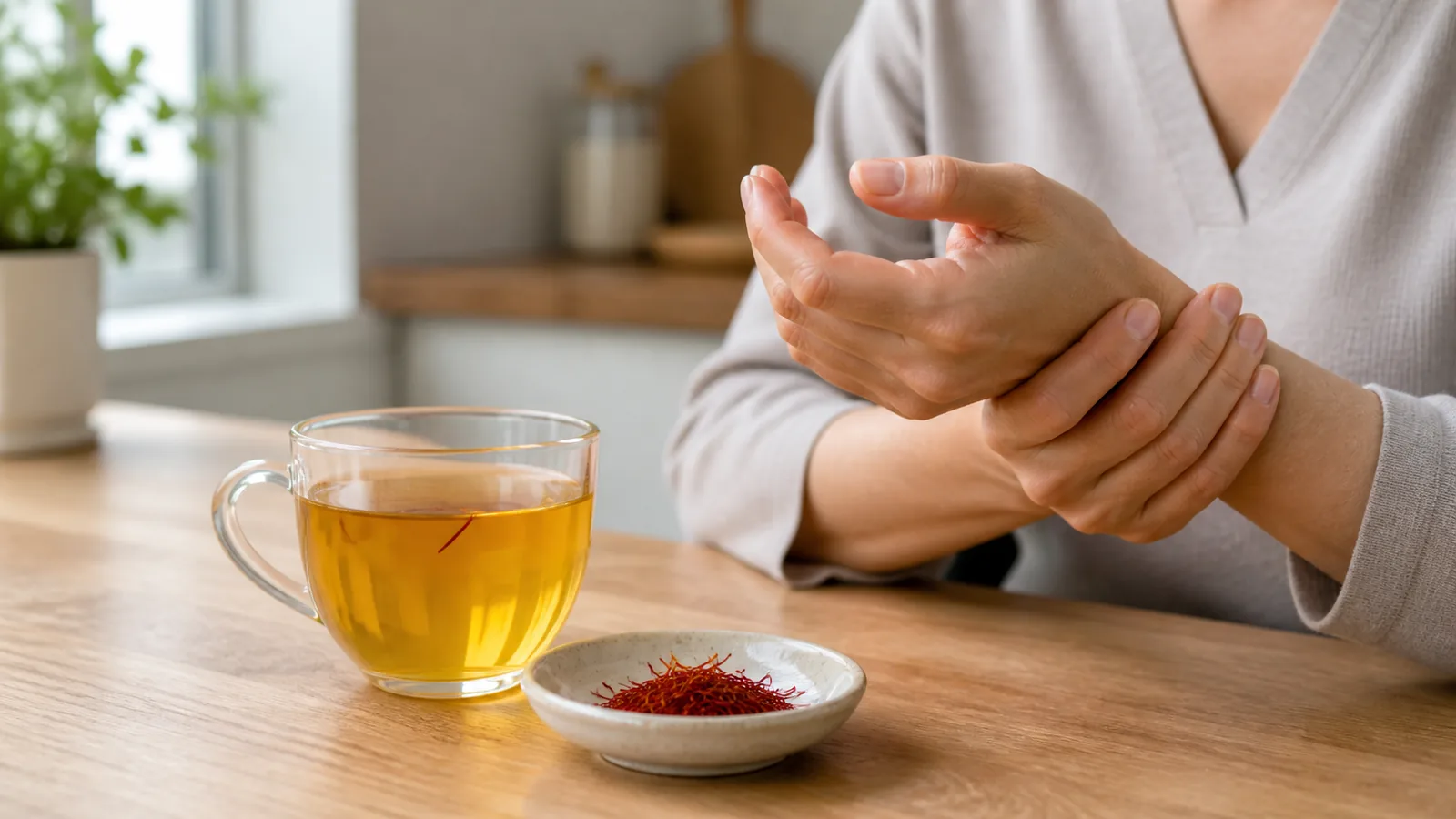
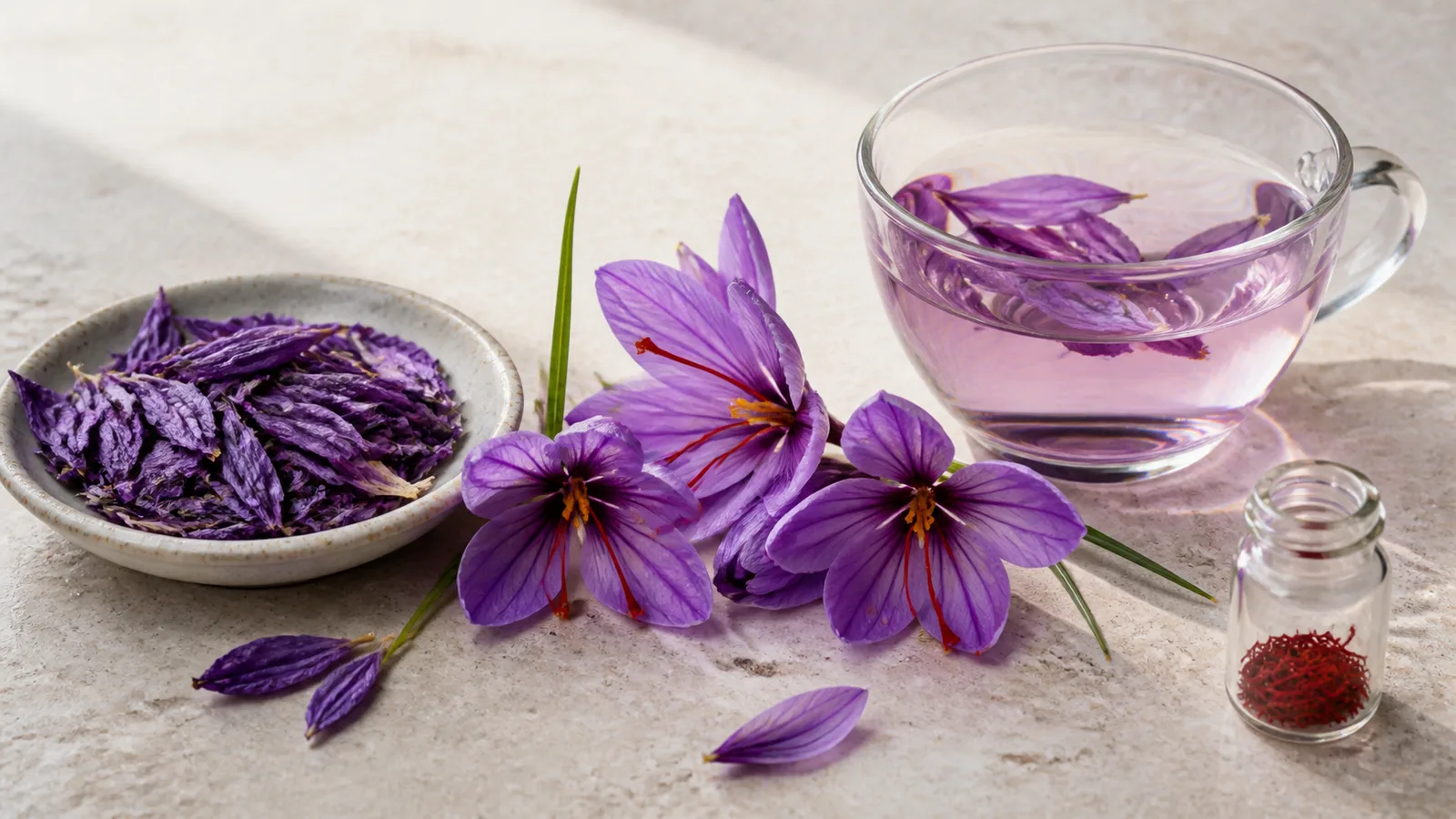
Saffron petals are the purple tepals left after the three red stigmas have been removed from each Crocus sativus flower. Food-grade petals can be dried for a mild floral infusion, and researchers are studying their pigments and flavonoids as a possible source of natural colour and other useful ingredients. They are not the saffron spice, and evidence does not show that petal tea treats disease.
Health note: This article explains research; it is not medical advice. Do not replace prescribed care with saffron petals, tea or supplements. Anyone who is pregnant, breastfeeding, taking medicine, managing a health condition or considering a concentrated extract should speak with a qualified clinician.
Saffron petals, stigmas and whole flowers are different
Every saffron flower contains purple tepals, yellow stamens and a style that ends in three red stigmas. The dried stigmas are the spice. The petals are the much larger floral by-product left after separation. Calling every part “saffron” causes confusion because a stigma extract, a petal extract and a cup of petal tea do not have the same composition or dose.
Crocin, picrocrocin and safranal are the best-known compounds associated with saffron spice. Petal analyses have also identified smaller amounts of carotenoids such as crocin and crocetin, but research characterises the petals especially by flavonols such as kaempferol and quercetin derivatives and by anthocyanins, including pigments responsible for their purple colour. Composition varies with origin, drying and extraction.
Practical uses of saffron flower petals
A mild floral infusion
Food-grade dried petals can be brewed on their own or blended with tea, rose or cardamom. The drink is paler and milder than an infusion made with red saffron threads. Use petals sold for food use, follow the supplier’s serving instructions and discard any material that smells musty or shows moisture or mould.
Steep the petals in freshly boiled water for the time stated on the food package, then strain. There is no established medical dose for homemade saffron-petal tea, so stronger is not necessarily better. The earlier method—placing fresh or dried petals in a glass and keeping it over indirect heat for 15–20 minutes—is a traditional preparation, not a clinically tested treatment.
Food colour and product research
Petal anthocyanins are being investigated as natural colourants, while drying research examines how to stabilise those compounds before extraction. This is promising work for reducing floral waste, but a compound showing antioxidant activity in a laboratory does not mean a petal drink prevents ageing, strengthens immunity or protects cells from disease in a person.
Cosmetic research and traditional skin care
Saffron petals and flower extracts appear in experimental and cosmetic research because of their flavonoids and pigments. The previous article advised applying ground saffron with honey and washing the mask off after 10 minutes. Evidence does not establish that this homemade mask prevents sun damage, moisturises every skin type or treats a skin condition. Honey, plant material and fragrance can irritate sensitive skin. Use a formulated product as directed, patch-test it first, and seek medical advice for a persistent rash or other skin problem.
What does health research actually show?
Mood
A small double-blind randomised trial published in 2006 studied a standardised saffron-petal capsule in 40 adults with mild-to-moderate depression for six weeks. The petal group improved more than placebo on the study’s rating scale. That is human evidence, so it would be inaccurate to say no clinical trial exists. It is still one small, short trial of a measured extract—not evidence that petal tea treats depression, anxiety, stress, insomnia or another sleep problem.
Later saffron mood studies often use stigma-based or proprietary extracts rather than petals. Proposed mechanisms sometimes mention neurotransmitters such as dopamine, but the petal trial did not establish that drinking petals changes dopamine in people. Findings from other extracts cannot automatically be transferred to a homemade petal drink. Depression can be serious; professional care should not be delayed while trying a botanical product.
Cancer
Petal compounds and saffron-related extracts have been tested in cells and animals, including experiments that measure cancer-cell growth. Laboratory activity is not cancer treatment. No evidence supports using saffron petals in place of surgery, radiotherapy, chemotherapy, immunotherapy or any plan from an oncology team.
Inflammation and brain conditions
Petal extracts have shown antioxidant or anti-inflammatory activity in preclinical experiments. Research on saffron more broadly has also explored Alzheimer’s disease and other neurological conditions. These subjects are frequently combined online, but the plant part, extract and study model matter. Saffron petals have not been established as a treatment for Alzheimer’s disease or another neurological disorder.
Eye health, blood sugar and respiratory or digestive symptoms
Claims about age-related macular degeneration, blood sugar, asthma, muscle fatigue, cough and bloating usually come from traditional use or research on saffron stigmas and specific extracts—not ordinary petals. The evidence is not sufficient to recommend saffron-petal tea for any of these conditions.
Can petals replace saffron threads?
No. Petals can provide a gentle floral note and colour of their own, but they do not provide the concentrated aroma, taste and golden colouring strength of the red stigmas. A package of petals should be labelled as saffron petals or tepals, not sold as saffron spice.
The former article also included a strong saffron-thread tea made with one gram of ground saffron plus black tea. One gram is far beyond the amount normally needed to flavour a household drink and should not be presented as a casual single-recipe measure. For a culinary saffron infusion, use a small recipe-appropriate pinch of threads and follow a tested preparation rather than treating the drink as medicine.
Buying and storing petals safely
- Buy petals identified as food-grade Crocus sativus, not ornamental crocus flowers.
- Choose a sealed package with producer, lot and storage information.
- Look for naturally purple dried material without dampness, visible mould or artificial perfume.
- Keep the package airtight, cool, dark and dry.
- Do not forage unknown crocus species for tea.
Saffron petals are an interesting agricultural by-product with real pigments and flavonoids, a traditional place in some infusions and potential uses in food and cosmetic development. That makes them useful without turning preliminary research into a promise to treat disease.