


The Kashmar saffron harvest began across 5,500 hectares in the historical season described here. Of that area, 5,200 hectares were reported as bearing, with an average forecast of 3 kg/ha and an expected crop of 15,600 kg. A neighbouring Khalilabad report forecast up to 18 tonnes, while a much smaller programme in Abadeh reported more than 150 kg from 30 hectares.
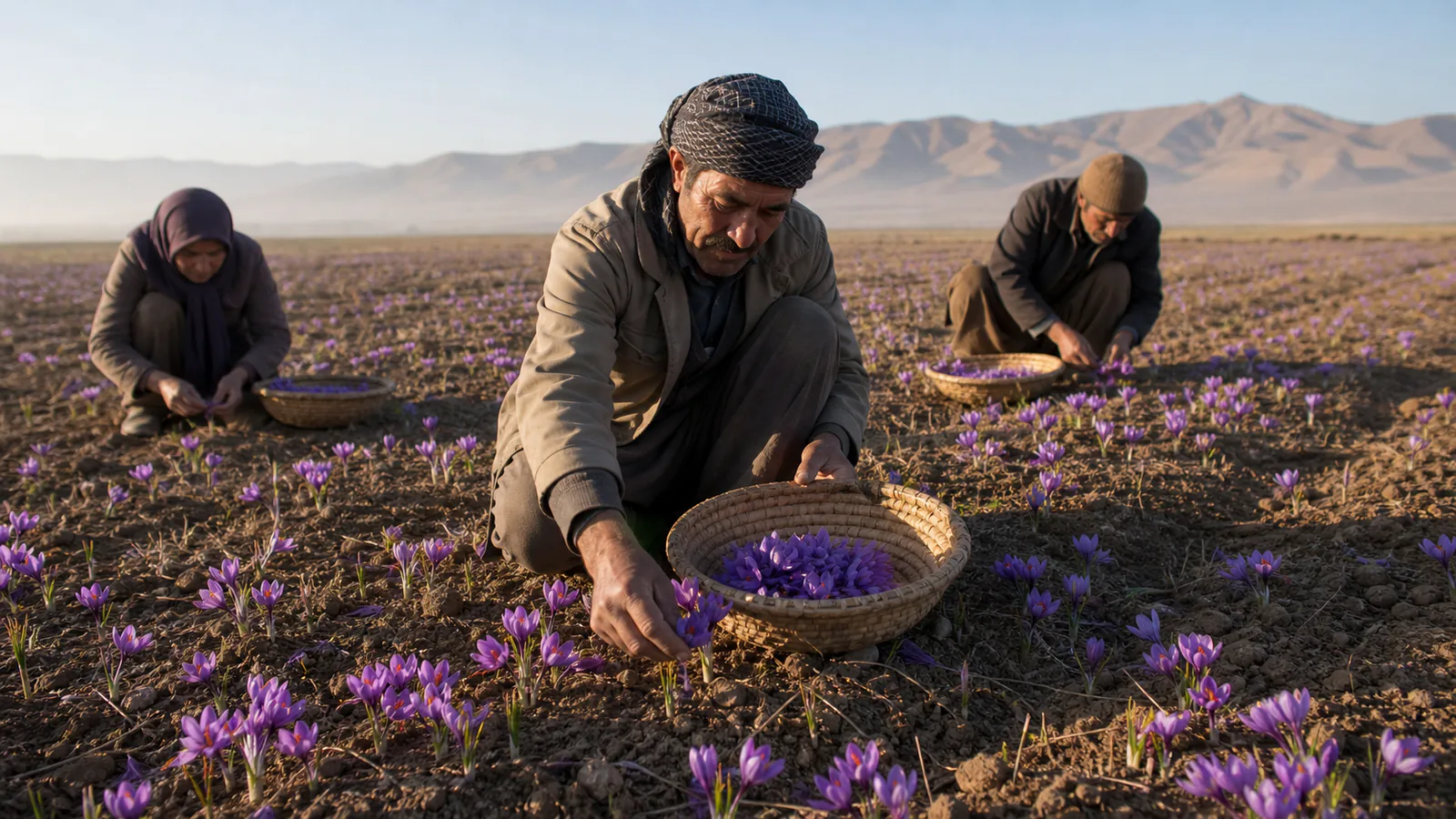
These accounts show three different scales of production and three kinds of support: post-harvest training in Kashmar, field inputs and a proposed purchase mechanism in Khalilabad, and close farm monitoring in Abadeh. Their figures belong to separate local reports and should not be combined into one regional total.
Kashmar’s 5,500-hectare harvest
Mohammad Swabi, as the official’s name appears in the English report, was identified as director of Kashmar Agricultural Jihad. He said flower picking had started and expected the crop to compare favourably with the previous year.
The report separated total planted area from bearing area: 5,500 hectares under saffron, of which 5,200 hectares were fertile or productive. At a forecast average of 3 kg of dried saffron per bearing hectare, the arithmetic gives exactly 15,600 kg. That agrees with the stated city forecast.
It remains a forecast rather than a final weighed harvest. The source supplies no crop-year label, collection method, field sample, grade breakdown or post-drying loss. The remaining 300 hectares may have been young or otherwise non-bearing, but the reason is not stated.
Training and post-harvest handling in Kashmar
The local agriculture office distributed educational material on hygienic saffron processing and held training courses in villages. It also reported establishing two hygienic-processing workshops with the National Saffron Council.
The wording does not say whether those workshops were buildings, training sessions or operating processing units, nor does it give capacity, equipment or inspection results. The supported point is that post-harvest handling was part of the local programme, not that every lot had been processed under one verified standard.
Swabi linked expected quantity and quality to timely fertilisation, appropriate irrigation and farmers following technical advice. No soil tests, input rates or controlled comparison are supplied. Those practices remain the official’s explanation; they are not a universal prescription for another farm.
Growers’ concern about costs and price
The Kashmar report identified fluctuating saffron prices and rising production costs as growers’ immediate concerns. Labour and agricultural inputs were specifically named. The official expressed hope for greater price stability.
No price, cost per hectare, wage, support payment or profitability calculation appears in the source. This article therefore does not convert the concern into a current market claim. A crop can meet its yield forecast and still leave farmers under pressure if labour and input costs rise faster than the amount they receive.
Neighbouring Khalilabad’s 18-tonne forecast
Majid Taherpour, then director of Khalilabad Agricultural Jihad, reported more than 4,500 hectares under saffron and forecast as much as 18 tonnes. Khalilabad neighbours Kashmar in Razavi Khorasan, making the report useful context for the same wider production area.
If the acreage were exactly 4,500 hectares, 18,000 kg would equal 4 kg/ha. But the source says the area was more than 4,500 hectares and production was expected up to 18 tonnes. Those open-ended terms prevent an exact average. The figure is best kept as a local forecast.
Taherpour said the preceding year’s crop had fallen significantly because of frost and hoped for a better result in the reported season. He did not give the previous output, affected hectares or temperature record. Our separate account of a reported Khalilabad saffron yield decline preserves another local snapshot without assuming the two reports refer to the same year.
What “220 people per day” most likely means
The old English translation says each saffron hectare employs “about 220 people per day of production,” with the greatest demand during flowering and flower collection. Two hundred and twenty simultaneous workers per hectare per day would be implausible and does not match the usual way seasonal labour is reported.
The likely intended measure is approximately 220 person-days of work per hectare across the production cycle. A person-day means one person’s work for one day; ten people working for five days would equal 50 person-days. Because the Persian wording is not preserved in the post and the labour period is undefined, even this corrected reading remains labelled as an interpretation.
The broader point is well supported by the report: labour demand peaks during the short flowering period, when flowers must be collected and stigmas separated promptly. It does not establish a headcount of unique workers.
Fertiliser distribution and field advice in Khalilabad
Taherpour reported distribution of more than 400 tonnes of chemical fertiliser to saffron growers. The source says growers received sufficient quantity and desired quality, but it does not identify products, nutrient analyses, allocation records, field area served or actual application rates.
Dividing 400 tonnes by 4,500 hectares would suggest about 88.9 kg/ha only if every reported tonne went evenly to exactly that area. Neither assumption is documented, so the quotient is not an application recommendation.
The local advice covered timely post-harvest irrigation and fertilisation, weed control, foliar micronutrients, disinfecting planting corms and selecting large, healthy corms. The old article calls corms “onions.” Any real input or disinfection decision needs the crop’s condition, product label, soil or tissue evidence and qualified local guidance; the historical list alone is not enough to prescribe a treatment.
Was a guaranteed purchase in place?
The Khalilabad account said the agriculture office was working with the Rural Cooperative Organization on a guaranteed-purchase approach intended to protect growers from a price fall. Its closing sentence is awkward and expresses hope rather than documenting a completed purchase round.
No opening date, buyer, grade schedule, quantity, price, delivered volume or payment record is supplied. The accurate description is that a purchase mechanism was being pursued or discussed, not that every grower had a guaranteed buyer.
Abadeh’s 30-hectare completed harvest
Mehdi Amini, identified as director of Abadeh Agricultural Jihad in Fars Province, said picking continued until mid-December and produced more than 150 kg from 30 hectares. He reported an average yield of about 5 kg/ha, which is consistent with a total just above 150 kg.
The Abadeh programme temporarily employed more than 150 people. This is a headcount claim rather than a person-day measure, and the source does not say how long each person worked or which harvest and processing tasks were included.
Support included training classes, regular expert visits, guidance on field nutrition and weed-control timing, and oversight of corm transport. Amini also said a planted saffron corm could keep flowering for up to seven years and hoped the city’s cultivated area would expand. Field longevity varies with corm health and management, so “up to seven years” remains his local programme statement rather than a guarantee for every planting.
What the three harvest reports establish
- Kashmar: 5,500 hectares planted, 5,200 bearing and a 15,600 kg forecast based on 3 kg/ha.
- Khalilabad: more than 4,500 hectares, up to 18 tonnes forecast, heavy seasonal labour demand and a prior frost-related loss.
- Abadeh: more than 150 kg harvested from 30 hectares, about 5 kg/ha and more than 150 temporary workers.
- Each locality paired expansion or production with training, monitoring, processing or market-support plans.
- All figures are historical; none is presented as a current acreage, crop result, fertiliser programme or price guarantee.
For the national production-chain context, see our article on Iran’s saffron harvest, processing and markets. It explains why planted area, bearing area, fresh flowers, dried output and saleable graded saffron must remain separate measures.
Sources and reporting limits
- Historical local reports attributing the Kashmar figures to Mohammad Swabi, the Khalilabad figures to Majid Taherpour and the Abadeh figures to Mehdi Amini.
- FAO Iran: harvesting, post-harvest practice and quality integrity in Iran’s saffron chain.
The reports do not share a stated crop year or common methodology. Forecasts, completed harvests, open-ended totals and interpreted translation units are identified separately so the comparisons do not imply more precision than the sources provide.

![Exporting Saffron to Turkey + Price Guide [Complete 0 to 100]](https://img.rowhanisaffron.com/20260827003933/saffron-export-turkey-quality-inspection.webp)



