


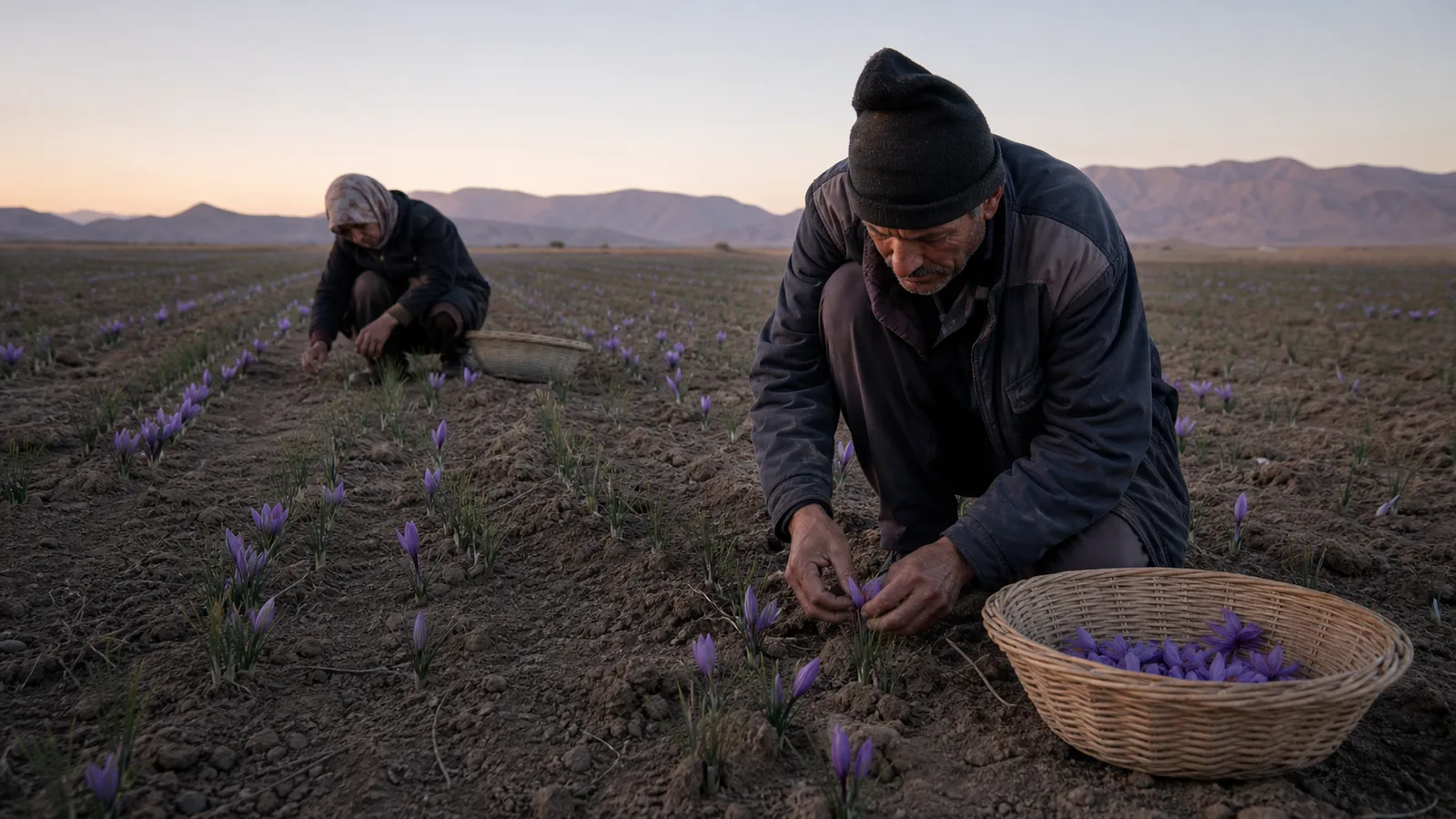
Iran’s saffron harvest begins in early autumn, builds quickly toward a short peak, and is still dominated by hand-picking. Historical reports collected here describe the opening of a new crop, a claim that 95% of cultivated area was harvested manually, attempts to sell larger volumes through the commodity exchange, and pressure to find export markets before supply reached its seasonal high.
The reports cover different crop years. Their production forecasts, prices and export values should not be combined as if they describe one season, and none is a current price quotation. Read together, however, they show how field labour, finance, trading policy and product identity meet during the few weeks when saffron flowers.
“Modern harvest” meant a new season, not machine picking
The original English headline called this the beginning of the “modern saffron harvest.” In context, the report was describing the new-season harvest. Seyed Ali Hosseini, then identified as vice president of the Association of Saffron Producers and Exporters of South Khorasan, said picking had begun about ten days earlier but volumes were still too small to shape the market. He expected the peak roughly 15 days later.
A companion report from another season gave October 11 as the official start. These dates are not contradictory: altitude, temperature, irrigation and location move flowering across districts, and an “official” date need not be the first day any farmer picks flowers.
The distinction matters because a second source said approximately 95% of Iran’s saffron area was harvested manually. Modernisation in the reports concerned organised sales, processing, packaging and export systems—not a claim that machines had replaced flower pickers.
Why saffron is still picked by hand
Saffron flowers close to the ground and the commercial product is only the three delicate red stigmas inside each bloom. Flowers arrive over a concentrated period and need careful collection before heat and handling damage quality. After picking, the stigmas must still be separated, dried and protected from moisture and contamination.
Hossein Shirzad, then a deputy agriculture minister, said 95% of the area under saffron was harvested manually and non-mechanically. A research record indexed by FAO’s AGRIS database likewise describes conventional harvest as labour-intensive and time-critical, while evaluating portable flower-picking and stigma-separation machines. Research into mechanisation therefore existed, but the official’s national estimate described a sector still reliant on people.
Manual work is not automatically a guarantee of quality. Timing, clean containers, rapid transfer, hygienic stigma separation and controlled drying determine what happens after the flower leaves the plant. A modern value chain can retain hand-picking while improving traceability and post-harvest handling.
The reported cultivated area and a decimal problem
Shirzad cited about 97,000 hectares under saffron nationwide, mainly small irrigated holdings. Approximately 92,000 hectares—almost 95% of that reported total—were in Khorasan Razavi, South Khorasan and North Khorasan, although he said the crop was produced in every province.
The old English source rendered the national average yield as 389 kg per hectare. That cannot be reconciled with the same period’s national area and production scale: 97,000 hectares at 389 kg/ha would imply 37,733 tonnes of dried saffron.
The likely lost decimal is 3.89 kg/ha, a plausible reading of Persian decimal notation. At 97,000 hectares, that would imply about 377 tonnes. The source also said the three Khorasan provinces averaged 20% more, which would be about 4.67 kg/ha if 3.89 were the intended base. Because the original statistical table is unavailable, 3.89 is presented as a reasoned correction, not a newly verified official figure.
This is also why total production should never be divided by a broad “cultivated area” without checking whether every hectare was mature and bearing. Our guide to saffron yield per hectare explains the denominator problem in more detail.
Early harvest, thin supply and uncertain prices
Hosseini said buyers were waiting for larger volumes from the new crop and that there was little product available for export at the opening of the season. He declined to forecast whether prices would rise or fall, pointing instead to global economic conditions, demand and the amount reaching market.
The report also recorded discussions in Mashhad among representatives from Khorasan Razavi and South Khorasan, exporters, National Saffron Council members and farmers. Two proposed benchmark figures—16 million and 20 million tomans per kilogram—were mentioned. The source did not preserve a clear grade for each number, a formal purchase order or proof that either became an enforceable floor.
Hosseini argued that any support programme would need enough finance to buy product and a workable export channel. A floor announced without purchasing capacity would not by itself support growers. The figures are historical tomans, not present-day prices, and they should not be converted or used for a sale without a date, grade, currency basis and transaction terms.
A different season’s 500-tonne forecast
In the second Hosseini report, good rain at the end of one year and the beginning of the next led to a forecast of 500 tonnes. He said 70–80% of production would need to be exported to keep that larger crop’s market balanced.
This was a forecast, not a final measured harvest. It belongs to a different season from the 16–20-million-toman discussion. Weather can improve field condition before flowering without guaranteeing the final dried-stigma total; labour, timing and post-harvest losses still intervene.
That report also said prices for the previous crop had reached 10–12 million tomans per kilogram at one point and later fallen to about 9 million. Grade, date and sale type were not specified. These values show the direction described by the speaker, not a universal price series.
The commodity exchange and the need for harvest finance
Shirzad reported that the Central Organization of Rural Cooperatives had offered 68 tonnes of saffron through the commodity exchange in the preceding year, calling it a record for that channel. His objective was to bring more organised capital into a market historically shaped by fragmented spot transactions.
A UNIDO diagnostic study of Iran’s saffron value chain had identified the same structural pressure: farmers and formal buyers often lacked finance at harvest, creating space for dealers to buy flowers or raw saffron immediately. The study also found weak long-term relationships between growers, packagers and international buyers.
An exchange can improve price discovery and standardisation only when grades, warehouse receipts, testing, settlement and access are trusted. The reported 68 tonnes shows channel volume; it does not by itself prove that every grower received a better net price.
Historical export values
Shirzad said exports in packages above 30 grams reached 210 tonnes worth $278 million in 2016, and that export value had grown beyond $350 million by Iranian year 1397 (roughly March 2018 to March 2019). These figures preserve the categories used in his statement. They should not be treated as the value of all saffron exports without the original customs table.
The larger point was that production alone did not secure value. Packaging, quality assurance, branding and stable buyer relationships determined how much of the final market price stayed with Iranian participants. Current FAO work in Iran still emphasizes post-harvest handling, authenticity, traceability and market competitiveness.
Afghanistan, informal trade and origin claims
Hosseini alleged that some traders acquired Iranian saffron through informal channels, moved it to Afghanistan and sold it abroad under Afghan origin. He blamed foreign-exchange and trade policy for making Iranian exports harder while competitors developed their markets.
The source did not provide shipment records, volumes, laboratory tracing or named traders. The allegation is therefore preserved as his account, not stated as a measured fact about all Afghan exports. Afghanistan also has its own saffron farms and an independently developing industry; legitimate Afghan production should not be conflated with alleged re-export.
What the report correctly highlights is the importance of verifiable origin. Batch records, recognised testing, documented chain of custody and honest country-of-origin labelling protect both producers and buyers. Repacking without traceability weakens confidence regardless of the border involved.
What the three reports establish
- Iran’s new-season saffron supply begins gradually and can take roughly two weeks to reach a local peak.
- The harvest in the reported period was overwhelmingly manual, even as trading and processing systems sought to modernise.
- Production forecasts and proposed price floors require dates, grades and programme terms before they can guide a transaction.
- The 389-kg/ha translation is arithmetically impossible; 3.89 kg/ha is likely but remains an inference until the original table is found.
- Finance at harvest, export access, quality control and traceable origin affect how value is distributed after flowers are picked.
For readers learning how the crop itself fits these market reports, our complete guide to Iranian saffron covers the plant, harvest and quality characteristics without turning historical market numbers into current offers.
Sources and context
- Historical statements attributed to Seyed Ali Hosseini and Hossein Shirzad in the three reports consolidated on this page.
- UNIDO: Saffron Industry Value Chain Development in Iran, diagnostic study.
- FAO AGRIS: research record on saffron-harvest mechanisation.
- FAO Iran: quality integrity, traceability and modern marketing in the saffron value chain.

![Exporting Saffron to Turkey + Price Guide [Complete 0 to 100]](https://img.rowhanisaffron.com/20260827003933/saffron-export-turkey-quality-inspection.webp)



