


The beginning of saffron harvest in Torbat Heydariyeh and Zaveh brings a short, intense season to the fields of Khorasan Razavi. Purple flowers appear over a few weeks, and each day’s crop must be picked, opened and processed with care. The value is in the three red stigmas at the centre of every flower.
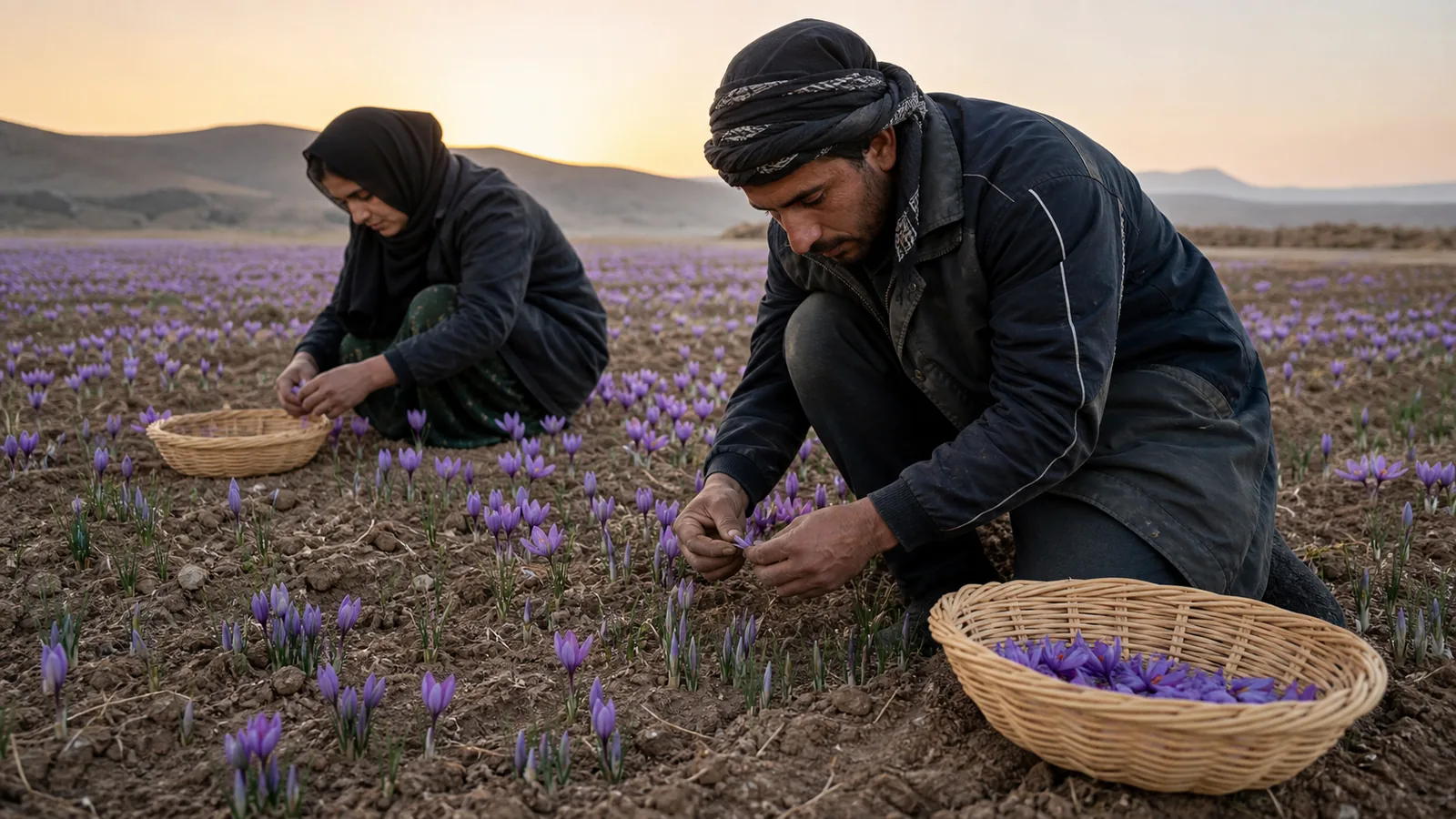
When saffron harvest begins in Torbat Heydariyeh and Zaveh
Saffron flowers in autumn, but the first day is not fixed by the calendar alone. Conditions in the field, the timing of irrigation, corm size and temperature all influence emergence. In much of Khorasan, the main flowering period falls from October into November.
The first open flower signals the start of daily work. A field does not bloom all at once: new buds continue to emerge while earlier flowers are being processed. A review of Iranian saffron production and collection describes a flowering window of roughly 15 to 25 days, with flowers lasting only a few days if they are left in the field.
That is why the harvest often appears sudden. Quiet plots turn purple, labour demand rises quickly and the same cycle repeats each morning until flowering tapers off.
Why flowers are picked early
Harvesters normally enter the field early in the morning, while the flowers are still closed or only beginning to open. The cooler air helps keep the blooms firm, and closed petals protect the delicate stigmas from sun, wind and dust during collection.
Flowers are picked by hand and placed loosely in clean baskets or shallow containers. Crushing a deep pile makes the later separation slower and can bruise the material. Speed matters, but so does gentle handling: the useful part of a saffron flower is small, and quality can be lost between the field and the drying room.
The work also creates seasonal income throughout the region. Women have traditionally carried out much of the picking and stigma separation, alongside other family and hired workers. It is skilled agricultural labour, not simply spare-time activity; an experienced worker recognises clean stigmas, handles them quickly and keeps petals and yellow stamens out of the final spice.
From a purple flower to red saffron threads
Every saffron flower contains three red stigmas. After the flowers arrive from the field, workers open them and separate those stigmas from the petals and yellow stamens. The separated material is then dried under controlled, hygienic conditions.
The fresh stigma is moist and perishable. Drying removes most of that moisture and develops the stable colour, aroma and flavour associated with saffron. The process should not be treated as an afterthought. A broad review of saffron quality and processing notes that harvesting and dehydration influence the finished spice, including the compounds connected with colour, bitterness and aroma.
Older household methods sometimes spread stigmas in shade on a clean cloth. Commercial producers may use controlled dryers instead. Neither a dark red colour nor a strong smell on its own proves quality; hygiene, final moisture, purity and laboratory grading all matter. Drying too slowly can expose wet stigmas to contamination, while excessive heat can change the product’s chemical and sensory profile.
What happens in a first-year saffron field
Saffron grows from corms rather than seed. A newly planted field can flower in its first season, but yield varies considerably. The size and condition of the planted corms, planting density, soil drainage, irrigation and weather all influence how many flowers appear.
The old version of this report said a first-year field produces only a few flowers from the largest corms. That can happen, but it is not a universal rule. Research has recorded first-year production across a wide range of planting systems. The more accurate expectation is that a new field may not yet show its mature yield, and a grower should judge it over more than one flowering cycle.
After flowering, the leaves remain important. They support development of daughter corms below the soil, which carry the planting into later seasons. Cutting the foliage too early or neglecting the field once the flowers are gone can weaken that next cycle.
Why Torbat Heydariyeh and Zaveh matter to saffron
Torbat Heydariyeh and neighbouring Zaveh sit in one of Iran’s best-known saffron-producing areas. The crop is woven into the region’s seasonal work, trading and household income, as it is in Taybad, Bakhrez, Gonabad and Bajestan in Khorasan Razavi and in Ghaen, Ferdows, Sarayan and Birjand in South Khorasan.
The name Zaveh also has a historical relationship with Torbat Heydariyeh. The two are now separate counties, but references to the older Zaveh region still appear in descriptions of the area’s saffron culture. Keeping both names in the harvest report helps readers locate the event and understand why the markets and farms are often discussed together.
Production is never identical from one season to the next. Water availability, heat, frost, corm health and farm management can all change the crop. Our related report on a forecast decline in Torbat Heydariyeh saffron production illustrates why an opening harvest should not be mistaken for a final yield figure.
What to look for during the harvest
For a grower or buyer, the first flowers are only the beginning. The most useful observations are practical: whether blooms are being collected daily, whether they reach a clean processing area promptly, how the stigmas are separated and how drying is controlled.
A responsible harvest keeps flowers off bare soil, protects them from compression and separates damaged or contaminated material. The red stigma should remain identifiable; adding yellow style, stamens or other plant matter increases weight without adding the same culinary value.
The beginning of saffron harvest in Torbat Heydariyeh and Zaveh is therefore more than a colourful field scene. It starts a chain of careful manual work. What reaches a kitchen later depends on decisions made during those first mornings: timely picking, clean separation, suitable drying and honest handling of the finished threads.

![Exporting Saffron to Turkey + Price Guide [Complete 0 to 100]](https://img.rowhanisaffron.com/20260827003933/saffron-export-turkey-quality-inspection.webp)



