


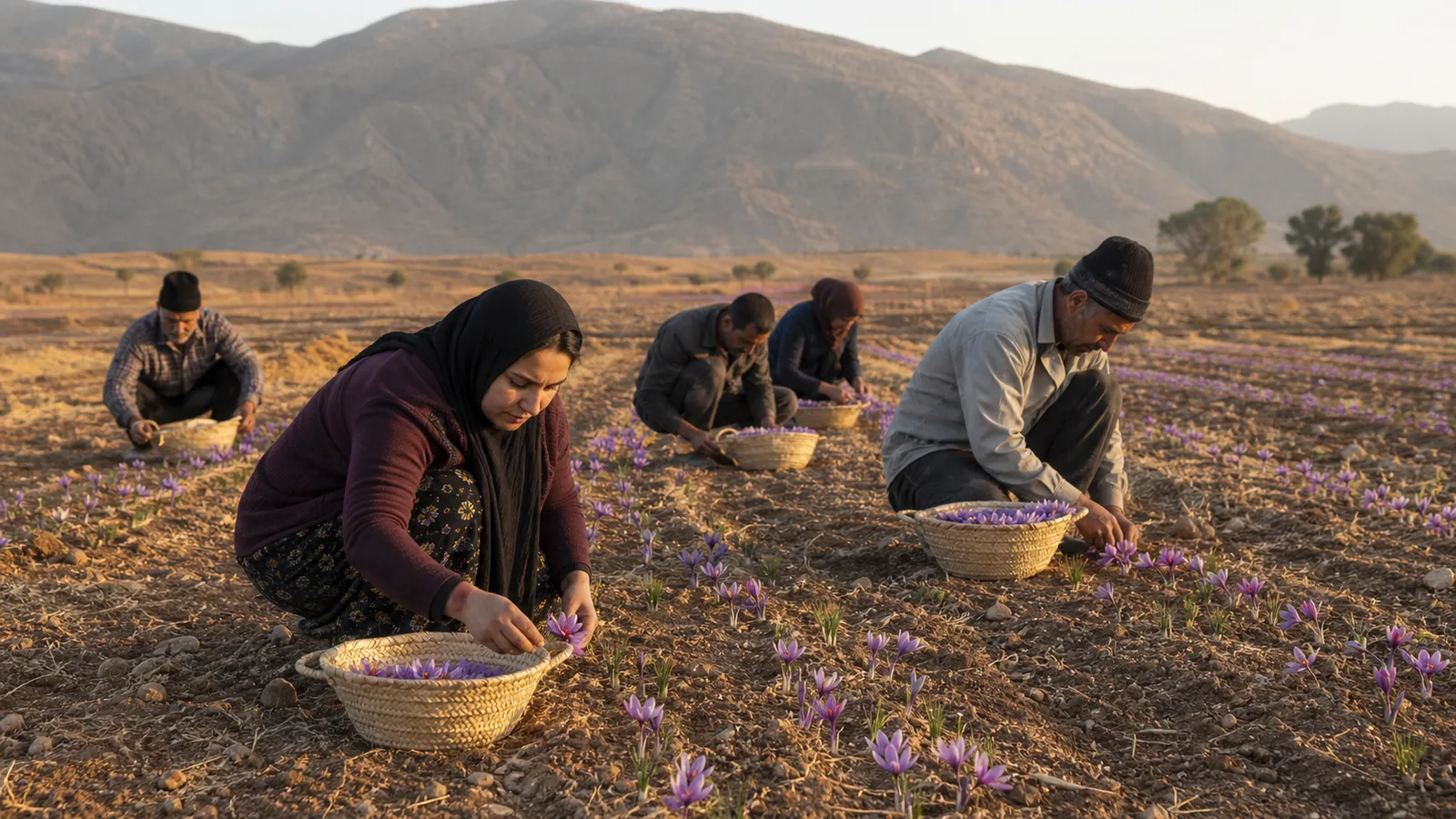
Gachsaran’s first reported saffron harvest came from a one-hectare pilot created to diversify rural income. Twenty-eight applicants in 14 villages joined the wider programme, while local institutions supplied corms, training, marketing support and access to low-cost finance.
The archived account is valuable as a record of that beginning, but it combines several speakers, forecasts and national statistics without giving the event date. Its numbers should be read as figures reported at the time, not as current prices or production data.
What happened in Gachsaran
Ali Hassan Ansari, identified as a Gachsaran Agricultural Jihad expert, said saffron had been harvested in the city for the first time. One hectare was planted through a sustainable rural-system plan designed to match economic activity to the climate, geography and capacity of individual villages.
Ansari said cultivation was possible across villages in the city’s four rural districts. He described first-year production of 200 grams per hectare, second-year production of 2 kilograms, a general average of 4 kilograms and an average harvest of 4.8 kilograms per hectare. Because the source gives both 4 and 4.8 kilograms as averages without defining them, they should not be collapsed into a single figure.
The low first harvest was not necessarily a failed result. A new saffron field usually produces less before replacement corms develop and the stand matures. Yield depends on corm size and density, water, soil, field age and management; a one-hectare pilot cannot establish what every Gachsaran field will produce.
The villages and farmers in the pilot
Hossein Jannati, named in the report as the provincial Director General of the Housing Foundation of the Islamic Revolution, said 2,500 kilograms of saffron corms had been distributed in October. The programme involved 28 applicants in 14 villages.
The translated village list is imperfect, but the report names Anjirsiah, Dale, Aro, Chaharbisheh Olya, Chaharbisheh Sofla, Marin, Imamzadeh Jafar, Pashkan, Pakoh, Abrigun, Genaveh, Abchirak and Mozaffarabad, followed by a place rendered as “Islam Abamabad.” Anjirsiah—literally translated in part of the source as “Black Figs”—was selected as the dedicated saffron-crop village, where 14 farmers tested cultivation.
The archived list appears to run place names together and may omit or mistransliterate one village. Retaining that uncertainty is more accurate than silently inventing a corrected fourteenth name.
What support farmers were offered
The Housing Foundation had signed a memorandum of understanding with an organization translated as the “mother industry farm” to support saffron cultivation. The sustainable rural-development project also involved Agricultural Jihad and the Omid Kohgiluyeh and Boyer-Ahmad Entrepreneurship Fund.
- Planting material: corms were supplied below the market price reported at the time.
- Training: new growers were to receive cultivation guidance.
- Finance: applicants could use low-cost banking facilities through the entrepreneurship fund.
- Marketing: assistance was included so the project did not end at harvest.
Jannati put the market price of corms at 125,000 rials per kilogram and the programme’s farmer price at 55,000 rials. He said 10 tonnes would be distributed the following year because of farmer interest. These are historical programme figures; the article provides neither a calendar year nor evidence that the later distribution occurred.
Why farmers were interested in saffron
Gachsaran already produced many agricultural and livestock products, but local experts saw diversification as a way to make farm income less dependent on a narrow crop mix. The report put total city output at more than 96,000 tonnes a year and presented saffron as a light, high-value product with comparatively low transport cost.
Growers were also attracted by a perennial field life. Ansari said saffron corms could remain productive for up to seven years after planting. That is possible in some systems, but the economic life of a field is not guaranteed: crowding, smaller daughter corms, disease and declining yield can make earlier lifting and replanting sensible.
The crop’s food use is well established. The original article also referred broadly to “many medicinal uses,” but that phrase should not be taken as a promise that ordinary culinary saffron treats disease. Research on standardised saffron preparations is product-, dose- and condition-specific.
Low water demand still requires local testing
Saffron is attractive in dry regions because it generally needs less irrigation than many crops and its active cycle makes use of cooler months. The FAO description of Gonabad’s qanat-based saffron system likewise places the crop in a severely water-scarce landscape.
“Low water” is not the same as “no water,” and “poor soil” is too broad to serve as a recommendation. Drainage, texture, salinity, fertility, irrigation quality and temperature still affect the field. A recent long-term study found saffron yield sensitive to salinity, while field research in Iran shows that supplying only half the crop’s water requirement reduced later flower and stigma yield.
For farmers considering the crop, a soil and water test, a small local trial and a realistic labour plan are safer than treating saffron as automatically suited to every arid parcel.
A planting-rate error in the archived report
The original translation says “modern cultivation” uses 10 kilograms of corms per hectare and “traditional cultivation” uses 6 kilograms. Those amounts cannot plausibly establish a commercial hectare and were almost certainly stripped of a unit or magnitude during reporting or translation.
Research at Ferdowsi University of Mashhad evaluates planting density in corms per square metre and corm weight. One field study tested 50, 75 and 100 corms per square metre; another reports dense planting rates in tonnes of corms per hectare. The appropriate rate changes with corm size, field duration and production objective. The 10 kg/6 kg claim should therefore not guide planting.
The historical prices and national figures
The report recorded minimum purchase prices of 1.5 million rials per kilogram of fresh saffron flowers, 160 million rials per kilogram for a category translated as “straw,” and 200 million rials for a category translated as “gem.” These translations do not reliably identify recognised commercial grades, and no market, date or contractual terms are given. They are not current price guidance.
It also recorded national figures in Solar Hijri years 1397 and 1398. For 1397, it gave 111,000 hectares, 380 tonnes produced and 281 tonnes exported for $386 million. For 1398, it gave 120,000 hectares, about 450 tonnes produced and 270 tonnes exported for $262 million. A peer-reviewed cultivation study citing Iran’s Ministry of Agriculture gives a somewhat different 2018 figure—113,938 hectares and 404.5 tonnes—showing why the source and crop-year definition matter.
Saffron elsewhere in Kohgiluyeh and Boyer-Ahmad
Elias Taj Al-Dini, identified as head of the provincial Agricultural Jihad Organization, said the province had 8.37 hectares of saffron farms across Boyer-Ahmad, Kohgiluyeh and Gachsaran counties. The report also put provincial agriculture at 50,000 households working 270,000 hectares, including 160,000 hectares described as arable land, with 910,000 tonnes of annual output.
Those figures set the pilot in perspective. Saffron was a tiny part of a much larger farm economy. Its value lay in testing whether a high-value crop could broaden local options, not in replacing the province’s existing production overnight.
What would prove the pilot succeeded?
A first flower is a milestone, not the final result. A useful follow-up would track surviving area, dry stigma yield, grade, labour hours, irrigation, farmer costs, actual sale price and repeat buyers over several seasons. It would also record whether the promised 10 tonnes of corms, training, finance and marketing support reached growers.
The Gachsaran saffron harvest showed that local farmers could establish and flower the crop. Whether it became a durable source of income depends on what happened after that first hectare—evidence the archived report did not yet have.

![Exporting Saffron to Turkey + Price Guide [Complete 0 to 100]](https://img.rowhanisaffron.com/20260827003933/saffron-export-turkey-quality-inspection.webp)



