


Torbat Heydariyeh saffron production was forecast to fall by 35–40% in one drought report and by 20–25% or more in another. The reports cover different seasons and different cultivated areas, so their figures should not be combined into a single decline. Together, they show how lower rainfall, failing qanats and late irrigation put a major saffron district under pressure.
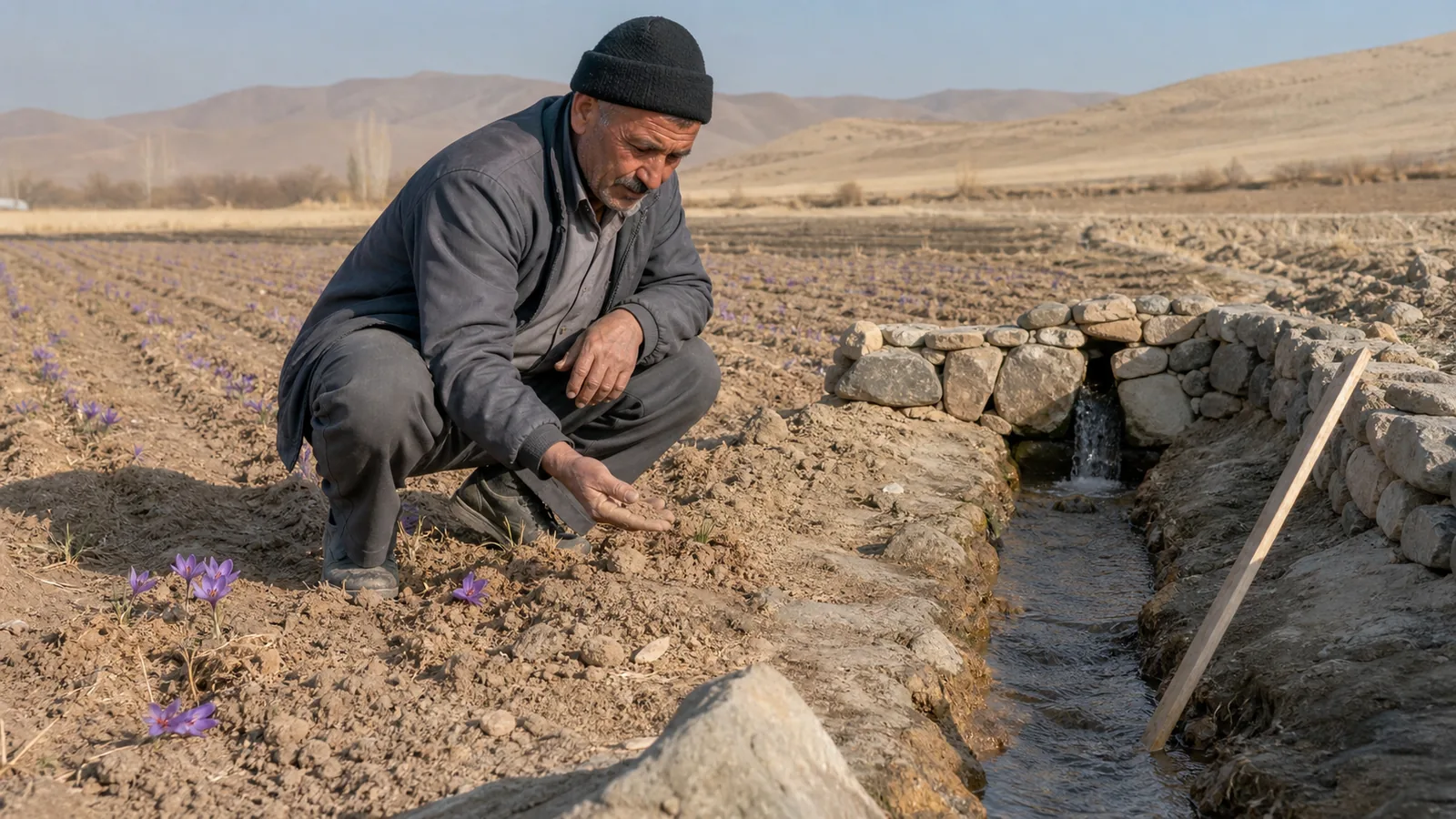
One report described 7,600 hectares and an expected 32-tonne harvest. The companion report described 6,830 hectares, about 22 tonnes of annual production, rainfall down by half and one sixth of saffron farms short of water. This article preserves both accounts, checks their arithmetic and separates forecasts from measured results.
The reported 35–40% decline
Saadat Ali Nia, identified as director of the Agricultural Jihad office in Torbat Heydariyeh, told ISNA that saffron production in the reported year was expected to be 35–40% below normal conditions.
He put normal yield at about 5.5–6 kg per hectare and said drought and insufficient water had reduced the figure to around 3 kg per hectare. The source also reported that harvest had started across 7,600 hectares and forecast approximately 32 tonnes from the district.
The yield and production numbers use different denominators
A simple division of 32,000 kg by 7,600 hectares gives about 4.21 kg per hectare, not 3 kg. If all 7,600 hectares produced exactly 3 kg/ha, the total would be 22.8 tonnes.
A 35–40% reduction from a normal 5.5–6 kg/ha produces a broad range of approximately 3.3–3.9 kg/ha. That is closer to, but still below, the 4.21 kg implied by 32 tonnes across the full area.
The report does not identify bearing versus non-bearing hectares, whether 3 kg described the most affected farms, or whether 32 tonnes was based on a separate field estimate. All four numbers are therefore retained as the official’s statements, but they should not be presented as one internally verified calculation.
For the definitions needed to compare these figures, see our explanation of saffron yield per hectare.
Fields that missed timely irrigation
The Persian text embedded in the original article referred to about 250 hectares of saffron farms that were not irrigated on time. The old English translation rendered this as 250 acres. The hectare unit is preserved here because it is the unit in the source attribute.
Ali Nia said those fields could not provide a harvest for their growers. The wording does not prove every plant was permanently lost; it records a failed or unavailable crop for that season.
He described repeated drought and declining water sources, especially qanats and springs, as barriers to farm development and rural employment. More than 1,750 hectares of city farmland were reportedly being supplied by water tanker. Because funding was limited and demand was high, irrigation did not always arrive at the right time.
Tanker delivery is evidence of an emergency response, not proof that the crop received the volume or timing it needed. The article supplies no tanker capacity, number of trips, allocation by field or measured effect on yield.
The companion season: one sixth of farms short of water
In the source being consolidated into this page, Ali Nia described another season with 6,830 hectares under saffron and about 22 tonnes of annual production. He said rainfall in the city was 50% lower than in the previous year.
He reported reduced flow or drying in the qanats used for saffron irrigation and said one sixth of the city’s saffron farms faced a water shortage. If the fraction applied evenly to all 6,830 hectares, it would represent about 1,138 hectares. The source did not give an exact measured area, so that conversion is explanatory rather than a new official figure.
For that season, the production decline was forecast at 20–25% and possibly more. The phrase “22 tonnes of annual production” is ambiguous: it may describe a recent baseline, an expected output or a typical figure. Without the original statistical table, it should not be used to calculate the prior year’s harvest.
The 50% rainfall reduction is also a one-year comparison reported by the official. It does not by itself establish a long-term climate trend or tell us which part of the crop cycle missed rain.
Why water timing matters to saffron
Saffron is often chosen for water-limited regions because it generally uses less irrigation than many conventional crops. That does not make the crop independent of water. Moisture around establishment, flower initiation, emergence and vegetative growth affects that season and the corms supporting later seasons.
A technical review of saffron water requirements describes both the crop’s high water productivity and the need for appropriate timing in dry regions. The FAO profile of Gonabad’s qanat-based saffron system likewise notes that saffron does not need large quantities while relying on a dependable irrigation source.
Those references support the mechanism behind the Torbat Heydariyeh reports, but they cannot reconstruct the missing rainfall, soil-moisture or irrigation records for either season.
Employment and the 50-hectare improvement project
Ali Nia called saffron one of Torbat Heydariyeh’s important sources of employment and cited about 16,000 people working directly in planting and harvest. The report did not define whether this was a headcount, seasonal jobs or full-time-equivalent employment, so the number remains an attributed historical estimate.
He also described a 50-hectare “ideal saffron farms” project intended to improve production per hectare. The translated text says fields were to be rehabilitated, corms screened and selected planting material used. It does not report a control group, budget, measured yield change or completed result.
Screening and renewing corms can be part of field management, but it cannot replace water planning. The project and the tanker program addressed different parts of the problem.
The proposed 17–18 million rial purchase price
In the one-sixth water-shortage report, Ali Nia said meetings were seeking an agreed purchase price of 17–18 million rials per kilogram from farmers. He also noted that saffron prices respond to supply and demand.
This was a negotiation target, not a confirmed purchase, guaranteed minimum or current price. The source does not state the grade, moisture, payment date, purchasing body, volume or whether the agreement was adopted. Those missing terms materially affect what a farmer would receive.
The price must remain attached to its historical context. It should not be converted into another currency or compared with today’s market without the exact date and grade.
How the two Torbat Heydariyeh drought reports fit together
The destination and source describe the same structural risk at different scales:
- one season recorded 7,600 hectares, a 32-tonne forecast and a 35–40% expected decline;
- that report said yield had fallen from 5.5–6 kg/ha toward 3 kg/ha, while 250 hectares missed timely irrigation;
- more than 1,750 hectares of city farmland relied on tanker supply amid limited funding;
- the companion season recorded 6,830 hectares, about 22 tonnes and rainfall 50% below the prior year;
- one sixth of saffron farms were said to face shortages as qanat flow declined; and
- the later forecast was a 20–25% or greater production reduction, alongside an unconfirmed purchase-price proposal.
The different areas and percentages do not prove that conditions improved or worsened from one report to the other; the dates, baselines and measurement methods are not aligned.
What a current assessment would need
A present-day account of Torbat Heydariyeh saffron production would need measured rainfall by crop stage, qanat and well flow, the number of bearing hectares, irrigation timing, dry output by grade and the share of fields receiving emergency water. It would also need to distinguish a preseason forecast from the final harvest.
For farm planning, the essential questions are equally concrete: which source can reliably deliver water, when the crop needs it, how young and mature fields differ, what emergency delivery costs, and whether a buyer’s price covers labour and quality control.
The historical 35% headline remains useful because it records the severity officials expected. The fuller record is more informative: Torbat Heydariyeh faced multiple drought seasons, a shrinking traditional water system and expensive stop-gap irrigation. Preserving those details makes the eventual source redirect relevant without pretending the old forecasts describe current production.

![Exporting Saffron to Turkey + Price Guide [Complete 0 to 100]](https://img.rowhanisaffron.com/20260827003933/saffron-export-turkey-quality-inspection.webp)



