


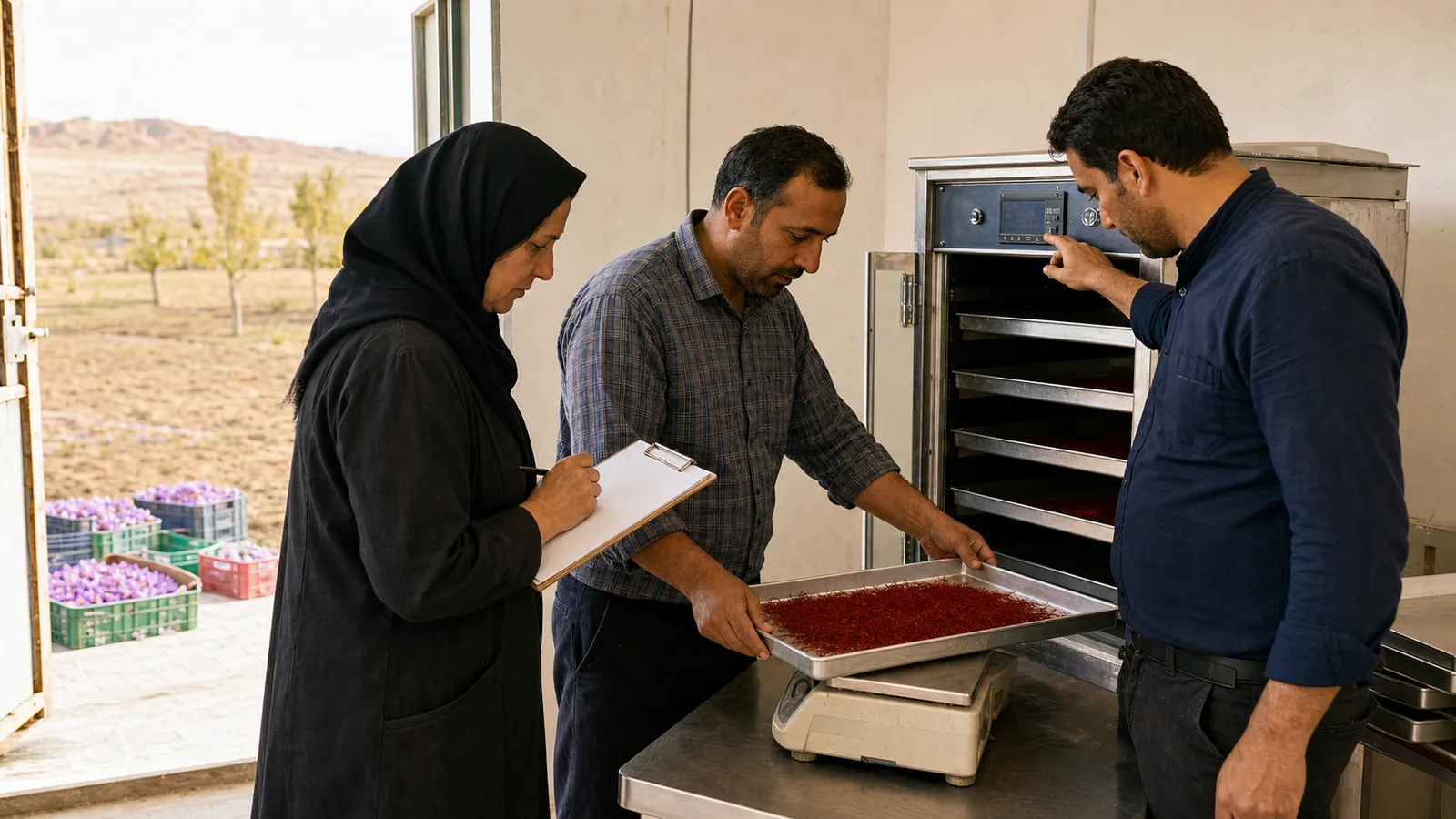
Monitoring “UNIDO” to improve farms described a 2015 saffron value-chain project in Gonabad and 17 saffron-producing counties across Razavi and South Khorasan. The United Nations Industrial Development Organization was working with local Agricultural Jihad specialists as harvest and processing began. The stated aim was to improve both the quality and quantity of production by organizing rural saffron beneficiaries into a network.
The article recorded the beginning of activity, not the final effect on farms. It named training locations and a dryer that was expected to be installed, but gave no baseline, completion date, adoption rate or measured change in yield or quality. UNIDO’s involvement made the programme noteworthy; it did not make every anticipated result automatic.
What began in Gonabad in 2015
ISNA’s Khorasan bureau attributed the county figures to Mohammad-Bagher Jahedi, then director of Gonabad’s Agricultural Jihad office. He said project monitors would work in Gonabad at the same time as counterparts in 17 saffron-growing counties of Razavi and South Khorasan.
The work started alongside saffron harvest and processing. That timing gave the team a chance to see the most sensitive handovers directly: flowers arriving from the field, stigma separation, drying, lot handling and preparation for sale. It also created pressure. Advice given after a harvest shift could not recover flowers that had already waited too long or a batch that had already been dried poorly.
The report called the initiative a way to improve rural farms through a network of saffron beneficiaries. A network can connect growers with training, equipment and buyers, but only if roles are clear. The source does not say how farmers joined, who governed the group, whether services had a fee or how decisions were made across 17 counties.
Kakhk became a local base for the work
Fatemeh Gavahi Kakhki, identified as manager of Gonabad’s Red Gold Beneficiaries Network, said UNIDO monitors had established a presence at the saffron education, processing and packaging centre in Kakhk. Specialist educational activity had begun in Kakhk, Sanou and Zibad.
Those villages and towns needed more than a generic presentation. Harvest crews, small growers, processors and network managers face different decisions. Useful field training would therefore follow the product through the local chain:
- harvest timing and clean flower containers;
- time from picking to separation;
- stigma handling and separation of damaged material;
- dryer loading, temperature, airflow and endpoint;
- lot identity, representative sampling and storage; and
- the buyer specification against which the finished lot would be judged.
The 2015 article confirms that specialist training started, but not its curriculum, attendance or field results. Those details would be needed before crediting the programme with better farms.
The planned dryer was one part of a longer process
Gavahi Kakhki said a standard saffron dryer would soon be installed and commissioned at the network centre by UNIDO specialists. The future tense matters. The report did not confirm the machine’s delivery, model, capacity, test run or later use.
A dryer can make time and temperature easier to control, yet the word “standard” is not enough to evaluate it. Performance depends on tray depth, batch mass, airflow, sensor placement, loading discipline, cleaning and the operator’s endpoint decision. A machine that produces a good small trial may behave differently when harvest volume peaks.
Evaluation should compare like with like. Split a representative flower lot, document the starting time and mass, process one part with the existing method and the other with the new dryer, then assess dry mass, moisture, appearance, key chemical measures and contamination risk. Repeating that comparison across days is more useful than selecting the best-looking tray.
Our guide to Iranian saffron flower handling and drying explains why speed before drying and control during drying must be considered together. Equipment cannot compensate for flowers left warm and compressed before they reach it.
Gonabad’s reported scale made coordination important
The briefing placed Gonabad’s saffron farms at about 3,500 hectares with capacity to produce more than 14 tonnes of dried saffron. On those rounded figures, 14 tonnes across 3,500 hectares equals four kilograms per hectare. That is a scale check, not an audited average: “capacity” may differ from actual harvest, and the source does not separate young, mature or inactive fields.
About 12,000 households were said to take part in collecting and processing saffron during the harvest period. The Persian dates ran from the first of Aban to the middle of Azar, roughly late October to early December. The old English version shortened that to October through mid-November.
The household number describes seasonal participation, not 12,000 farm owners or 12,000 full-year jobs. Several people from one household may share tasks, while some farms may hire labour from elsewhere. The article gives no person-days, wages, gender breakdown or share of household income.
UNIDO had already mapped the saffron value chain
UNIDO published a Saffron Industry Value Chain Development in Iran diagnostic study in 2014. Its model followed saffron from farmers through dealers and processing or packaging businesses to the market. It identified several kinds of “upgrading” rather than treating improvement as a single farm input.
Process upgrading meant doing the same transformation more efficiently, such as improving drying or post-harvest logistics. Product upgrading meant meeting a more demanding specification. Functional upgrading involved taking on higher-value work such as design or marketing. The report also considered diversification into processed saffron for food manufacturers.
That framework helps interpret the Gonabad project. Training growers addressed only part of the chain. A dryer could improve a process. A beneficiary network could coordinate supply. Testing and records could support a product specification. Packaging or direct market relationships could change who captured value. None of those moves should be credited without measuring the relevant outcome.
What monitoring should have recorded
Monitoring is not the same as visiting a farm or opening a local office. To show whether the programme improved farms, observers needed a starting point and a consistent follow-up method.
At minimum, useful records would include:
- participating growers, mapped plots and field age;
- the practice or equipment used before the intervention;
- training attendance and the practice each participant adopted;
- fresh flowers received, accepted dry saffron and processing loss;
- quality-test results from representative, traceable samples;
- labour, energy, maintenance and finance costs;
- rejected lots, failures and reasons for non-adoption; and
- prices and buyer terms, kept separate from agronomic yield.
A before-and-after comparison alone can still mislead if weather, field age or market conditions changed. Similar non-participating farms, or staged adoption across villages, would give a stronger indication of whether the programme caused the observed difference.
The rural network needed its own safeguards
A network can make shared training and equipment affordable for small farms. It can combine lots for a contract, coordinate a harvest service and give members a stronger voice with processors. It can also blur responsibility if no one owns the records or if higher-volume members dominate.
Before combining saffron, the network should know whether lots have compatible grade, moisture, origin records and handling history. Once mixed, a weak component can affect the whole batch and the original cause may be impossible to trace. Shared equipment similarly needs booking rules, cleaning logs and a plan for the few days when everyone wants it.
Transparent membership criteria, elected or accountable management, published service charges and a complaints route matter just as much as technical instruction. The historical article identifies Gavahi Kakhki as the local network manager but provides no governance or financial details.
UNIDO’s role then and now
The United Nations Industrial Development Organization was established in 1966 and its constitution as a specialized UN agency entered into force in 1985. Its headquarters are in Vienna. The 2015 article described 172 member states; UNIDO’s current official overview lists 173, illustrating why institutional counts should always be dated.
The 2015 overview said UNIDO helped developing countries and economies in transition. It described the organization as mobilizing knowledge, skills and technology to support productive employment, a competitive economy and a healthy environment. Those phrases record how its role was presented with the project; they are not measurements of what the Gonabad activity achieved.
The article also said UNIDO’s Iran office had opened in 1999 to work with ministries, public and private bodies, civil and research institutions, and the private sector. It referred to a country programme organized around six strategic areas of cooperation, but did not name them. That part should remain a description of the programme at the time rather than be filled with a modern list.
UNIDO now describes its functions as technical cooperation, policy advice and statistical analysis, standards and norms, convening, and partnership development. Those functions fit a value-chain project, but they do not imply that UNIDO certified every participating farm or guaranteed its saffron.
What this project record can and cannot tell us
The 2015 report establishes that monitoring and training began in Gonabad and other Khorasan counties, that Kakhk served as a local base, and that activities also covered Sanou and Zibad. It records a planned dryer, 3,500 hectares of saffron, capacity above 14 tonnes and roughly 12,000 households involved in the harvest and processing season.
It does not provide the dryer’s commissioning record, participant count, measured yield change, quality results, farm income, export result or final evaluation. Those omissions do not make the project unsuccessful; they mean this article cannot supply the verdict.
The sound interpretation is practical. UNIDO and local specialists were trying to move improvement beyond individual farms and into training, processing and network organization. The right way to judge that work is the same way a good field programme should have been designed: preserve the baseline, record adoption, test representative lots, count costs and publish what changed—including what did not.

![Exporting Saffron to Turkey + Price Guide [Complete 0 to 100]](https://img.rowhanisaffron.com/20260827003933/saffron-export-turkey-quality-inspection.webp)



