


Appropriation “UNIDO” to the Iranian saffron referred to a reported US$2 million, four-year initiative intended to strengthen the saffron value chain. Provincial agriculture officials described farmer networks, technical supervision, hygienic processing and industrial dryers as parts of the programme. The announcement was made in 2015, so its budget, export figures and production statistics are historical rather than current funding guidance.
The official UNIDO diagnostic study of Iran’s saffron industry, published in 2014, confirms the project’s broader logic. It mapped a fragmented chain in which farmers, village processors, dealers, packers and exporters did not always share information or value efficiently. Improving one field practice alone could not solve problems that continued through drying, testing, packaging and access to final markets.
What the US$2 million announcement covered
Mohammad Reza Qodsi, then horticulture manager at the Khorasan Razavi Agriculture Jihad organisation, told an ISNA press meeting that the United Nations Industrial Development Organization had allocated US$2 million to improve the sustainability of Iranian saffron. He said the saffron industry value-chain project had begun late in the previous year in cooperation with the Agricultural Bank of Iran.
Ramin Esmi, identified in the report as the provincial saffron expert, described the allocation as expenditure over four years and said it might increase if the project produced results. That was an official’s forecast at the time, not a standing UNIDO grant that farmers or businesses can apply for today.
The programme was described in three connected stages:
- select pilot counties and villages, build networks and train growers to improve efficiency and production sustainability;
- select and train saffron supervisors; and
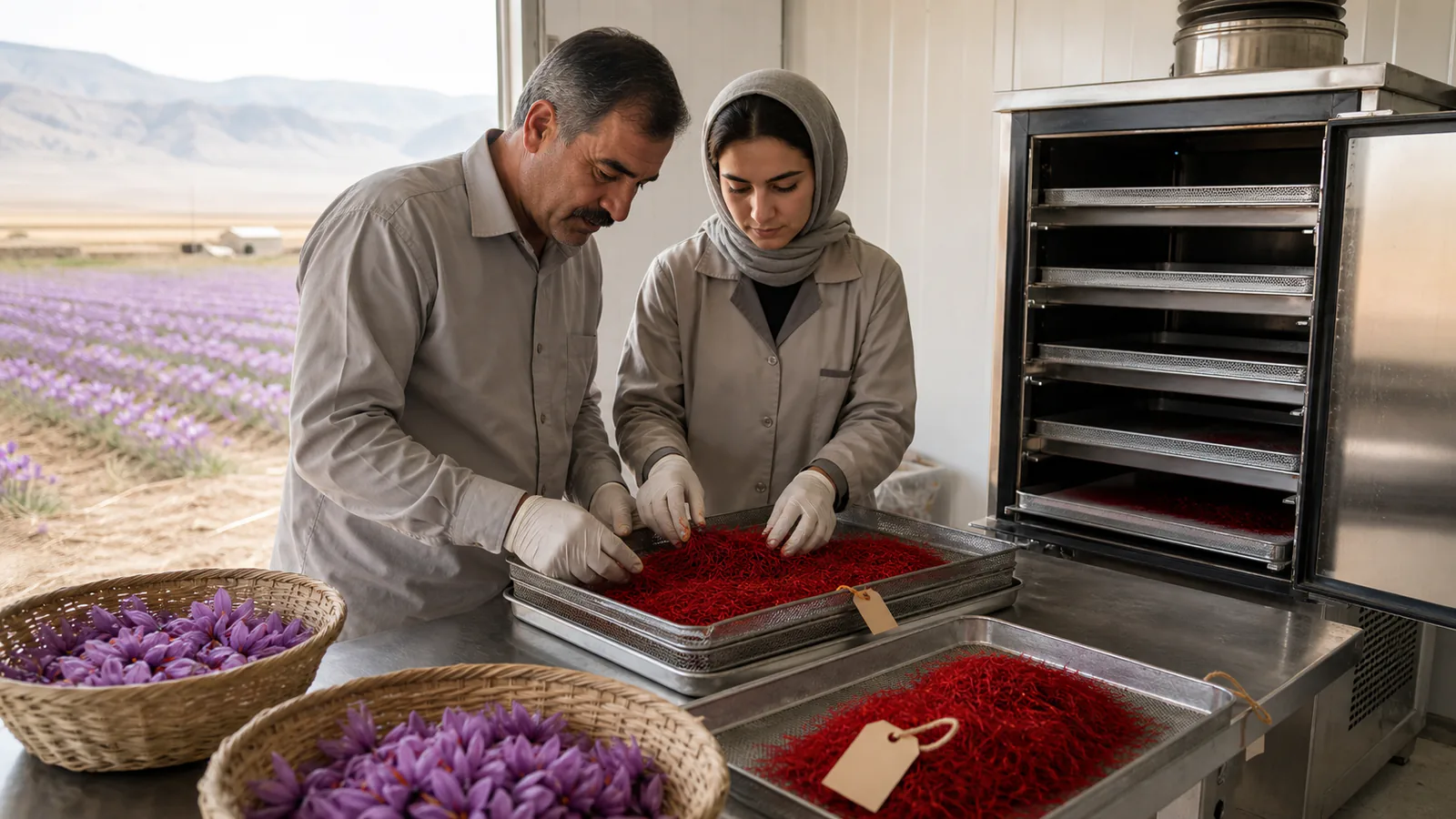
- strengthen hygienic processing, including 20 village workshops equipped with industrial drying machines and supported by training and supervision.
The historical article used “healthy and organic” in its description of the target product. Hygienic handling and organic certification are not the same thing. A dryer or supervised workshop can improve handling, but a product should only be sold as organic when the applicable production and certification requirements have been met.
The pilot locations in Khorasan
The first-stage network covered a wide production area. In Razavi Khorasan, officials named Torbat Heydarieh, Zaveh, Kashmar, Roshtkhar, Khalilabad, Bardaskan, Bajestan, Gonabad, Sabzevar, Nishapur, Bakharz and Mahvelat. Ferdows, Qaen and Sarayan were selected in South Khorasan.
This geographic spread mattered because the programme was not only buying equipment. It aimed to connect growers with trained supervisors, common technical guidance and post-harvest capacity. A dryer that sits far from freshly picked flowers, or a training course without follow-up in the field, does not create a functioning value chain.
Earlier “ideal farm” work formed the local baseline
Qodsi linked the UNIDO announcement to an earlier provincial “ideal saffron farms” programme. He said it had operated across 40 hectares in Solar Hijri 1388, 100 hectares in 1389 and 75 hectares in 1390. The package included planting at the appropriate time, using standard corms above eight grams, choosing a suitable planting density and improving crop care and nutrition.
Officials reported that these demonstration farms achieved about three times the average yield of traditional farms. The article does not provide a trial design or underlying dataset, so the multiplier should be read as a programme report, not a yield promise for another farm.
In Solar Hijri 1392, the province also allocated a reported 200 million toman subsidy for saffron fields. The money was distributed across producing areas for foliar nutrition and mechanical weed control. Qodsi said field visits and reports showed improvements in production, quantity and quality. Again, this is historical programme evidence; it does not establish that the subsidy or the same recommendations remain available.
Why corm quality and planting density were central
Mahmoud Sareban, then deputy for plant production in the provincial organisation, said certified corms above eight grams were difficult to obtain and that much of the material on the market was unsuitable for the demonstration-farm standard. The province therefore supported 16 hectares of corm-multiplication farms in Solar Hijri 1389 and 1390.
He reported that the farms produced standard planting material equal to 2.5 times the quantity planted within a year. Whether that result transfers to another field depends on corm health, climate, soil, irrigation and management. Current evidence also cautions against treating higher planting density as a shortcut: a study of saffron farm efficiency found that dense planting can reduce the productive life of a field.
The programme’s quality code was intended to record the cultivation location, farmer, farm name, harvest time and production time. That is an early form of lot traceability. It becomes useful only when the code follows the physical saffron through drying, storage, testing, packing and sale.
Hygienic processing was more than buying dryers
The article described two related workshop efforts. The proposed UNIDO stage would establish 20 hygienic-processing workshops in pilot villages. An earlier provincial quality programme had already formed and equipped 36 workshops across 14 counties: Bajestan, Bardaskan, Bakharz, Torbat Jam, Torbat Heydarieh, Khaf, Roshtkhar, Zaveh, Sabzevar, Kashmar, Gonabad, Mahvelat, Nishapur and Mashhad.
Sareban said those 36 workshops had processed about three tonnes of saffron under the programme. Esmi also referred to dryers able to handle ten kilograms per hour in major producing centres such as Zaveh, Torbat Heydarieh and Kashmar.
Capacity alone does not establish quality. Flowers need prompt separation, clean contact surfaces, a validated time-and-temperature process, moisture control, protected storage and records that connect the dried lot to its source. Research indexed by FAO’s AGRIS database confirms that drying method affects saffron’s moisture and qualitative properties.
The 2015 production and export figures need date labels
The press briefing bundled the project announcement with a snapshot of the provincial market. Esmi reported a 36% rise in saffron exports after export duties were removed. He said more than five tonnes a year went from the province to the United Arab Emirates, followed by Spain and Japan, with shipments to around 50 other countries.
He forecast more than 160 tonnes of exports that year and estimated world demand above 500 tonnes. He also offered a domestic-consumption scenario: if every Iranian used one gram per year, the country would need about 80 tonnes. That was arithmetic based on an assumed consumption level, not a measured demand result.
Other figures in the report put world production at 330 tonnes, Iran at 310 tonnes and Razavi Khorasan at 243 tonnes. It said saffron was grown on a limited basis in 22 provinces, while 77% of planted area was in Razavi Khorasan, 19% in South Khorasan and 4% elsewhere. Sareban separately said 80–85% of the province’s crop was exported to 53 countries.
These statistics describe the period surrounding the 2015 briefing. They should not be combined with today’s trade data or used to quote a current market share. The original article also contains a contradictory cultivated-area figure before describing growth from about 18,000 to 54,000 hectares; the inconsistent number is not repeated as fact.
The yield problem explained the emphasis on training
Sareban said average yield had fallen from roughly six kilograms per hectare to about 3.5 as planted area expanded. He attributed the decline to traditional practice, drought and frost. His proposed strategy was to limit further area growth while raising average yield toward eight to ten kilograms per hectare through newer scientific methods.
Those targets were ambitions, not guaranteed outcomes. They nevertheless explain why the UNIDO programme focused on field supervisors and networks. A farmer needs recommendations fitted to that field’s age, soil, water, corm condition and climate; a province-wide target cannot replace diagnosis.
The report also noted a labour trade-off. Esmi estimated that 65% of saffron employment was associated with flower picking and stigma separation and warned that mechanising those steps could remove jobs. Processing technology therefore had to be judged by more than speed: product quality, worker safety, seasonal employment and cost all mattered.
Soil evidence belonged in the same farm strategy
The provincial briefing extended beyond saffron to soil and input planning for eight major crops. Sareban said 18,500 soil samples had been assessed and reported projected provincial needs of 235,000 tonnes of nitrogen fertiliser, 80,000 tonnes of potash and 70,000 tonnes of phosphate fertiliser.
He also reported that 75% of land needed phosphorus, 73% of agricultural soils were deficient in iron, 75.8% were deficient in zinc and 41% in manganese. Average organic matter was stated as 4%, with about 7% in Quchan and Torbat Heydarieh and 0.2% in Khaf. These were broad historical provincial claims, not a fertiliser prescription for a saffron field.
The practical rule is to test the actual soil and interpret the result with a qualified adviser. Applying nutrients from regional percentages can waste money, create imbalance and fail to address the limiting condition.
What the UNIDO diagnostic found in the value chain
UNIDO’s 2014 report estimated a very large farmer base alongside far fewer processors, packers and exporters. It found weak coordination between many actors, considerable bulk trade and limited direct access to international retail networks. Its economic model suggested that much of the final value was added after Iranian saffron left the domestic chain.
That diagnosis explains why the project combined production with processing and networking. A sustainable improvement needs several links to hold:
- healthy, traceable planting material and field records;
- practical extension support based on local measurements;
- fast, hygienic stigma separation and controlled drying;
- testing and lot identification that buyers can verify;
- packaging and product forms designed for real demand; and
- market relationships that return more information and value to producers.
Export growth by itself does not show whether farmers, processors and Iranian brands retain more value. The chain has improved when quality is more consistent, origin claims are verifiable and buyers can purchase the form they need from a reliable supplier.
The project’s themes remain current
The UNIDO allocation and every quantity in the original briefing belong to a historical programme. They should not be presented as active finance. The issues it targeted have not disappeared.
In 2025, FAO and Iran again brought farmers, processors, cooperatives, traders and experts together around production practice, post-harvest handling, food safety, traceability and marketing. The FAO saffron value-chain workshop shows continuity in the work without implying that it is the same programme or funding stream.
The lasting lesson is straightforward. Iranian saffron earns more durable value when the field, workshop, laboratory, packer and buyer operate as one traceable system. Equipment and funding can support that system, but they cannot substitute for coordination, evidence and accountable execution.

![Exporting Saffron to Turkey + Price Guide [Complete 0 to 100]](https://img.rowhanisaffron.com/20260827003933/saffron-export-turkey-quality-inspection.webp)



