


How much saffron is harvested per hectare in Iran? Two provincial reports on this site cited about 3.5–4 kg of dried saffron per hectare in Khorasan Razavi and 4 kg per hectare in Markazi. These are dated regional estimates, not a universal yield. Field age, the definition of harvested area, weather and management can change the result substantially.
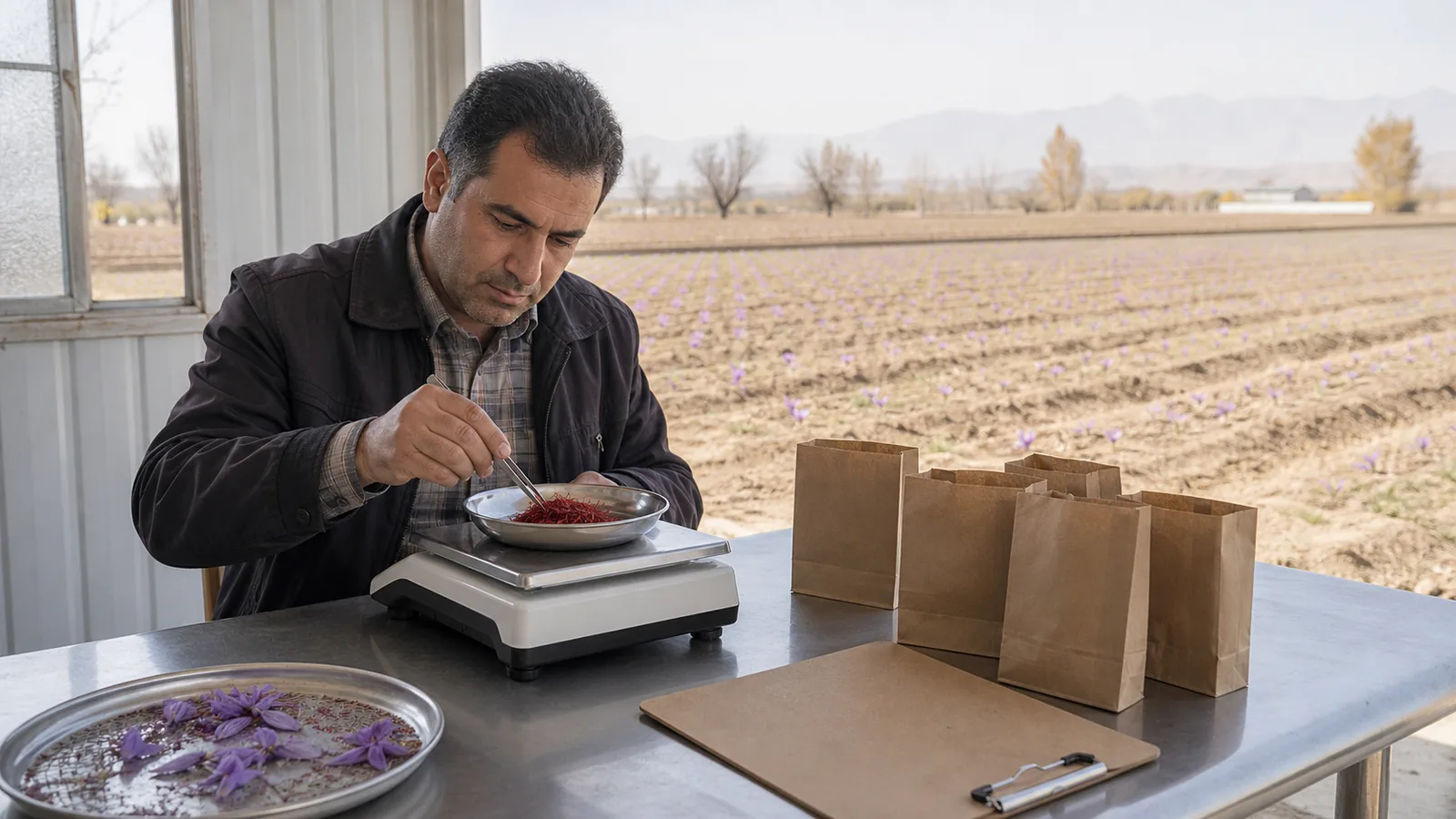
The reports also contain arithmetic that does not fully reconcile. Rather than choose whichever number looks better, this article preserves the figures, checks the calculations and explains what would be needed for a fair comparison.
What “saffron yield per hectare” should mean
Saffron yield is normally expressed as kilograms of dried stigma product harvested from one hectare in one season. The numerator should be a verified dry weight. The denominator should be the area that was actually bearing and harvested, not every newly planted or dormant hectare in an administrative total.
This matters because saffron is a perennial crop propagated by corms. Young fields may produce fewer flowers, established fields can improve as daughter corms multiply, and crowded or declining plots may later yield less. Our guide about Iranian saffron explains that multi-year cycle.
Grade and processing also matter. A kilogram of dried red stigma is not the same product as a kilogram that retains more yellow style, and neither should be compared with fresh flower weight. A reliable yield record states exactly what was weighed.
The Khorasan Razavi estimate: 3.5–4 kg per hectare
Hashem Naghibi, identified in the destination article as director of horticultural affairs at the Khorasan Razavi Agricultural Jihad Organization, reported approximately 84,000 hectares of saffron in the province. He said the area represented about 80% of Iran’s saffron cultivation at the time.
Naghibi placed annual yield at about 3.5–4 kg per hectare and total production at roughly 280–300 tonnes. Those figures describe Khorasan Razavi in the report’s period; they are not today’s official area or harvest.
Checking the Khorasan arithmetic
Multiplying 84,000 hectares by 3.5 kg gives 294,000 kg, or 294 tonnes. That sits within the stated 280–300-tonne total. Multiplying the same area by 4 kg gives 336 tonnes, which does not.
Several explanations are possible: 84,000 may be total planted area while fewer hectares were bearing; 3.5–4 may describe a range among fields rather than the province-wide average; or the area and production numbers may have been rounded from different datasets. The article does not say which. The defensible conclusion is that its lower yield estimate broadly agrees with its stated production total, while the upper estimate does not usefully reconcile with all 84,000 hectares.
The Markazi report: 1,180 kg from 385 hectares
A separate report quoted Ali Asghar Zarei, director of horticulture at the Markazi Agricultural Jihad Organization. He said the province produced 1,180 kg of saffron in the reported year from 385 hectares under cultivation. He also stated a yield of 4 kg per hectare and said 50 hectares had been newly planted that year.
Checking the Markazi arithmetic
Dividing 1,180 kg by 385 hectares gives approximately 3.1 kg per hectare. That does not equal the reported 4 kg per hectare.
Removing only the 50 newly planted hectares leaves 335 hectares; 1,180 kg divided by 335 is about 3.5 kg per hectare, still below four. A four-kilogram average would imply approximately 295 bearing hectares. The source does not identify another 40 hectares as non-bearing, nor does it provide a district or field-age breakdown that resolves the gap.
Both figures should therefore remain visible but labelled correctly: 1,180 kg and 385 total hectares produce a simple administrative average near 3.1 kg/ha; 4 kg/ha was a separate official yield statement that may have referred to a smaller bearing area.
Why saffron yield varies between fields and years
There is no single “typical saffron yield” that applies to every farm. The most important dependencies include:
- Field age: newly planted corms, established stands and crowded older plots do not have the same flower potential.
- Corm size and plant density: the amount and health of planting material affect early flowers and future daughter corms.
- Soil and drainage: waterlogging can damage corms, while soil structure affects root growth and usable moisture.
- Water timing and seasonal rain: saffron uses relatively little irrigation compared with many crops, but poorly timed water stress or damaging rain can reduce flowers or quality.
- Nutrition, weeds and disease: site-specific management changes both the crop and the corms that support later seasons.
- Harvest and processing: flowers missed during the short bloom, slow separation, uneven drying or a different final moisture level can change recorded dry weight.
Iranian field research confirms that water and management can produce materially different yields across treatments and seasons. For example, a peer-reviewed irrigation and nutrient-management experiment reported changing flower and dry-stigma yields under different combinations. A result from one experiment is evidence that the variables matter; it is not a recipe to copy to every province.
The FAO profile of Gonabad’s qanat-based saffron system likewise describes saffron as suited to water-scarce conditions while still depending on a reliable water system. “Low water requirement” should not be misread as “yield does not depend on water.”
Weather context in the Khorasan report
Naghibi discussed rainfall damage in the same interview. The translation first says no previous agricultural damage was observed, then identifies rain in May of that year as the main loss. It supplies no affected hectares, crop stage, yield loss or quality measurement.
The useful point is that the timing of rain matters. Moisture that supports vegetative growth can be beneficial, while rain around flowers, harvest or drying can create different risks. The source does not provide enough information to quantify the May event or connect it directly to the 3.5–4 kg range.
Saffron within Khorasan Razavi’s medicinal-plant sector
The Khorasan article placed saffron within a wider medicinal- and aromatic-plant program. It reported about 19,500 hectares of these crops, with green cumin forming the largest share. Naghibi said roughly 40–50 plant types were cultivated, including cumin, fennel, Mohammadi rose and peppermint.
He also said many were exported as raw materials to around 50 countries. The article does not list the year, customs codes, destinations or tonnage, so that number remains a historical official statement rather than a current export count.
The water needs of those crops were not treated as identical. The source grouped cumin, some seed herbs and Mohammadi rose among lower-water or sometimes rainfed options, while saying more water-demanding plants were grown on smaller plots. This broader context helps explain why saffron yield is only one part of provincial crop planning.
Saffron and medicinal plants in Markazi Province
Zarei’s Markazi report also described crop diversification. It cited 1,200 hectares of Mohammadi rose and called the province fifth in Iran by that measure. It separately referred to 1,200 hectares of medicinal plants, including peppermint, thyme and lavender, promoted in response to the climate and water constraints.
The source does not say whether the Mohammadi rose area was included in or additional to the medicinal-plant total. It also lacks the statistical year behind the national ranking. Adding the two 1,200-hectare figures together would therefore risk double counting.
Markazi’s 50 newly planted saffron hectares show that its reported production base was still expanding. That is another reason to separate total cultivated land from bearing land when calculating output per hectare.
How to compare saffron yield figures correctly
Before comparing a farm, district or province with the 3.5–4 kg figures, check that both records use the same definitions:
- the same harvest year and a clearly stated geographic boundary;
- bearing hectares actually harvested, with young and failed plots identified separately;
- dry product weight at a stated moisture condition;
- the same commercial style or grade, especially the amount of style retained;
- measured output rather than a preseason forecast; and
- enough field coverage to distinguish one good plot from a provincial average.
This is why the Khorasan and Markazi reports should be read as snapshots. Khorasan’s 3.5 kg figure aligns reasonably with its 84,000-hectare and 280–300-tonne totals; its 4 kg upper bound does not. Markazi’s direct division produces about 3.1 kg/ha across all 385 hectares, while its separate 4 kg claim probably used an unstated bearing-area denominator.
For broader context, see our evidence-bounded review of Iran’s share of world saffron production. The same rule applies there: preserve the reported number, but do not separate it from its year, definition and arithmetic.

![Exporting Saffron to Turkey + Price Guide [Complete 0 to 100]](https://img.rowhanisaffron.com/20260827003933/saffron-export-turkey-quality-inspection.webp)



