


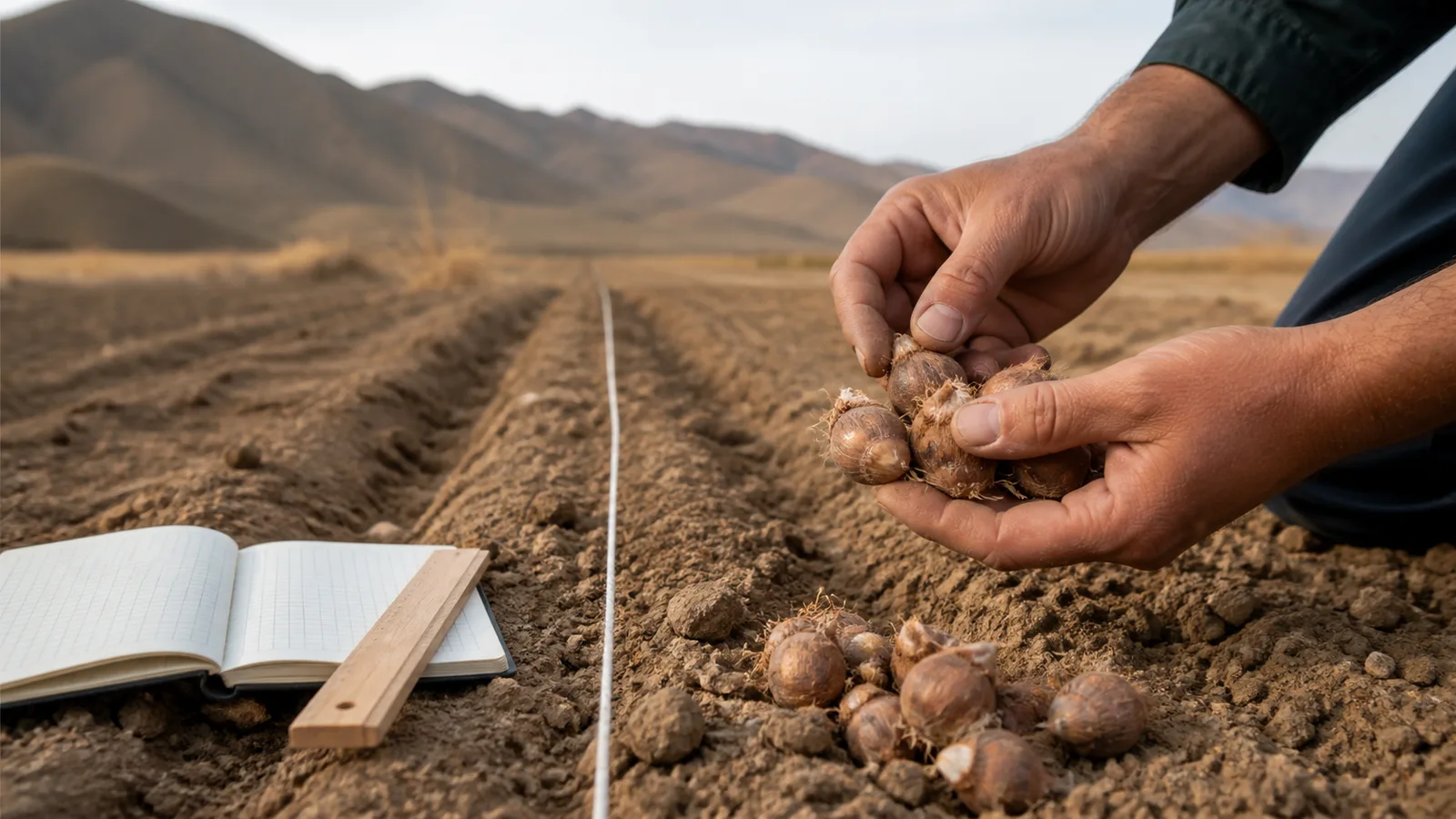
“Increasing the Saffron by 2% based on research findings” is the inherited title of a translated 2019 report. The figure is misleading: the interview itself described the possibility of doubling a low average yield, not raising it by 2%. Even that stronger claim was conditional. Research-based saffron production depends on planting date, corm quality, density, field age, soil, water, crop health, harvest timing and drying—not one universal trick.
The speaker was saffron researcher Abdollah Mollafilabi, whose name appeared in several corrupted forms in the old translation. He discussed farm practice and the larger question of how Iran could keep more value by improving processing, product development and export quality. This article preserves those subjects while separating dated interview claims from evidence that can be used today.
What did the “2%” claim actually mean?
Mollafilabi said that about 80% of farmers were then planting corms in August and September and recommended planting in the first half of June. He placed average stigma yield at about 3.8 kilograms per hectare and argued that better timing and management could at least double output.
A three-year field study in the Mashhad region later reported 5 June to 5 July as the best sowing window among the dates it tested. It also found that corm and flower traits were closely associated with yield. This supports the value of planting-date and corm-management research, but it does not turn early June into a worldwide rule. Climate, soil temperature, corm dormancy, lifting date, storage conditions and irrigation vary between regions and seasons.
The 3.8-kilogram figure is also a historical average, not a target for every farm. A 2020 scientific overview reported saffron yields across published systems ranging roughly from 2 to 28 kilograms per hectare. That range shows why a promised percentage increase without a farm baseline is not meaningful.
The field decisions that influence saffron yield
Choose healthy, suitable corms
The old interview advised farmers to buy corms from a reliable source, disinfect them and plant at high density. The useful principle is to begin with healthy, traceable planting stock and reject damaged or diseased corms. “Disinfect” is not a licence to apply an unspecified chemical. Any treatment must match the diagnosed risk, product label and local agricultural rules.
Corm size and plant density can influence early flowering and the development of daughter corms. More corms are not always better: crowding increases competition and can make disease and later lifting harder to manage. Density, row spacing and planting depth should be selected together for the intended field life and local system.
Match planting date to local dormancy and weather
Moving corms promptly during true dormancy can reduce storage damage and protect flower initiation. The exact window should come from regional extension advice and current field conditions. A calendar date from Mashhad cannot simply be copied into Kashmir, Spain, Morocco or a different Iranian province.
Use manure and fertiliser safely
Mollafilabi warned that contaminated manure could compromise a product that cannot be washed after drying. That food-safety concern is legitimate. Well-managed organic amendments can support soil structure and fertility, but raw or poorly handled manure can introduce microbial, chemical and physical hazards.
A soil test and nutrient plan are safer than a generic prescription. The former article also implied that saffron needs neither pesticide nor fertiliser. That is incorrect: pressure from weeds, rodents, nematodes and fungal disease varies, and nutrient needs depend on the field. The aim is justified, documented use—not pretending inputs never exist.
Manage field age rather than relying on tradition
The interview compared an eight-year field producing a cumulative 40 kilograms with reaching the same amount in four years under better management. Those are illustrative historical figures, not a forecast. As daughter corms multiply, crowding can reduce individual corm size and flowering. The economical time to lift and replant varies with yield records, disease, soil, labour and the intended production cycle.
Harvest and drying can protect value already grown
The old report advised picking flowers before strong sunlight and drying the separated stigmas quickly. Early collection helps reduce wilting and gives workers time to separate stigmas the same day. “Faster” drying, however, is not automatically better. Temperature, time, airflow, loading and final moisture all influence safety, colour, aroma and flavour.
Current FAO work with Iran’s Ministry of Agriculture Jahad specifically prioritises post-harvest handling, good manufacturing practice, standardisation and quality control. The Codex saffron standard defines requirements for dried stigmas and styles, including moisture and extraneous matter. A farm should use a validated drying process and protect the finished spice from moisture, light, contamination and odour.
Water productivity needs a real calculation
Mollafilabi presented saffron as a strong option where drought makes other crops difficult and reportedly compared its economic water value with around 40 crops grown in Khorasan. The old translation also said “one gram” was harvested per cubic metre of water. The underlying dataset and units were not available, so neither statement should be treated as a current benchmark.
Saffron can fit arid and semi-arid systems because its growth cycle differs from summer crops and the dried product has high value per unit weight. Yet “low water” does not always mean high water productivity. A useful calculation includes rainfall, irrigation, yield, crop life, pumping energy and opportunity cost for that field.
Processing does not turn saffron into a cancer drug
The 2019 interview argued that Iran should move beyond raw exports and sell more than unprocessed saffron. It mentioned experimental or commercial uses in sunscreen, anti-acne ointment, chewing gum, mood products, tablets and beverage colourants. The damaged translation also repeated “saffron powder” several times; its intended list appears to have included items such as saffron cake powder, drink or food powders and other processed formats.
Product development can add value when it solves a real customer need and meets the rules for its category. Food, cosmetics and medicines have different evidence, safety, manufacturing and labelling requirements. Laboratory anticancer activity does not make saffron an “anticancer drug,” and a cheerful or mood pill cannot be marketed responsibly from tradition alone. Human clinical evidence, standardised formulation, dose, interactions and regulatory authorisation all matter.
Promising research on crocin, crocetin and other constituents remains research. It should encourage careful trials, not treatment claims on an ordinary food package.
What value-added saffron can realistically mean
Moving beyond anonymous bulk exports does not require turning every crop into medicine. Useful value can come from:
- clean separation, controlled drying and protected storage;
- lot-level traceability and honest origin information;
- testing against recognised saffron specifications;
- food-safe retail and food-service formats;
- consistent grading and packaging sized for the customer;
- responsible use of flower by-products where safety and law allow; and
- clear contracts that reward growers for documented quality.
The original report referred to Spain buying, packing and reselling Iranian saffron while producing about one tonne itself. Production and trade figures change by year, and the one-tonne claim should not be used as a current statistic. The durable point is that processing, brand trust and market access influence who captures value after harvest.
Tariffs, competitors and dated market claims
The interview said Saudi Arabia, India and China imposed 25–30% tariffs on Iranian saffron while Afghanistan faced different treatment, and it described Afghanistan as the fourth-largest producer and third-largest exporter. These were time-sensitive claims from a 2019 report. Tariffs depend on product code, origin, agreement and date; production rankings also change. Exporters must verify current customs data for the actual destination rather than quote this article.
The old translation contained two visibly corrupted figures: it said the government bought and “decommissioned 70 people,” then that “270 people” worked annually across 25 provinces. These likely referred to quantities of saffron or production, but the source units cannot be recovered safely. The existence of government purchasing arrangements in the three Khorasan provinces remains part of the report; the broken numbers are not repeated as facts.
Organic saffron requires evidence, not an assumption
The article called saffron inherently organic and proposed separation from other fields, no chemical fertiliser for five years, organic manure and hygienic drying. Those are relevant risk-management topics, but “organic” is a controlled claim. Requirements depend on the applicable standard, conversion period, permitted inputs, buffer areas, records, inspections and certification.
A saffron field does not become organic merely because the crop often has modest input needs. Nor does organic certification replace food-safety controls. Soil amendments, water, workers, surfaces, drying equipment and packaging can all introduce hazards.
A research-based improvement plan
The sound way to increase saffron yield and value is to establish a baseline, change what local evidence supports and measure the result. Record plot area, corm source and size, planting date and density, soil results, irrigation, inputs, field age, flower and dry-stigma yield, labour, drying conditions, quality results and sale price.
Then compare seasons carefully. A higher yield that lowers quality, spreads disease or costs more than its return is not an improvement. Research findings become useful on a farm when they are adapted, documented and checked—not when a percentage is copied from a headline.
Sources
- The 2019 interview with Abdollah Mollafilabi preserved in the previous version of this page.
- Three-year Mashhad study of traits, planting date and saffron yield.
- Scientific overview of saffron production, agronomy, processing and quality.
- FAO: saffron harvesting, processing and post-harvest quality in Iran, 20 October 2025.
- FAO: quality integrity and value-chain development, 25 November 2025.
- Codex CXS 351-2022: Standard for Dried Floral Parts—Saffron.

![Exporting Saffron to Turkey + Price Guide [Complete 0 to 100]](https://img.rowhanisaffron.com/20260827003933/saffron-export-turkey-quality-inspection.webp)



