


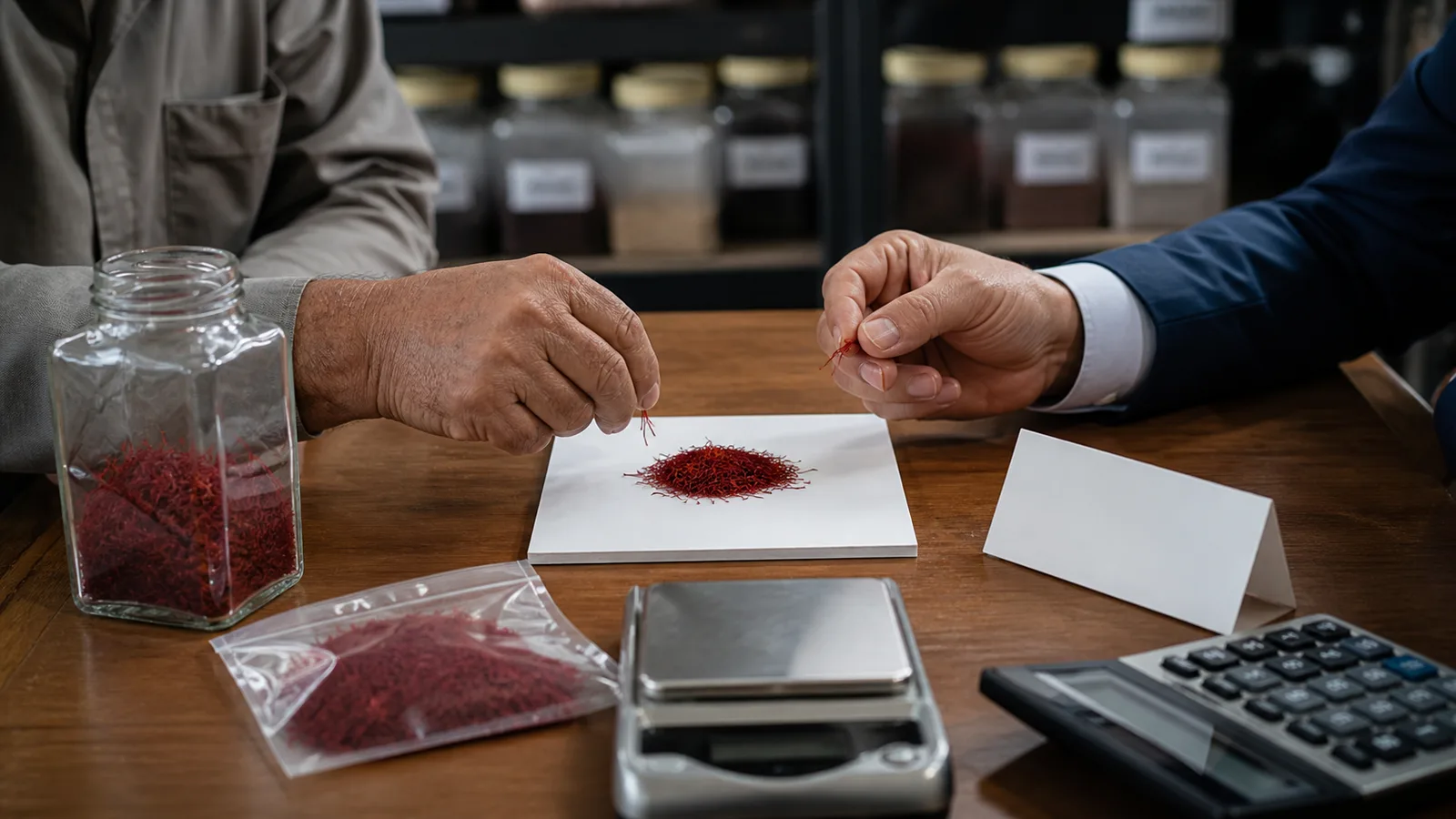
The role of foreigners in determining the price of Iranian saffron is real, but “foreigners” do not set one universal number. International buyers, re-export hubs, competing origins and destination-country costs all influence bids. So do Iranian harvest volume, quality, exchange rates, finance, policy, warehouses, exporters and the bargaining power of growers.
That distinction matters whenever someone searches for a saffron international price. Saffron does not have one continuously published global benchmark comparable to gold or crude oil. A farm-gate price in Khorasan, an export price per kilogram and the retail price of a small branded pack are different stages with different costs.
What the original 2019 interview argued
This page began as a translated interview with Ali Moradi Behjou, then identified as the Ministry of Agriculture Jahad specialist responsible for medicinal-plant cultivation, production and processing. He told ISNA that Iran’s traditional saffron market lacked a clear price-discovery mechanism. In his account, traders and exporters had greater influence over the price paid to farmers, while small landholders had little direct participation.
Moradi Behjou also said international intermediaries played a key role because Iranian saffron moved through Gulf countries, Spain and, in part, Afghanistan before reaching other markets. The point was not that every buyer in those countries acted together. It was that trading, packing and reselling outside Iran could shape the price offered back to Iranian merchants and growers.
The interview quoted an export price of about US$1 per gram, or US$1,000 per kilogram. That was a dated approximation from 2019. It is not a current quotation and says nothing about grade, lot size, payment terms, destination, insurance or whether the price was at the farm, warehouse, border or buyer’s door.
Why one “global saffron price” is misleading
A meaningful price must identify the product and the delivery point. At minimum, compare:
- whole red stigma versus saffron with more yellow style;
- physical grade, moisture, aroma, colouring strength and test results;
- crop year, storage history and remaining shelf life;
- bulk lot size versus a finished retail pack;
- country and documented region of harvest;
- currency, payment timing and credit risk;
- shipping, insurance, tariffs, brokerage and compliance costs; and
- the exact trade term and point of delivery.
A low bulk quote and a high retail price can both be genuine. The difference may include cleaning, sorting, testing, rejected material, packaging, marketing, inventory loss, tax and the retailer’s margin. It can also include excessive intermediation. Only a transparent chain shows which is which.
For a live commercial reference rather than the historical figures here, use our current saffron price page and confirm the grade, quantity and delivery basis before comparing offers.
How international buyers influence Iranian bids
Export demand reaches the farmer through several channels. A buyer may request a particular grade and pack, reduce a bid to cover currency or sanctions risk, switch to another origin, or buy through a re-exporting market with established finance and distribution. Those decisions can change what an Iranian exporter is willing to pay even before the physical product leaves Iran.
Foreign participation can also add value. Reliable importers create market access, handle destination compliance and introduce Iranian saffron to customers an individual grower could not reach. The problem is not the nationality of an intermediary. It is an opaque market in which the producer cannot see the quality basis, reference price or margin between stages.
Iran’s production share is influence, not automatic price control
The old interview said Iranian farmers produced more than 90% of world saffron and argued that Iran should become the global price reference. Current FAO material places Iran at roughly 85–90% of production, still by far the leading source.
A dominant production share creates potential influence but not automatic pricing power. Saffron is perishable in quality even when it remains physically saleable: aroma and colour can decline with poor drying or storage. Growers may need cash at harvest, exporters face currency and policy constraints, and buyers can hold stock or adjust order timing. A fragmented supply side can therefore accept prices set through stronger, better-informed buying networks.
What transparent price discovery can change
The interview supported Iran’s commodity-exchange mechanisms, including spot trading, warehouse receipts and futures, and called for better farmer education and market infrastructure. A transparent market can publish bids, offers, transaction volume and standard contract terms. Warehouse grading can also make compared lots more consistent.
That does not guarantee a high price or eliminate speculation. It can improve the quality of information available to farmers and make it harder for one buyer to present a private offer as the only market price. FAO likewise treats timely price information as a foundation for more efficient markets and better decisions along the chain.
Warehouse receipts and minimum lot size
Moradi Behjou said the minimum saffron quantity for an individual farmer to enter the exchange was 1,000 grams. The operational rules may have changed since that interview, so growers must check current exchange and warehouse requirements. The underlying access problem remains relevant: a small producer may not have a full kilogram of qualifying product or the time, documents and internet access needed to trade directly.
Why cooperatives can help
The article proposed farmer cooperatives as an intermediary between smallholders and the exchange. A well-governed cooperative can aggregate consistent lots, arrange testing and storage, explain contracts and negotiate as a larger seller. It should not become another opaque broker. Members need clear rules for grading, fees, timing, rejected product and distribution of proceeds.
The small-farm structure behind the debate
The 2019 report said 75% of saffron land was in holdings under one hectare and gave typical yield as about four kilograms per hectare. It used those figures to explain why even “major” individual growers represented a small part of total output. These are historical, attributed estimates rather than current census results.
The structure still illustrates a real bargaining issue. Thousands of small sellers may harvest during a narrow period, while fewer traders, warehouses and exporters have better access to finance and market information. Independent research on Iran’s saffron market has described an oligopolistic structure and measured marketing margins between production and final sale.
Support purchasing, standards and fraud control
Moradi Behjou described an earlier guaranteed or support-purchase plan as imperfect but broadly satisfying to farmers. He said its standards improved the quality of accepted saffron and reduced fraud or misuse. He also argued that later versions should involve all stakeholders so weaknesses could be corrected.
Any purchasing programme needs published grade rules, independent sampling, prompt payment and a clear appeals process. Otherwise, a support price can be difficult for small farms to access or can reward quantity without protecting quality.
Current FAO work in Iran connects economic stability with authenticity, traceability, quality control and post-harvest practice. Those measures help a buyer trust a lot and help a producer defend its value. They do not fix every price imbalance, but a product with documented origin and quality is easier to compare fairly than anonymous bulk material.
What futures can and cannot do
A futures contract creates a standardised agreement for a future delivery month. It can help a grower, cooperative, trader or processor manage price risk and can reveal the market’s collective expectations. The old article called for extensive education before farmers used this tool, which remains sound advice.
Futures are not a guaranteed sale at the best possible price. Contract specifications, margin calls, basis risk, liquidity and delivery rules matter. A farmer should not enter a leveraged position without understanding what happens if the market moves sharply.
Brokers are not automatically the problem
The interview asked why a farmer should sell cheaply to a broker, but it also recognised that saffron’s wide production geography creates useful work for intermediaries. A broker may collect small lots, provide immediate cash, transport product, absorb quality risk or connect a remote village with a warehouse.
The test is whether the service and margin are visible and competitive. Better orientation means bringing legitimate brokers into traceable, standardised channels rather than assuming every middleman can be removed. Farmers benefit most when they have several credible routes to market and can compare the net return after fees, delays and rejected material.
A practical way to compare saffron offers
Before deciding which country or buyer “sets” the price, put competing offers on the same basis:
- Record the grade, test results, crop year and net accepted weight.
- Convert all offers to one currency and one unit.
- Subtract testing, packing, warehouse, brokerage, freight, finance and payment-delay costs.
- Check who bears rejection, exchange-rate and non-payment risk.
- Compare the net farm or seller return, not only the headline export figure.
Foreign demand is one part of that calculation. Quality, transparent information and organised access determine how much of the international value returns to the people who grew and processed the saffron.
Sources
- The 2019 ISNA interview with Ali Moradi Behjou preserved in the previous version of this page.
- FAO: price information and agricultural market transparency.
- FAO: transparency, authenticity and sustainability in Iran’s saffron value chain, 29 October 2024.
- FAO: Iranian saffron quality integrity and value-chain development, 25 November 2025.
- AGRIS: technical efficiency, marketing and market structure of Iranian saffron.
- UNIDO diagnostic study of Iran’s saffron industry value chain.

![Exporting Saffron to Turkey + Price Guide [Complete 0 to 100]](https://img.rowhanisaffron.com/20260827003933/saffron-export-turkey-quality-inspection.webp)



