


A saffron protection fund will be created was a policy proposal reported in 2019, not proof that an operating fund existed at that time. Saeed Bastani, then the member of parliament for Torbat Heydarieh, Zaveh and Mahvelat, argued that a national saffron plan needed its own budget line and a fund to support the full value chain.
A later support package issued in 2021 instructed the relevant agricultural investment body to establish a Saffron Industry Development Support Fund by the end of the Iranian year 1400. Public material reviewed for this update does not establish the fund’s present legal, financial or operating status, so buyers and growers should verify that separately rather than relying on the headline.
What Saeed Bastani proposed
The original English text rendered Bastani’s name once as “Ancient,” a literal mistranslation of his surname. His comments concerned three connected problems: weak Iranian branding, incomplete coordination from farm to export, and missing public finance for a national plan.
Bastani said many exporters had operated like order fulfilment agents. They bought saffron inside Iran, delivered it abroad and earned a fee per kilogram, but did little with the product after the transaction. His criticism was not that every commission-based export is improper. It was that this model leaves processing, packaging, brand recognition and the final customer relationship in other hands.
He wanted the national saffron plan to cover planting, harvest, processing, domestic marketing and export marketing as one system. According to the report, preliminary work had been done, but the Plan and Budget Organization did not include the requested budget line in the 1397 budget bill. Bastani then sought funding in 1398 and called for a saffron protection fund.
The 70-tonne support purchase
The speech also described a separate intervention already under way. Rural cooperatives had entered the market and purchased about 70 tonnes of saffron that season. Bastani said the stock was ready for branding and connected the purchase with roughly two years of work by parliament and the Ministry of Agriculture-Jahad on exports and packaging.
A support purchase and an industry fund are not the same instrument. A cooperative purchase can give farmers an additional buyer during harvest and may reduce the pressure to sell immediately. A fund is a continuing organisation that needs capital, governance, eligibility rules and an accountable programme.
Later contemporary reporting confirms that Iran’s Central Rural Cooperative Organization carried out a government-directed supportive saffron purchase in the 1398 production year. That supports the existence of the intervention, but it does not by itself verify every detail of how the 70-tonne stock was graded, stored, branded or sold.
What happened after the proposal?
In September 2021, Iran’s Council for Pricing and Support Policies for Basic Agricultural Products approved a saffron support package. The published decision covered support prices, purchases intended for export and foreign-market development, credit, insurance and a value-chain strategy.
Clause eight instructed the state company responsible for agricultural investment support to form a Saffron Industry Development Support Fund with people and organisations from across the value chain. The package envisaged a government share of up to 49 percent, specified funding ceilings and said the new body should begin managing the market and value chain from 1401.
That decision is evidence of a formal instruction. It is not sufficient evidence that the fund was subsequently registered, capitalised and operating as designed. A current claim should be supported by a registry record, audited accounts, a governing board, membership rules and recent activity reports.
What a useful saffron fund would need to do
The word “protection” can mean many things. A credible fund should state whose risk it addresses and how results will be measured. Useful functions could include:
- short-term finance that prevents a grower from being forced to sell a sound crop immediately after harvest;
- transparent quality grading and warehouse controls for purchased stock;
- batch-level testing, traceability and lawful export documentation;
- shared research, training and market intelligence that small producers cannot finance alone;
- support for packaging and product development tied to a real target market;
- published accounts showing who contributed, who received support and what happened to held inventory.
A fund should not guarantee that every batch will sell at any requested price. Nor should it become a permanent buyer for poor-quality or untraceable stock. That would shift risk without improving the product or the market.
Safeguards for support purchases
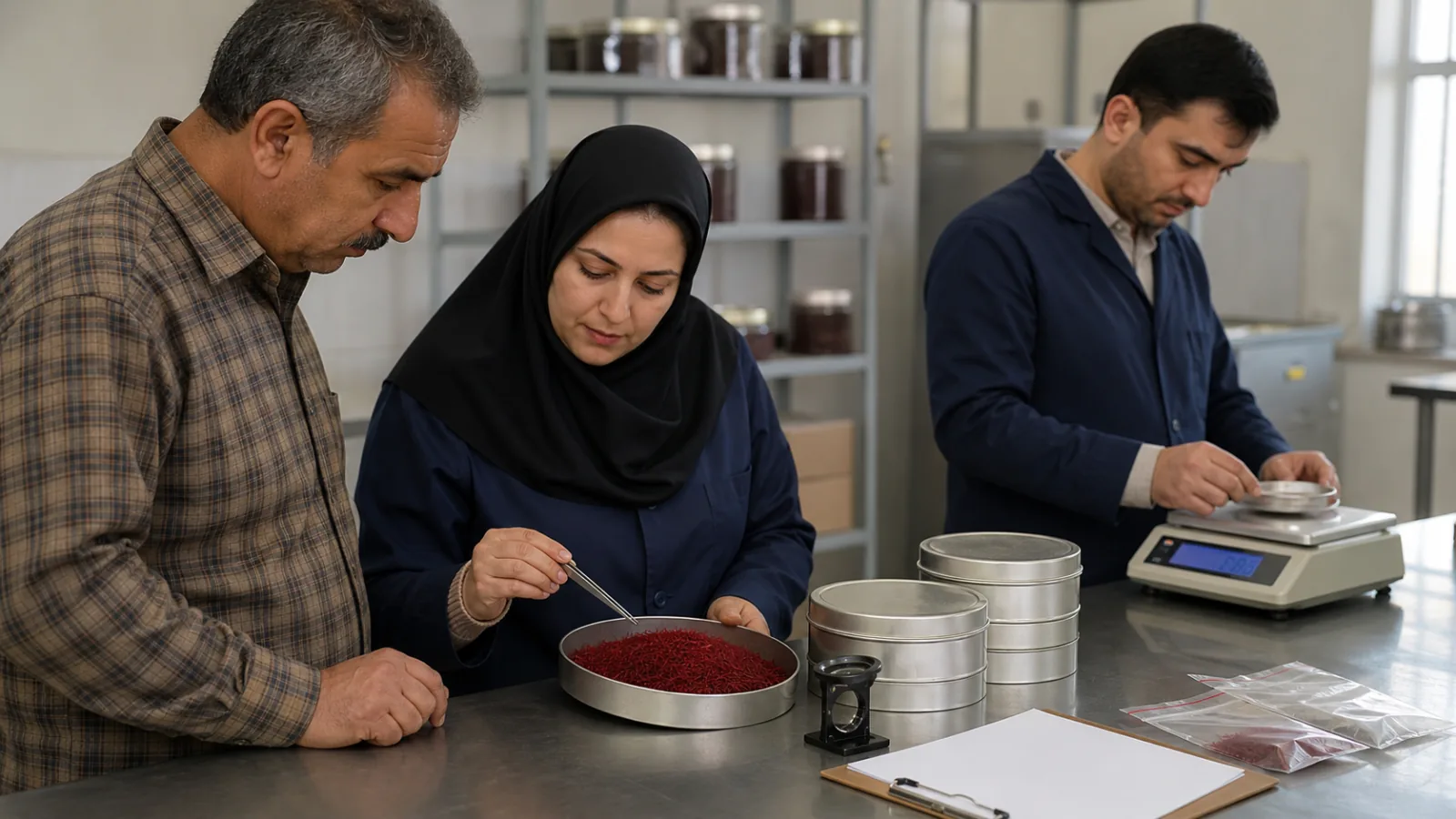
Purchasing a large volume can support the farm price temporarily, but storage creates its own obligations. Saffron must be protected from moisture, light, contamination, odour transfer and lot mixing. The buyer needs documented intake grades, secure custody and a plan for releasing stock without creating another price shock.
Payment terms matter just as much. A support price has limited value if grading is opaque or growers wait too long to receive funds. The rules should be published before harvest and applied consistently, with an appeal process for rejected or downgraded lots.
The site’s earlier review of a guaranteed purchase fund for saffron covers a related proposal and the same need to distinguish an announcement from an operating institution.
Branding begins before the package
Bastani correctly connected the farm and export ends of the chain. A new package cannot repair saffron that was mixed without records, dried inconsistently or stored badly. Branding works when the name on the jar is backed by repeatable quality and a traceable batch.
For a national plan, that means measuring more than tonnes purchased. Better indicators include the farmer’s payment time, grade distribution, storage loss, direct export destinations, repeat buyers, packaged versus bulk sales, complaints and the value returned to producers.
The original proposal still has a useful principle: planting, harvest, processing and marketing should not be treated as separate problems. Whether that work is financed by a dedicated fund, cooperatives, commercial credit or a combination of them, support should be transparent, time-bound and tied to a product the market actually wants.
Sources
- The statements attributed to Saeed Bastani in the original 2019 post.
- Iran Agricultural News Agency: text of the 2021 saffron support-policy package (Persian).
- Iran Agricultural News Agency: completion of the 1398 supportive saffron purchase (Persian).

![Exporting Saffron to Turkey + Price Guide [Complete 0 to 100]](https://img.rowhanisaffron.com/20260827003933/saffron-export-turkey-quality-inspection.webp)



