


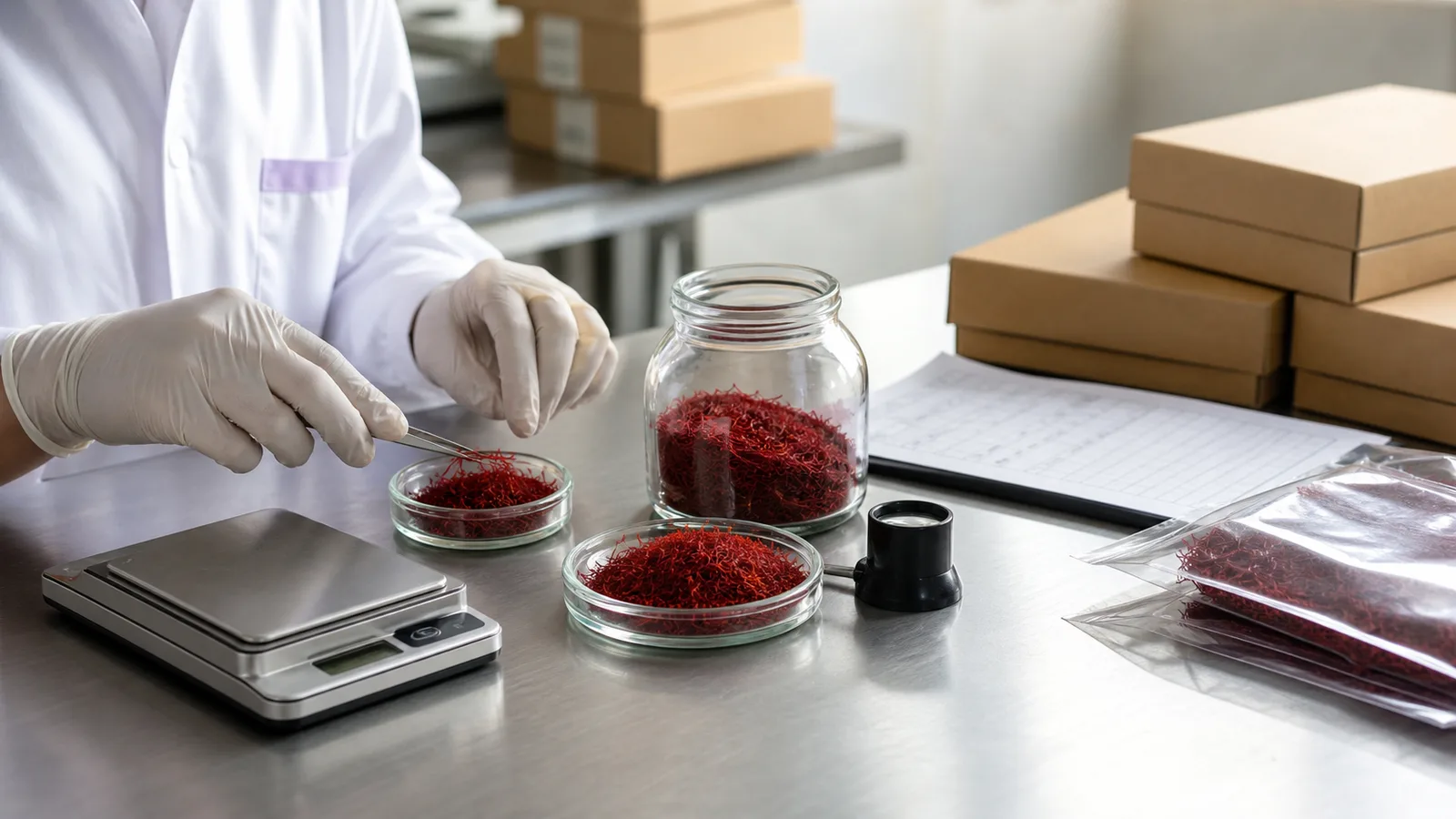
In the first nine months of the Iranian year that ended on 21 December 2017, official figures reported that more than 160 tonnes of Iranian saffron, worth over US$219 million, went to 56 countries. The shipment weight was 33.33% higher than in the same period a year earlier, while reported export value increased 26.05%.
Those numbers explain the title 56 countries eat Iranian saffron, but they are a historical snapshot, not a current list of saffron exporting countries or today’s trade value. This article preserves the destinations and details from the original report, corrects several translation errors, and shows how to read the figures without mistaking them for live market data.
What period do the 56-country figures cover?
The report covered nine months ending 21 December 2017. Its original English translation said “the first nine months of this year” without naming the year, which made an old statistic look current. Contemporary coverage identifies the period and reports more than 160 tonnes with a value above US$219 million.
The archived article rendered the value as “219 million and 270 dollars.” That is not a credible complete currency expression. It appears to be a damaged translation of a more precise dollar total, so the defensible wording is more than US$219 million. The 33.33% increase refers to export weight; 26.05% refers to value.
The 56 destinations named in the report
The customs-based list named the following customers for Iranian saffron during that nine-month period:
Latvia, Austria, Jordan, Spain, Australia, Slovakia, South Africa, Afghanistan, Algeria, Germany, the United Arab Emirates, the United Kingdom, the United States, Italy, Bahrain, Brazil, Belgium, Bosnia and Herzegovina, Pakistan, Taiwan, Turkey, Turkmenistan, the Czech Republic, South Korea, China, Denmark, Japan, Singapore, Sweden, Switzerland, Serbia, Iraq, Oman, France, Finland, the Philippines, Kyrgyzstan, Qatar, Canada, Kuwait, Georgia, Lebanon, Poland, Madagascar, Malta, Malaysia, Hungary, Morocco, Mauritius, Norway, New Zealand, Vietnam, the Netherlands, India, Hong Kong and Greece.
This is a list of reported destinations, not 56 countries that produced or re-exported saffron. “Customers” also does not mean that demand was evenly distributed. A small group accounted for most of the recorded weight.
Which markets bought the most?
The leading destinations were the United Arab Emirates, Hong Kong, Spain, Afghanistan and China. Contemporary English-language coverage gives their volumes as approximately 33 tonnes, 15 tonnes, 14 tonnes, five tonnes and four tonnes respectively. Together, these five markets bought about 78% of the saffron in the report.
The previous page said the UAE bought “more than 23 people” and China “more than four hundred.” These phrases were machine-translation failures: people were not the unit, and the China figure was not 400 tonnes. The period report supports tonnes as the unit and four tonnes for China. The UAE figure appears as 33 tonnes in contemporary coverage; the corrupted page had 23.
Markets with greater year-on-year buying
The report also identified the United States, Germany, the United Kingdom, Italy, Belgium, Sweden, Switzerland, France, Canada and the Netherlands as markets that purchased more Iranian saffron than in the comparable period a year earlier. Madagascar was described as a new buyer.
That does not establish a lasting trend. A country can import more in one nine-month window because of stock timing, a single large order, currency movements or a new distributor. Current decisions require a current customs series rather than an old country name alone.
Bulk saffron and small packs were not the same market
The old translation distinguished more than 50 tonnes of bulk saffron and more than 25 tonnes of unground product. It rendered the categories as “saffron of the flax” and “unpeeled and unsalted saffron,” neither of which is a meaningful commercial saffron grade in English. The accompanying version of the report instead describes bulk saffron and crushed or unground forms.
It also referred to retail-size packs, including 10–30 gram and under-30-gram formats, but ended with the impossible statement that total exports “did not reach 50 grams.” That unit is plainly corrupted in the archived translation. Because the original customs table is not reproduced on the page, this article does not substitute a guessed number.
What survives the error is the report’s commercial point: most recorded weight moved in larger formats, while smaller consumer packs represented a much smaller part of the export flow. Bulk trade and finished retail packs should be analysed separately because packing, testing, branding, distribution and retail margins change the value per kilogram.
Why the destination is not always the final consumer market
A customs destination tells us where a shipment first went; it does not necessarily identify where every gram was ultimately consumed. The UAE, Hong Kong and Spain are also trading and distribution centres. Saffron can be repacked, blended, branded or re-exported after its first recorded destination.
That distinction matters when comparing Iran’s export records with another country’s import or retail data. The same saffron may appear at different stages, values and dates. It is therefore unsafe to add every figure together as if each represented a separate crop.
How to check current saffron export markets
For a current answer, start with a defined period and product code. The United Nations Comtrade database allows users to compare reported international merchandise trade by reporter, partner, year and commodity. Iran’s customs authority and destination-country customs data may provide more recent detail, but publication timing and classification can differ.
Before comparing two export reports, check:
- the beginning and end dates, including whether “year” means a calendar or Iranian year;
- whether the figure covers saffron alone or a broader commodity group;
- net weight, declared value and currency;
- whole threads, crushed or powdered saffron, and package-size categories;
- country of origin, reporting country and first destination;
- whether the number is provisional, revised or reported by a trade partner; and
- whether growth is measured by weight or value.
Our Iran saffron export statistics guide explains these comparisons in more detail. A buyer looking for product rather than national statistics should also define grade, test documentation, lot size, pack format and delivery terms before comparing suppliers.
What the 2017 snapshot still tells us
The list demonstrates how widely Iranian saffron already travelled: Europe, Asia, North America, Africa and Oceania all appeared among the 56 destinations. It also shows concentration. Five leading markets handled roughly four-fifths of the recorded quantity, so geographic reach did not automatically mean diversified demand.
The original article concluded that public- and private-sector organisations should give saffron more attention and organise the market. A practical version of that recommendation is better traceability, clearer product categories, accurate statistics and more finished products that can be identified as Iranian. FAO’s current work with Iran likewise focuses on authenticity, quality control, traceability and value-chain development.
So, did 56 countries eat Iranian saffron? During the reported 2017 period, customs records named 56 destinations. The phrase is a memorable shorthand, but the useful evidence is more precise: over 160 tonnes, more than US$219 million, strong concentration in five markets, and a trade structure still dominated by larger-format shipments.
Sources
- Iran News Daily: Saffron exports up 26% in nine months, 24 January 2018, reporting the period, value, growth rates and leading destinations from ISNA.
- The customs-derived country list and packaging passages preserved in the previous version of this page and its later duplicate.
- United Nations Comtrade, official international merchandise-trade database.
- FAO: innovation and quality integrity in Iran’s saffron value chain, 25 November 2025.

![Exporting Saffron to Turkey + Price Guide [Complete 0 to 100]](https://img.rowhanisaffron.com/20260827003933/saffron-export-turkey-quality-inspection.webp)



