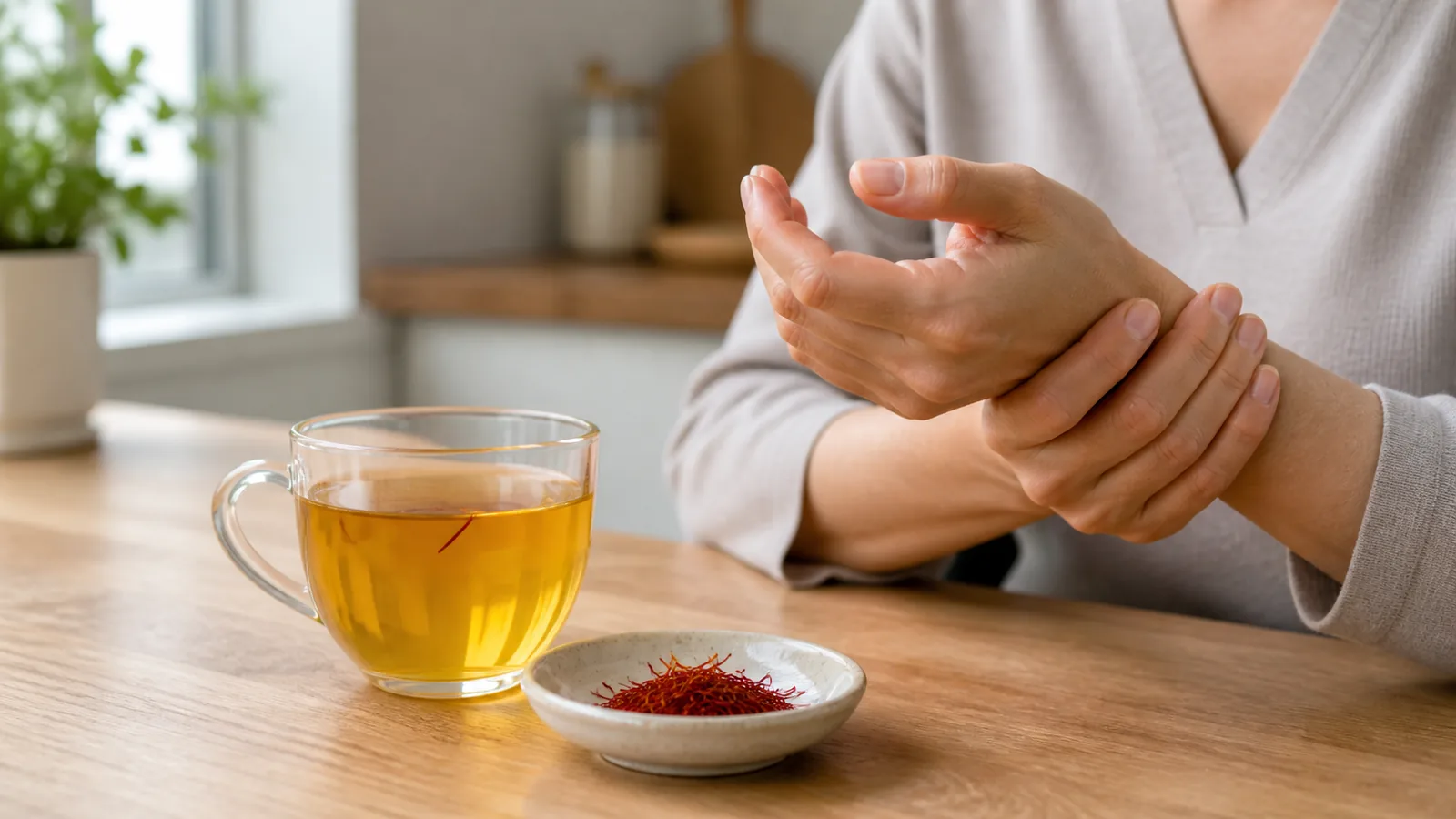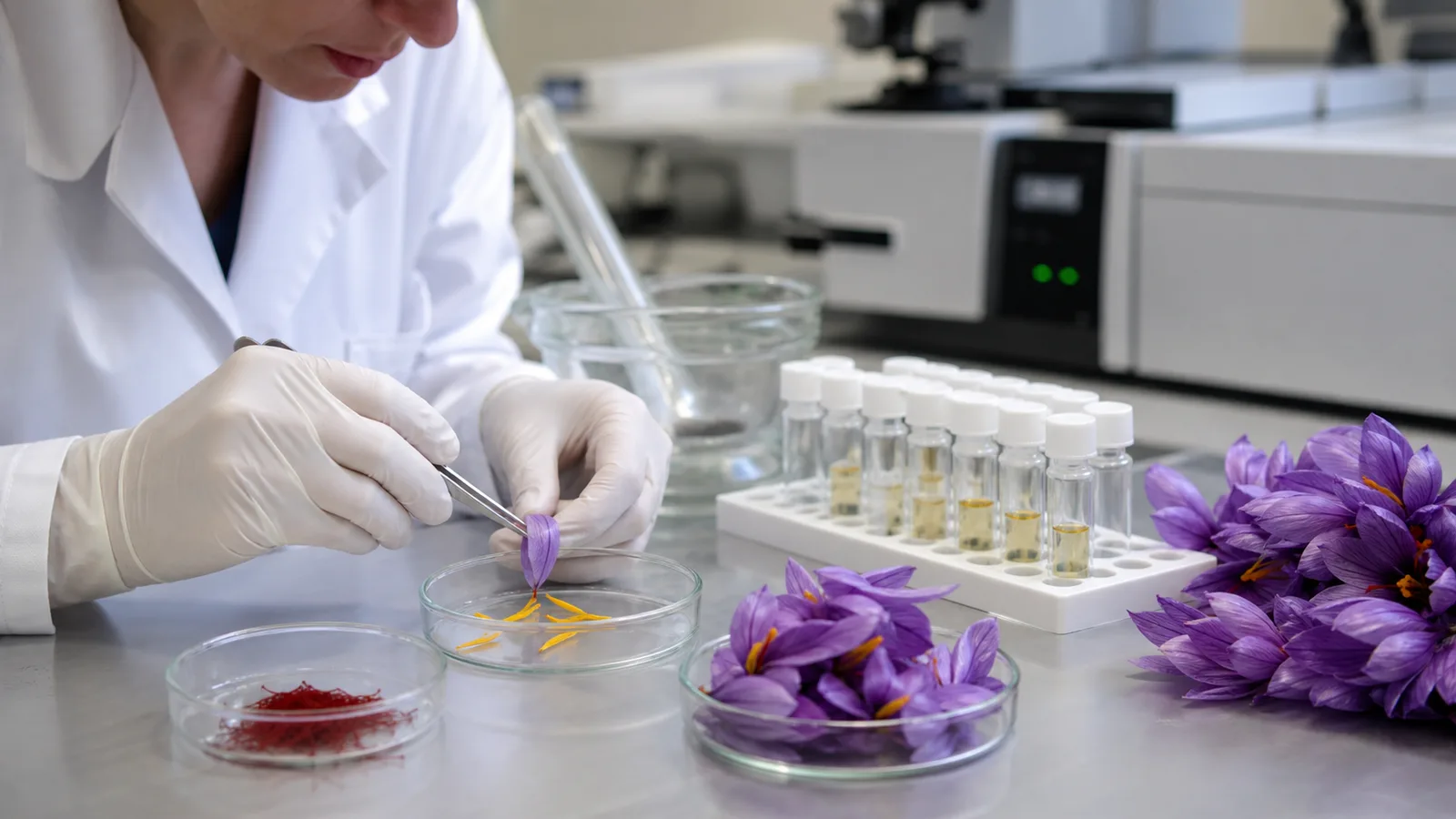
Researchers at the University of Birjand reported two sugars in saffron flower waste: D-allose and levoglucosan. They identified the compounds by gas chromatography–mass spectrometry (GC–MS) after extracting material from petals and stamens collected near Birjand, Iran.
The finding is the basis of this article’s original title, Identification of important sugars in waste saffron by researchers in the country. “Important” should be read as analytically interesting, not as proof that the waste treats disease, is safe to eat, or is ready for profitable industrial use. The study detected the compounds; it did not establish those further claims.
Which country did the saffron samples come from?
For readers asking which country the saffron came from, the samples were Iranian. The research record says flower waste was collected in November from a farm near Birjand, at the coordinates 32°24′06.7″N, 59°16′53.5″E. The material was transferred to a freezer at −15°C before extraction.
Birjand lies in South Khorasan, one of Iran’s established saffron-growing regions. The paper was published in 2017 in Saffron Research, volume 5, issue 1, pages 90–99, by the University of Birjand Saffron Research Group.
What “saffron waste” means in this study
Commercial saffron spice consists mainly of the dried red stigmas and the end of the style from Crocus sativus flowers. After these threads are separated, much of the flower remains: purple tepals or petals, yellow stamens and other plant material. In this paper, “waste” refers to those floral by-products, specifically petals and stamens, rather than damaged or adulterated saffron spice.
That distinction matters. The chemical composition of a petal or stamen is not the same as the composition or specification of the dried stigma sold as saffron. Our guide to the parts of a saffron flower shows where each component sits before harvest workers separate the spice.
The old version of this page described the sample as “petals and frozen flag.” That was a translation error. The university record identifies the two materials as petals and stamens; freezing was the storage step, not the name of a flower part.
How the researchers examined the flower residues
The researchers prepared separate extracts with three solvents: water, ethanol and methanol. They used maceration and ultrasound-assisted extraction, then applied several carbohydrate tests. The earlier account also described thin-layer chromatography (TLC) during separation before the compounds were examined with GC–MS.
These methods answer different questions. Extraction transfers soluble compounds from the plant material into a liquid. TLC can help separate components in a mixture. GC–MS then separates compounds and compares their mass-spectral fragments with known patterns, supporting a proposed chemical identification.
The published abstract reports presence, not a validated commercial yield. It does not give a concentration for either sugar in the AGRIS record, compare many farms or seasons, or show how much material a processor could recover economically.
The two sugars: D-allose and levoglucosan
D-allose
D-allose is a rare monosaccharide related to glucose by molecular arrangement. The old page called it “D-Alves,” which is not the compound named in the paper. The correct English name in the University of Birjand record is D-allose.
Finding a spectral signal assigned to D-allose in this floral material was scientifically noteworthy because the authors reported it in saffron waste for the first time. That statement concerns the literature available to the researchers in 2017. It does not mean D-allose was newly discovered as a chemical or that the study demonstrated a nutritional benefit.
Levoglucosan
Levoglucosan is an anhydrosugar with the molecular formula C6H10O5. It is also used in environmental research as a marker associated with biomass burning. The archived translation alternated between “Lugluccane” and “Loglucosan”; the paper and the National Library of Medicine’s PubChem record use levoglucosan.
Its detection in an extract should not be converted into a health recommendation. Chemical identity, dose, purity, exposure route and toxicology would all have to be evaluated for any proposed food, cosmetic or pharmaceutical application.
Why researchers study saffron floral by-products
Harvesting saffron creates much more flower material than dried red spice. The original news account used an historical estimate of about 70,000 hectares of saffron farms in Razavi and South Khorasan to explain why even a low-value residue could exist at meaningful scale. That figure belongs to the report’s period and is not a current land-area estimate.
Later research has continued to examine saffron petals and other floral by-products. Studies have reported sugars such as glucose and fructose, organic acids, pigments and phenolic compounds in different samples. This broader work supports investigating the material rather than discarding it automatically, but composition varies with origin, flower part, drying, storage and extraction method.
The previous page also noted earlier isolation of non-volatile compounds, including flavonols and anthocyanins, from saffron floral waste. Those compound families remain relevant to by-product research, but they are separate from the D-allose and levoglucosan identification that was the focus of the Birjand paper.
Potential value can also be environmental. If a safe, stable use is demonstrated, a processor may reduce organic waste and create another product from the same harvest. It is still necessary to count collection, rapid drying or freezing, transport, testing, extraction energy and disposal of solvents. A compound’s presence alone does not prove that recovery is sustainable or profitable.
What the 2017 study did not establish
The paper was an identification study. On the evidence described in its abstract, it did not establish:
- how much D-allose or levoglucosan occurs per kilogram of fresh or dried waste;
- whether samples from other farms, harvest years or countries have the same profile;
- whether either compound remains stable during drying, storage or processing;
- whether a saffron-waste extract is safe or effective for people or animals;
- whether petals or stamens can be sold as saffron spice;
- a scalable food-grade extraction and purification process; or
- an economically viable product or market.
This is why the previous claim that the researchers had found “two beneficial carbohydrates” was too strong. The study identified two compounds. Benefit requires a separate line of evidence.
What research should come next?
The original researchers called for wider studies of active compounds in saffron waste and further work on D-allose metabolism in other plants. A useful follow-up programme would first confirm the identification with standards and independent laboratories, then quantify the compounds across flower parts, farms and seasons.
Only after that should researchers compare extraction methods, preferably including lower-toxicity and lower-energy processes. Any intended food or health use needs contaminant testing, toxicology, dose and bioavailability data, while commercial work needs a full mass balance and cost analysis.
The durable lesson is modest but valuable. Most of a saffron flower is not the spice, yet the remaining petals and stamens are chemically complex plant material. The Birjand study added D-allose and levoglucosan to the compounds worth investigating. It opened a research question; it did not close the safety, health or business case.
Sources
- FAO AGRIS: Identification of two new sugars in wastages of Crocus sativus using GC–MS, with the University of Birjand abstract and bibliographic record.
- University of Birjand: full 2017 journal paper (Persian).
- US National Library of Medicine PubChem: levoglucosan.
- Foods: underutilised Crocus sativus flowers as potential value-added ingredients, 2023.