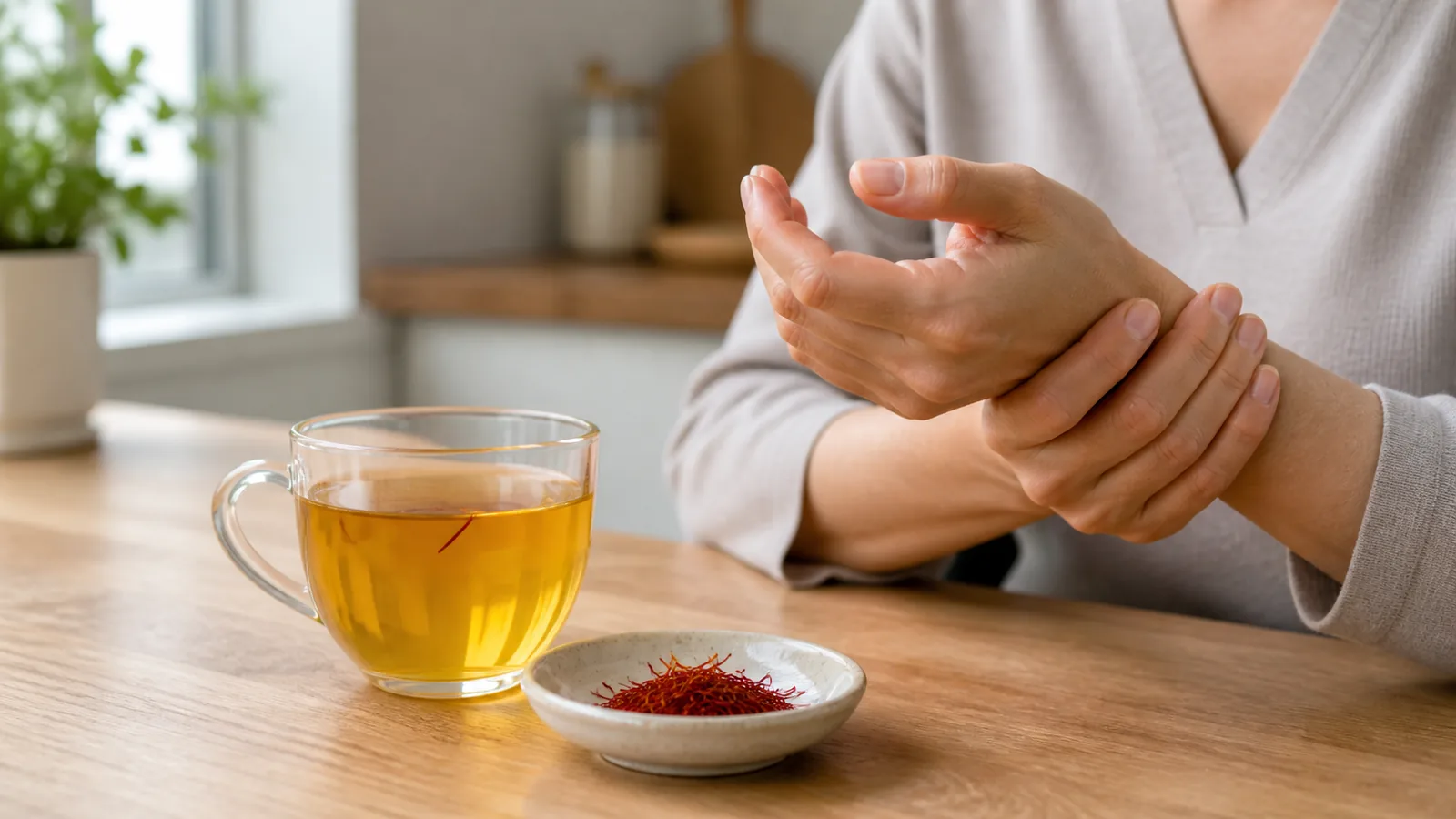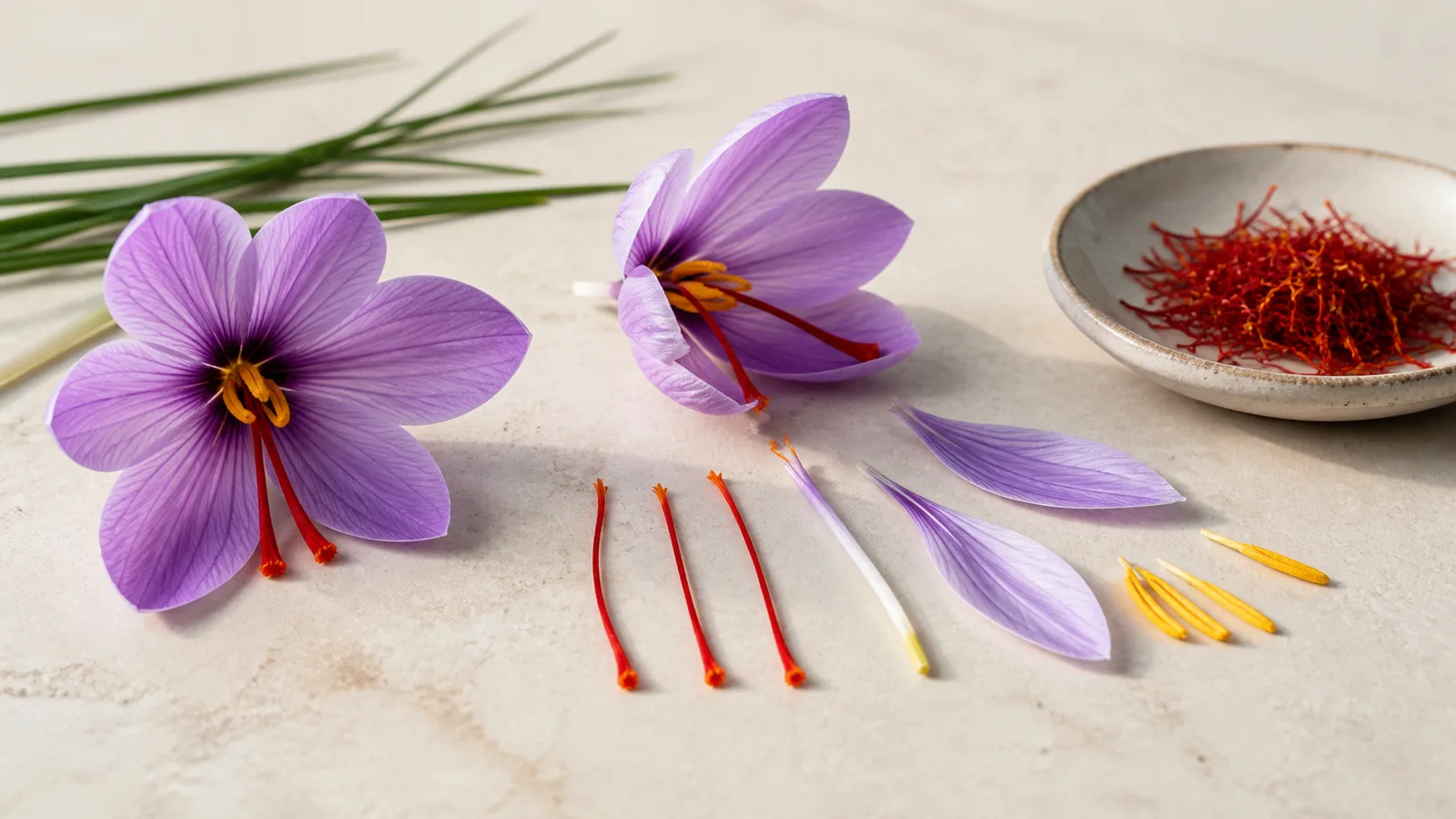
Saffron flower and its properties is a subject that needs one clear distinction at the start: the flower is not the same thing as the saffron spice. Saffron comes from the three red stigmas of Crocus sativus. The purple tepals, yellow stamens, pale style, leaves and corm are different plant parts, with different compositions and uses.
That matters when reading claims about saffron flower uses. Most clinical studies have tested measured amounts of saffron stigma or a standardised extract, not a whole flower, a homemade petal drink or “saffron vinegar.” Evidence about one preparation cannot automatically be transferred to another.
Saffron comes from what flower?
The culinary spice comes only from Crocus sativus, an autumn-flowering crocus. Each flower normally carries three orange-red stigma branches. Pickers separate them soon after harvest and dry them under controlled conditions; those dried threads are saffron.
The old version of this page said 400,000 grams of flowers produced about one kilogram of saffron. That figure mixed weight and flower count. FAO material gives a more useful estimate: roughly 150,000 to 170,000 flowers, or about 450,000 stigmas, may be needed for one kilogram of dried spice. Cultivar, stigma size, harvest and drying alter the result.
Do not identify an edible flower by colour or the common name “autumn crocus.” The Royal Horticultural Society warns that Crocus sativus can be confused with highly poisonous Colchicum, also called meadow saffron or autumn crocus. Use only a crop whose botanical identity and food handling are known.
What “kumkum flower uses” usually means
People searching for kumkum flower uses may be asking about saffron because kunkuma, kumkuma and related words are used for saffron or sacred red-yellow colour in parts of South Asia. “Kumkum” can also mean a ceremonial powder made from other ingredients. It is not a reliable botanical name.
If a product is offered as kumkum flower, check the label for Crocus sativus and the plant part. A cosmetic or ceremonial powder should not be assumed edible. Likewise, a purple ornamental crocus should not be harvested for food merely because it resembles a saffron flower.
The useful parts of a saffron flower
Stigmas: the culinary spice
The dried red stigmas provide saffron’s characteristic colour, aroma and bitter taste. They are used in rice, bread, sweets, sauces and drinks. Crocins contribute much of the colour, picrocrocin to taste and safranal to aroma. These compounds are also the subject of medical research, but culinary use and clinical supplementation are not equivalent doses.
Styles: part of some commercial grades
The pale style connects the stigmas to the flower. Some grades contain more style than others. It is genuine plant material, but it has lower colouring strength than the red stigma. Its presence affects grade and value rather than turning a sample into another species.
Tepals and stamens: a large harvest by-product
After the stigmas are removed, most of the flower remains. Researchers are studying purple tepals and yellow stamens as sources of pigments and other compounds for foods, cosmetics and materials. That research does not make every fresh or dried petal product an approved treatment. Safety, extraction, contaminants, stability and local food or cosmetic rules still apply.
Corms and leaves: cultivation material, not spice
Saffron is propagated from corms, and its narrow leaves support the next growth cycle. Neither is culinary saffron. Corm health is important to a grower, but corm or leaf remedies do not inherit the evidence from stigma studies.
What research says about the claimed health properties
The former article presented a long list of diseases as if the saffron flower could prevent, control or treat them. A safer reading separates human evidence from preliminary research and from traditional use.
Mood, anxiety and sleep
Randomised trials and meta-analyses have found promising changes in some depression, anxiety and sleep scores with saffron or standardised extracts. The evidence base is still uneven: products, doses, participants and outcome scales differ, studies are often small, and publication bias or limited regional diversity has been reported.
This supports further clinical use and research; it does not show that saffron tea prevents depression, controls a psychiatric disorder or replaces prescribed treatment. A person with persistent low mood, severe anxiety, insomnia, mania or thoughts of self-harm needs professional assessment. Stopping an antidepressant or sleep medicine suddenly can be dangerous.
Menstrual pain and premenstrual symptoms
Recent evidence reviews report possible benefit for premenstrual symptoms and dysmenorrhoea. Earlier trials also examined combinations containing saffron with other herbs, which cannot reveal saffron’s effect alone. The old advice that saffron “facilitates bleeding of the uterus” is not an appropriate treatment goal and could be alarming in someone with heavy or unexplained bleeding.
Severe pelvic pain, fainting, fever, pain during pregnancy or bleeding that soaks through pads rapidly needs medical attention. Saffron should not be used to delay investigation of endometriosis, fibroids, infection, pregnancy complications or another cause.
Blood pressure, cholesterol and heart health
Meta-analyses of supplementation trials have reported small changes in blood pressure and some metabolic measures, but results are not uniform. One blood-pressure review found reductions so small that they might not be clinically important. That is far from evidence that a “saffron sprout” can control hypertension or substitute for medicine.
Blood pressure and cholesterol need measurement. Anyone taking anticoagulants, blood-pressure medicine or several supplements should discuss concentrated saffron products with a clinician or pharmacist rather than combining them on the basis of a blog claim.
Cancer and antioxidant claims
Saffron contains carotenoid compounds and shows antioxidant activity in laboratory systems. Cell and animal experiments have explored crocin, crocetin and extracts in cancer models. Reviews still call for suitable human clinical trials before saffron can be considered a cancer-prevention or cancer-treatment intervention.
Antioxidant activity in a test does not mean a food prevents cancer in a person. Saffron should never replace screening, surgery, radiotherapy, chemotherapy or other oncology care.
Asthma, cough, chest pain and headache
Saffron has a history of traditional use for respiratory and nervous complaints, and at least one small randomised trial examined supplementation alongside care in adults with mild or moderate allergic asthma. That is not evidence for drinking saffron vinegar continuously, nor for treating chest pain, an asthma attack, cough or a neurological event at home.
Difficulty breathing, blue lips, new chest pain, weakness on one side, confusion or a sudden severe headache is urgent. Use a prescribed reliever and emergency plan for asthma; do not wait for a spice preparation to work.
Digestion, appetite and abdominal pain
Traditional sources describe saffron for appetite and stomach discomfort. The old page extended that to upper-abdominal and large-intestinal pain without reliable clinical support. Persistent or severe abdominal pain can have many causes. Pain with fever, vomiting, black stool, blood or a rigid abdomen requires assessment rather than a home remedy.
Bone health, bladder stones and acne
There is no good human evidence that eating saffron prevents osteoporosis by increasing calcium absorption, crushes a bladder stone, or that taking it with milk expels a stone. Osteoporosis is assessed through risk factors and bone-density testing; urinary stones vary in composition and can obstruct or infect the urinary tract.
The former recipe combining saffron, basil and rose water for acne was also unsupported. Topical plant mixtures may irritate skin, introduce contamination or trigger allergy. Evidence-based acne care depends on severity and skin type; painful nodules or scarring deserve medical advice.
Pregnancy needs more nuance than “prohibited”
The old page stated that all saffron consumption during pregnancy was prohibited because it causes abortion. That is too absolute. Culinary exposure and concentrated medicinal use are different, while pregnancy safety data remain limited. Reviews associate higher doses or occupational exposure with uterine stimulation and possible miscarriage risk.
A pregnant person should not start saffron supplements, extracts or repeated medicinal drinks without advice from their obstetric clinician. Do not use saffron to induce labour or change bleeding. If exposure is followed by pain, contractions, bleeding or illness, seek prompt medical care. This caution does not turn ordinary food into a universal emergency; it avoids pretending that every preparation and dose has been proven safe.
How to use the evidence responsibly
For cooking, use food-grade dried stigmas from an identified, traceable source. For any supplement, check the plant part, extract standardisation, dose, other ingredients, lot testing and interactions. A study of a capsule cannot validate a random flower tea, and an in-vitro experiment cannot establish a treatment.
The most defensible uses of saffron flower are botanical and culinary: grow the correctly identified plant, harvest its three stigmas, dry them cleanly and use the resulting spice for flavour, aroma and colour. The rest of the flower is a promising research material, but the health claims need to follow the actual preparation and strength of evidence.
Sources
- FAO: saffron flower anatomy, harvest and flower-to-spice yield.
- Royal Horticultural Society: saffron crocus and poisonous Colchicum warning.
- Meta-research review mapping saffron’s clinical evidence and methodological limits.
- Systematic review and meta-analysis of saffron for depression and anxiety symptoms and systematic review of sleep trials.
- Systematic review and meta-analysis of premenstrual symptoms and dysmenorrhoea.
- Systematic review of saffron supplementation and blood pressure.
- Review of preclinical saffron and cancer research and integrative review of pregnancy evidence.